[pageLogInLogOut]

#Textile chemistry

More sustainable products of proven high quality
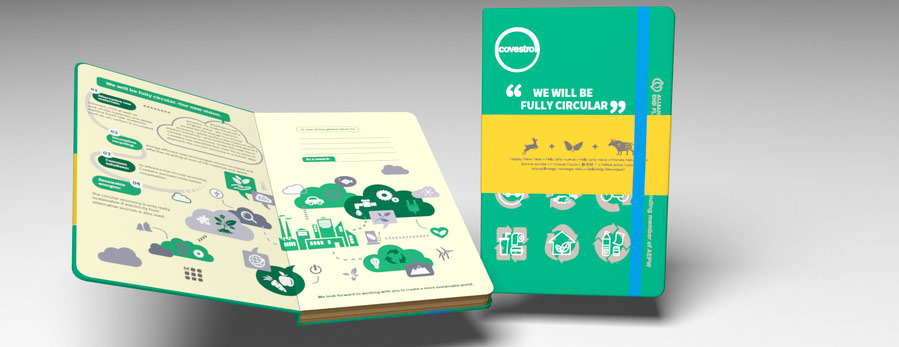
The application focuses on waterborne PU dispersions with up to 50 percent biomass-based carbon content, reducing the carbon footprint accordingly but offering the same good quality as fossil-based raw materials. © Covestro
Increased use of circular raw materials thanks to INSQIN® waterborne PU technology

Moleskine® notebooks are replicas of the legendary notebook used by such notable people as Vincent Van Gogh, Pablo Picasso, Ernest Hemingway, and Bruce Chatwin. Moleskine places great emphasis on more sustainable products and manufacturing processes and has already been certified by the Forest Stewardship Council (FSC). For the covers of its classic notebooks, the company relies on Covestro’s advanced INSQIN® waterborne polyurethane (PU) technology for textile coating with partially bio-based raw materials. This will increase the use of alternative raw materials in the production of the PU synthetics covers.

This application focuses on waterborne PU dispersions with up to 50 percent biomass-based carbon content, reducing the CO2 footprint accordingly but offering the same good quality as fossil-based raw materials. The coating also features a premium look and feel – as befits the characteristic quality of these notebooks. Using INSQIN® technology, Moleskine® and Chinese PU synthetics material specialist Hexin are now able to produce partially bio-based coatings for hardcover and softcover notebooks.

On the path to more circularity

"We are partnering with Covestro to perfect these high-quality, low-solvent coatings for our classic Moleskine® notebook covers," says Daniela Riccardi, the company's Chief Executive Officer. "Covestro’s partially bio-based coating technology enables us to reduce our impact on the environment and improve our sustainability."


"Working with innovative partners like Moleskine® allows us to develop more sustainable materials," explains Dr. Torsten Pohl, global head of Textile Coating at Covestro. "With our new partially bio-based raw material, Covestro allows for a total of approximately 23 percent renewable carbon in this coating, which is in line with our vision to become fully circular."

For the covers of its classic notebooks, Moleskine® relies on Covestro's aqueous INSQIN® polyurethane (PU) technology for textile coating with partially bio-based raw materials. © Covestro


The project is part of a global strategic program with which Covestro is fully committed to the circular economy. That’s why the company is focusing on the use of alternative raw materials and renewable energy, the development of innovative recycling technologies, and collaboration with partners along the value chains.


More News from Covestro AG

#Technical Textiles

Covestro showcases monomaterial concept in autonomous SUE People Mover

UE | STUDIOS has unveiled the fully autonomous electric minibus “Self-driving Urban E-Shuttle” (SUE), placing strong emphasis on sustainable material design. Developed within a project funded by the Federal Ministry for Economic Affairs and Energy (BMWE) and the European Union, the vehicle will begin public road testing this year. At the core of the concept is the consistent use of recyclable monomaterials to improve circularity at end of life.

#Textile chemistry

Covestro and Heraeus Precious Metals collaborate to enable safer, more sustainable antimicrobial textile coatings

Laboratory tests reveal that AGXX antimicrobial surface technology from Heraeus Precious Metals is fully compatible with Impranil® PU dispersions which are part of the waterborne INSQIN® textile coating technology from Covestro, paving the way for more sustainable antimicrobial textile coatings. This discovery comes at a key moment for the textile coatings industry. As the sharing economy continues to grow, more people are coming into regular contact with high-use surfaces, creating ideal conditions for bacteria, viruses, and other microorganisms to thrive.

#Textile chemistry

Covestro celebrates decade of innovation and sustainable growth

Covestro celebrates its 10-year anniversary today. Since its carve-out from Bayer in 2015, the company has developed into a global leader in high-performance polymer materials and a pioneer in circular economy solutions. With a strong focus on innovation and sustainability, Covestro’s materials are now embedded in countless applications worldwide – from mobility and construction to electronics, healthcare, and consumer goods.

#Textile chemistry

Covestro extends contract with CTO Dr. Thorsten Dreier ahead of schedule until 2031

Dr. Thorsten Dreier will remain Chief Technology Officer of Covestro for a further five years. The Supervisory Board has extended his contract, which runs until June 2026, ahead of schedule from July 1, 2026 to June 30, 2031.

More News on Textile chemistry

#Textile chemistry

A flagship for chemical production: BASF inaugurates world-scale Verbund site in China

BASF today (March 26, 2026) celebrated the official inauguration of its newly built, world-scale Verbund site in Zhanjiang, Guangdong Province in southern China. Covering an area of around four square kilometers, it is more than a major BASF project in the chemical growth market of China. “Zhanjiang shows what the future of chemistry looks like: efficient, digital and sustainable by design. The site showcases a smart integrated Verbund structure on an industrial scale,” said Dr. Markus Kamieth, CEO of BASF, at the ceremony attended by representatives from government, customers, business partners and employees.

#Research & Development

Hof University develops sustainable textile coating for the fashion of tomorrow from mushrooms

Clothing is often treated as disposable: T-shirts for events, general merchandise, or short-term campaigns frequently end up in the trash after only a few uses. This is particularly problematic given that their production still largely relies on fossil-based materials. This is precisely where a new research project at Hof University of Applied Sciences comes in.

#Textile chemistry

DyStar Group announces Board transition to drive innovation

DyStar, a leading specialty chemical company with a heritage of more than a century in product development and innovation, announced today the appointment of Ruan Cunfan to its Board of Directors, effective 20 February 2026.

#Textile chemistry

Jeanologia urges industry to accelerate PP Spray phase-out following ZDHC Watchlist update

Potassium permanganate has officially entered the Chemical Watchlist of the ZDHC Foundation, signaling increased scrutiny and potential phase-out of one of the most hazardous chemicals still used in denim finishing. The inclusion confirms an industry shift that Jeanologia anticipated more than a decade ago.

Latest News

#Recycling / Circular Economy

ABB and Syre partner to explore technologies for industrial-scale textile recycling

ABB has signed a Memorandum of Understanding (MoU) with Swedish textile impact company Syre to jointly explore technologies to support the development of Syre’s first textile-to-textile recycling plant in Vietnam. The agreement establishes a framework for collaboration to investigate how ABB’s automation, electrification and digital technologies could contribute to safe, efficient and scalable operations. It will also explore how these capabilities could further optimize process and quality control performance as Syre advances its ambition to produce circular polyester at industrial scale.

#Techtextil 2026

From Nature Performance to Circular Economy: Techtextil 2026 focuses on the future market for technical textiles

Alternative materials and recycling technologies are one of the most important future segments and drivers of innovation in technical textiles. Sustainability goals and regulatory requirements increase their relevance, while advances in performance and economic viability enhance their market competitiveness. Taking place from 21 to 24 April 2026, Techtextil reflects this key industry trend with a growing number of specialised exhibitors. With the new “Nature Performance” label, the leading global trade fair bundles relevant market offerings and facilitates access to new solutions – from natural fibres and yarns to bio-based materials and circular approaches.

#Research & Development

Textile cascade filter for removing microplastics from wastewater

Microplastics are now found almost everywhere, even in remote regions of Antarctica. They enter the human body through the food chain. Studies indicate that microplastics may have negative effects on the human health.

#Textile processing

Jeanologia showcases the future of product development

Jeanologia is showcasing how software is transforming product development in the fashion industry at PI Apparel Europe: The Fashion Technology Show, taking place on March 30–31 in London.

TOP