[pageLogInLogOut]

#Textile chemistry

3D-printed TPU insoles

Materials manufacturer Covestro and orthopedic service provider GeBioM mbH, based in Münster, Germany, are expanding their cooperation in the field of orthopedic footwear. In addition to producing lasts and trial shoes, they now support orthopedic shoemakers in the production of custom insoles using 3D printing.

More sustainable production of individual productsA new Addigy® FPU 79A thermoplastic polyurethane (TPU) from Covestro is used in the form of filaments. Together with Danish printer partner Create it REAL, the companies offer a novel and sustainable solution for the digital production of shoe insoles.

"Our new TPU plastic and a printer developed specifically for this application make it possible to print very soft structures. The material and printer were harmonized during development to achieve a perfect result," explains Lukas Breuers, 3D printing expert at Covestro. "With the help of the automated software solution, soft and hard structures can be combined in a shoe insole, achieving a level of customization that was previously virtually impossible." The TPU also meets the requirements for medical devices with regard to cytotoxicity and skin sensitization in accordance with the DIN EN ISO 10993-5 and 10993-10 standards.

In addition to functionality, the development of the material also focused on its ecological footprint, as Marcel Domenghino, Managing Director of GeBioM, points out: "It was important to us that the new solution also allows for improved sustainability. Currently, the production of insoles also generates large amounts of waste. Moreover, the insoles themselves are hazardous waste after use. With 3D printing, we now enable our customers to produce in a waste-free manner by using only the material that is needed for the insoles."


Aiming for recyclable material

Covestro is currently working on a recyclable TPU for this application and is developing opportunities with GeBioM and value chain partners to recover used insoles for recycling. Already, the spools on which the filament is wound are reused. The development is part of a global strategic program to fully align the company with the Circular Economy. Components of the program include innovative recycling technologies and the increased use of alternative raw materials such as biomass, CO2 and plastic waste, as well as renewable energy.
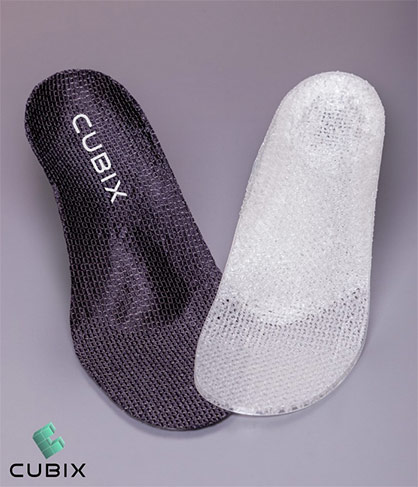
Covestro and orthopedic service provider GeBioM are now also supporting orthopedic shoemakers in the production of customized insoles using 3D printing. Covestro's thermoplastic polyurethane Addigy® FPU 79A is used in the process. © GeBioM


Covestro has been committed to developing innovative material solutions for additive manufacturing products for years and offers a versatile product range under the Addigy® brand, including for orthopedic shoe insoles. Just recently, the company also significantly strengthened its 3D-printing portfolio with the acquisition of the Resins & Functional Materials business of the Dutch DSM Group.


More News from Covestro AG

#Technical Textiles

Covestro showcases monomaterial concept in autonomous SUE People Mover

UE | STUDIOS has unveiled the fully autonomous electric minibus “Self-driving Urban E-Shuttle” (SUE), placing strong emphasis on sustainable material design. Developed within a project funded by the Federal Ministry for Economic Affairs and Energy (BMWE) and the European Union, the vehicle will begin public road testing this year. At the core of the concept is the consistent use of recyclable monomaterials to improve circularity at end of life.

#Textile chemistry

Covestro and Heraeus Precious Metals collaborate to enable safer, more sustainable antimicrobial textile coatings

Laboratory tests reveal that AGXX antimicrobial surface technology from Heraeus Precious Metals is fully compatible with Impranil® PU dispersions which are part of the waterborne INSQIN® textile coating technology from Covestro, paving the way for more sustainable antimicrobial textile coatings. This discovery comes at a key moment for the textile coatings industry. As the sharing economy continues to grow, more people are coming into regular contact with high-use surfaces, creating ideal conditions for bacteria, viruses, and other microorganisms to thrive.

#Textile chemistry

Covestro celebrates decade of innovation and sustainable growth

Covestro celebrates its 10-year anniversary today. Since its carve-out from Bayer in 2015, the company has developed into a global leader in high-performance polymer materials and a pioneer in circular economy solutions. With a strong focus on innovation and sustainability, Covestro’s materials are now embedded in countless applications worldwide – from mobility and construction to electronics, healthcare, and consumer goods.

#Textile chemistry

Covestro extends contract with CTO Dr. Thorsten Dreier ahead of schedule until 2031

Dr. Thorsten Dreier will remain Chief Technology Officer of Covestro for a further five years. The Supervisory Board has extended his contract, which runs until June 2026, ahead of schedule from July 1, 2026 to June 30, 2031.

More News on Textile chemistry

#Textile chemistry

DyStar Group announces Board transition to drive innovation

DyStar, a leading specialty chemical company with a heritage of more than a century in product development and innovation, announced today the appointment of Ruan Cunfan to its Board of Directors, effective 20 February 2026.

#Textile chemistry

Jeanologia urges industry to accelerate PP Spray phase-out following ZDHC Watchlist update

Potassium permanganate has officially entered the Chemical Watchlist of the ZDHC Foundation, signaling increased scrutiny and potential phase-out of one of the most hazardous chemicals still used in denim finishing. The inclusion confirms an industry shift that Jeanologia anticipated more than a decade ago.

#Textile chemistry

RUDOLF gets the exclusive global distribution rights for Sanitized® textile technologies

With effect from today, RUDOLF officially assumes exclusive global distribution rights for Sanitized® textile technologies from SANITIZED AG. This is the next milestone in the strategic collaboration announced in 2025, with the partnership between the two companies now fully implemented and expanded worldwide.

#Denim

organIQ seek: smart alternative to potassium permanganate

CHT Group announces new technical findings within its organIQ seek platform that significantly advance the transition toward permanganate-free denim bleaching. Through extensive industrial testing and application research, CHT confirms that organIQ seek can now be used with remarkable effectiveness as a substitute for potassium permanganate in spray bleach, while remaining aligned with sustainability expectations and cost realities in the European market. At the COLOMBIATEX in Medellín as well as at the Exintex in Puebla and the Kingpins Show in Amsterdam the CHT Group will present organIQ seek as an alternative to potassium permanganate.

Latest News

#INDEX 2026

EDANA unveils nominees for INDEX™26 Awards: Highlighting the next generation of nonwoven excellence

EDANA is proud to unveil the highly anticipated nominees for the INDEX™26 Awards, the nonwoven industry’s highest accolade for technical and sustainable excellence. Out of a record-breaking field of entries, these finalists represent the cutting edge of material science—from bio-based hygiene fibers and PFAS-free protective textiles to revolutionary water-filtration machinery. Each nominee has been selected by a jury of industry experts for their ability to solve critical global challenges, including the transition to a circular economy and the pursuit of enhanced consumer performance.

#Raw Materials

Lenzing Group positions bio‑based materials as a strategic asset for Europe’s economic security

The Lenzing Group, a leading supplier of regenerated cellulose fibers for the textile and nonwovens industries, hosted a high‑level roundtable in Brussels to discuss how bio‑based materials can strengthen Europe’s economic security and support the shift toward a fossil‑free future. Organized in cooperation with Euractiv, the event brought together representatives of the European Commission, the UK Mission to the EU, academia, civil society, and industry.

#Natural Fibers

Beyond Cotton: Natural Fibres in the Spotlight at the Bremen Cotton Conference - Branded by DNFI

Climate targets, fragile supply chains, and rising regulatory requirements are fundamentally changing the perspective of the textile industry - the focus is increasingly shifting toward the base material. Not only cotton, but natural fibres are gaining significant importance: they stand out not only because of their outstanding functional properties, but also because they make a valuable contribution to the bioeconomy and responsible product development.

#Textiles & Apparel / Garment

Coats to showcase innovative reinforcement and filler materials for leather goods and accessories at APLF 2026

Coats, a world-class Tier 2 manufacturer and trusted partner for the apparel and footwear industries, will be promoting four advanced materials from its ‘Lifestyle Solutions’ portfolio at APLF 2026 in Hong Kong in March. Each innovation has been specifically engineered to help luxury and premium brands elevate the craft, durability, sustainability and creative expression required in the manufacturing of handbags, purses, and other high-end designer accessories.

TOP