[pageLogInLogOut]

#Textile chemistry

Archroma and Jeanologia join forces to launch ‘Pad-Ox G2 Cold’, a new water-saving dyeing process for denim and casual wear
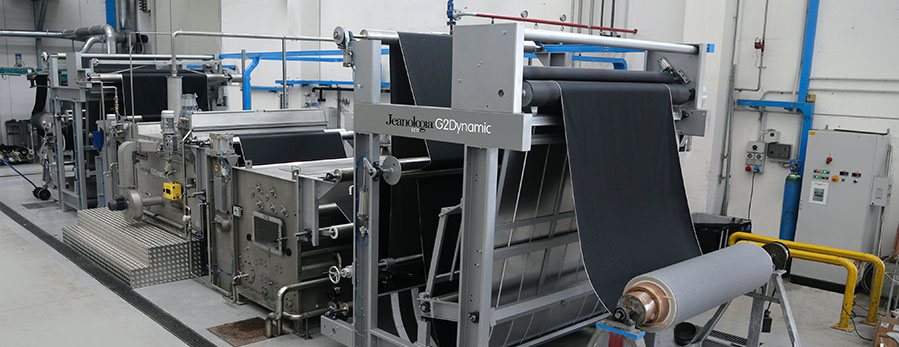
Jeanologia G2 Dynamic machine. (Photo: Jeanologia)
Archroma, a global leader in specialty chemicals towards sustainable solutions, and Jeanologia, world leader in sustainable and efficient technology development, today announced the launch of ‘Pad-Ox G2 Cold’, a water-saving dyeing process at room temperature for casual looks.

Archroma initially introduced its eco-advanced Pad-Ox dyeing process for woven fabrics, and then used it as part of its ADVANCED DENIM concept. The idea was fairly simple, yet technically revolutionary at the time. By combining the oxidation and fixation steps, it is possible to shorten the dyeing process and thus realize substantial resource savings in water, wastewater, cotton waste, and energy.

Over the years the company has worked with its textile manufacturers and partners to improve the Pad-Ox process, in particular woven applications such as chinos and casual wear. To achieve maximum positive impact, Archroma is using its Diresul® range of low sulfide sulfur dyes and, more recently, its innovative plant-based range of EarthColors®. A wide selection of dyes from these two ranges have received the Cradle-to-Cradle Product Innovation Institute’s Platinum Level Material Health Certification.

Denim overdyed using Pad-Ox G2.<br />
(Photo: Jeanologia)
Denim overdyed using Pad-Ox G2. (Photo: Jeanologia)


Meanwhile, Jeanologia has been working on the technology side, with laser and eco-finishing solutions for more than 25 years, accompanying the textile industry on their way to producing with zero discharge. In 2008, the company introduced its G2 Dynamic the first ozone treatment for continuous fabric that dramatically reduces the amount of water and chemicals used, while at the same time saving costs at the mill and eventually at the garment finishing facilities. This technology makes fabric more stable and consistent and prepares the fabric better for the use of other technologies like laser. This machinery can be used along with Pad-Ox technology to help cleaning fabric thus improve fastness results. While it allows process to work at room temperature.

Project focus on water saving

Archroma and Jeanologia therefore understandably decided to team up and combine their expertise in sustainable dyeing and finishing technologies. The objective of the project was to improve the Pad-Ox dyeing process even further, in particular in one area that still offered room for positive impact: temperature and fastnesses. After several months of development, they have come up with a way to apply the Pad-Ox dyeing process at room temperature, whilst still improving fastnesses and allowing higher contrasts after washdown. A binder-free technology to obtain end articles that are softer and have greater color durability to repetitive washing and solidity against rubbing than other wash-out processes.


The new ‘Pad-Ox G2 Cold’ dyeing process works thanks to the insertion of very small machinery into the existing finishing range process, using cold processing and thus operating with much less water, carbon footprint and energy than traditional benchmark fabric finishing processes, whilst retaining the water and other resource savings offered by the Pad-Ox technology.

Maximum savings can be achieved by mills and garment manufacturers who wish to switch from a conventional dyeing process straight to ‘Pad-Ox G2 Cold’ to obtain high quality fabrics for comfortable and casual wear.

Chinos dyed using Pad-Ox G2. (Photo: Archroma)


With this, Archroma and Jeanologia are again breaking the boundaries of what is considered feasible in the industry.

Manel Jimenez, Business Development Manager at Archroma’s Competence Center for Denim & Casual Wear, who was the project leader for this new development, comments: “At Archroma, we strive to develop solutions in line with our principles of “The Archroma Way to a Sustainable World: Safe, efficient, enhanced, it’s our nature”. It was therefore very inspiring to work with a partner who shares the same values of developing efficient new processes to bring all know-how to our customers to maximize results.”

For Jean Pierre Inchauspe, Business Director of G2 Dynamic at Jeanologia, “this association is another step to change traditional, more polluting and water consuming processes in the textile industry for new ones using technology, improving, and boosting subsequent production stages up to the finishing of the garment, making them more efficient and allowing companies to be more competitive, increase productivity and offer a product that is completely sustainable with high quality.”


More News from Archroma Textile Specialties

#Textile chemistry

Archroma wins ICIS Innovation Award for sulfur dye breakthrough

Archroma, a global leader in specialty chemicals, has won a coveted 2026 ICIS Innovation Award for Best Product Innovation from a Large Company for FiberColors®. These high-performance sulfur dyes are synthesized from pre-consumer wool waste, reducing industry reliance on petroleum-based inputs while contributing to the circular economy by upcycling unwanted wool that farmers would otherwise pay to dispose of.

#Techtextil 2026

Archroma showcases innovations delivering performance without compromise at Techtextil 2026

Archroma, a global leader in specialty chemicals, is bringing a full suite of advanced solutions to Techtextil 2026 to help technical textile manufacturers achieve cutting-edge functionality with optimized productivity and enhanced sustainability.

#Textile chemistry

Orta and Archroma launch denim collection dyed with wool waste

Archroma, a global leader in specialty chemicals, and Orta Anadolu, the premium Türkiye-based denim manufacturer behind the ORTA brand, today announced a collaboration to bring circular dye chemistry into commercial denim production.

#Denim

Archroma expands denim possibilities at Kingpins Amsterdam

Archroma, a global leader in specialty chemicals, will present a portfolio of six sustainable denim innovations at Kingpins Amsterdam from April 15-16, 2026. Under the theme “Creating Possibilities in Denim”, the showcase reflects Archroma’s commitment to giving brands and mills solutions that are as commercially compelling as they are environmentally responsible.

More News on Textile chemistry

#Textile chemistry

ZymoChem secures $4 million in renewed federal funding to advance U.S. biomanufacturing of critical materials and their supply chains

ZymoChem, the specialty chemicals company dedicated to bringing decarbonization, sustainability, and supply chain resiliency to the chemical industry through innovative biological manufacturing, today announced the resumption and expansion of its federal research portfolio. The company has been notified that previously paused work under a $5 million U.S. Department of Energy (DOE) program is officially back on, to be joined by continuing collaborations with three of the nation's premier national laboratories.

#Textile chemistry

bluesign updates chemical reference lists with stronger PFAS restrictions

bluesign has published the 2026 editions of its three core chemical reference lists, introducing updated substance limits and testing requirements in line with the latest scientific findings and regulatory developments.

#Textile chemistry

Fashion for Good launches DW(O)R-X to navigate the emerging landscape of PFAS-free finishes

Fashion for Good announced the launch of Project DW(O)R-X, a collaborative initiative designed to benchmark PFAS alternative durable water- and oil-repellent (DW(O)R) chemistries. Responding to growing market demand for alternatives to PFAS‑based finishes, the project aims to generate reliable, comparable data that can support informed sourcing decisions and the assessment of emerging chemistries.

#Sustainability

Indovinya advances sustainable solutions with agreement for the supply of renewable Oxygen from Air Liquide

Indovinya, the specialty chemicals and surfactants division of Indorama Ventures, has entered into an agreement with Air Liquide — a world leader in gases, technologies, and services for industry and healthcare — for the supply of renewable oxygen. The agreement represents a strategic advancement in Indovinya’s commitment to sustainability, as it increases the share of renewable raw materials in the production of ethylene oxide, one of its key products.

Latest News

#Recycling / Circular Economy

Arc'teryx introduces System 0™, a new framework for the future of product design and circularity

Arc'teryx Equipment, the global design company specializing in technical high-performance apparel and equipment, today introduced System 0™, a new framework that reimagines how products can be designed, manufactured, used, repaired, and ultimately regenerated. System 0 represents the next evolution for sustainability in the outdoor industry, as it embeds circular thinking across an entire product lifecycle while maintaining the uncompromising performance standards that define the Arc’teryx brand.

#Recycling / Circular Economy

2. RETRAKT EU Conference - „Join the Circle“: Turning challenges of the textile sector into chances

On 19 November 2026, the second RETRAKT EU Conference – “Join the Circle” will take place in Brussels. The event, which focuses on the transformation of the textile sector towards a circular economy, will be held under the motto: “Turning Challenges in the Textile Sector into Chances.”

#Textiles & Apparel / Garment

Texworld Apparel Sourcing Paris reflects shift towards more diversified sourcing

The latest edition of Texworld Apparel Sourcing Paris confirms the global reshaping of sourcing strategies. The offer is evolving to satisfy more selective buyers, looking for responsiveness, innovation and diversification in their sourcing options.

#ITMA Asia + CITME 2026

ITMA Asia 2026: How Barmag is reshaping the future of man-made fiber production

The textile industry is entering a groundbreaking era. Manufacturers face rising energy prices, growing sustainability demands, increasing labor shortages, and an unprecedented need for flexibility. For a globally active textile industry, where competitiveness is closely linked to production efficiency and cost leadership, this means that technology is no longer merely a means of improving operational processes – it is increasingly becoming a strategic differentiator.

TOP