#Texprocess 2022
Advances in automation from Svegea at Texprocess 2022
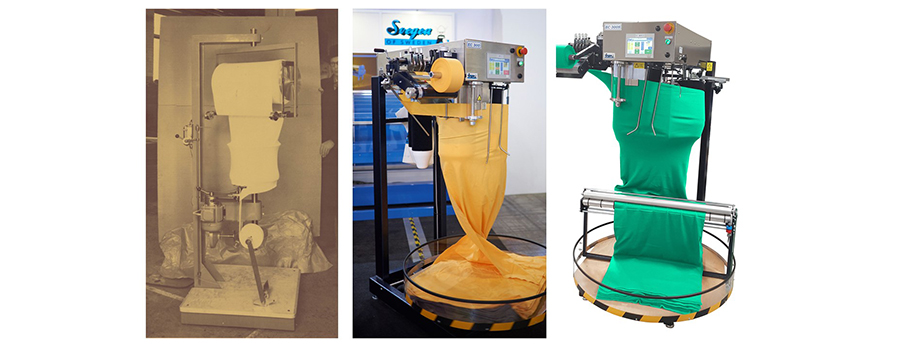
On its introduction back in 1952, this machine – used by garment manufacturers around the world for the production of tubular apparel components such as cuff and neck tapes and other seam reinforcements – caused a sensation with its then-unprecedented output of 300 metres per hour.
Time doesn’t stand still, however, and the latest EC 300 machine Svegea will demonstrate at Texprocess 2022 has a slightly improved output – of around 20,000 metres per hour.
“Advances in automation are only making the specialised, bespoke machines we engineer even more efficient and we are expecting a very busy show in Frankfurt and a busy year,” says Svegea Managing Director Håkan Steene. “The garment components our collarette cutters produce make it logical for them to be integrated into the operations of making-up operations wherever they are, and at the moment we’re seeing a lot of interest in the reshoring of operations by our customers, to bring final-stage manufacturing closer to the key European and US markets.”
E-Drive 2
The EC 300 collarette cutter on show in Frankfurt is equipped with the latest E-Drive 2 system providing the operator with a very user-friendly touchscreen, providing full control of the cutting process.
“A key function is the ability to ensure perfect synchronization of the tubular fabric between the machine’s turntable platform and its upper cutting body,” Steene explains. “We supply a wide range of automatic collarette band cutting machines with capacities to match the needs of our customers.”
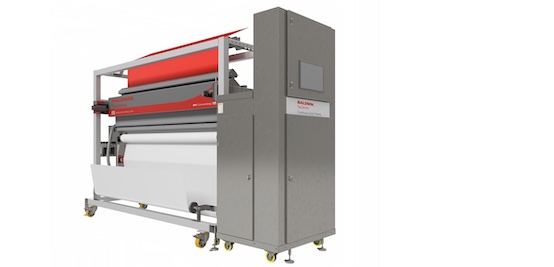
The integrated, fully automatic FA500 roll slitter accommodates diameters up to 400mm and is equipped with three separately adjustable settings enabling three different band widths to be cut within the same cutting cycle. Automatic tube sewing units are provided for sewn tubes in optional rolled or flat folded forms, depending on customer preference.
Niche applications
Svegea supplies many other bespoke machines for applications in the production of both garment components and technical textiles, including rewinding, measuring, inspection and band knife machines.
Occupying a unique niche are the company’s customer-specific bias cutting and winding units. On these machines, circular woven materials are fed to the cutter via a revolving winder and slit at angles, so that both the warp and weft of the weave are skewed at specified angles rather than just in the vertical and horizontal directions, as is usual.
This allows the slit fabrics to drape and form much more easily to the complex shapes of technical textile components such as, for example, circular rubber hoses and special diaphragms and seals which are employed in the aerospace and automotive industries, and for which the special fabrics act as critical reinforcements.
The ability to produce tubular fabric which is cut on the bias allows customers to provide textiles which not only have improved drape and elasticity properties for complex and intricate shapes, but also offer ways to reduce production costs by eliminating unnecessary wastage from the manufacturing process. Pre-cutting the fabric to a specific bias reduces extra handling of the fabric in further processes, saving customers both valuable production time and costs.
“Our latest bias cutting and winding units are being equipped with new features such as edge alignment and electronic roll tension control,” says Steene. “We will be happy to discuss its unique capabilities with interested parties in Frankfurt.”

Wide portfolio
“Svegea is a unique company with some ingenious solutions for both garment manufacturers and companies making specialised technical products,” says TMAS Secretary General Therese Premler-Andersson. “Messe Frankfurt’s decision to hold Texprocess, Techtextil and the Heimtextil Summer Special together this June will allow our members to showcase the full breadth of their portfolios, extending to all areas of the textile supply chain.”
Svegea will be one of a number of TMAS companies exhibiting at stand F41 in Hall 8 at Texprocess. In addition, Coloreel is jointly exhibiting with embroidery machine maker Tajima at stand H44 in Hall 8. ACG Kinna will be at stand E27 in Hall 3 as part of the Heimtextil show and Eltex will be at Techtextil in Hall 12, at stand E19.