[pageLogInLogOut]

#Techtextil 2022

Online, stationary and mobile measurement of characteristic fabric-design parameters
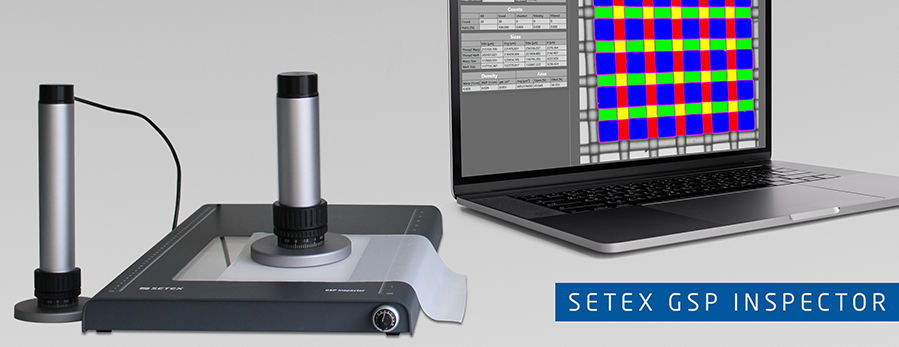
SETEX GSP250 Inspector © 2022 SETEX
SETEX increased the product family of camera-based instruments to provide fabric parameters such as yarn thickness, yarn frequency, fabric geometry and pore size.

GSP INSPECTOR 250/5 for direct measurement of characteristic filter parameters.

The effect of functional wear, filters or clinical applications depends on the diameter of the largest particles that can just pass through the mesh. In the forefront of complex permeability tests, the measurement-based determination of the critical mesh parameters already enables a correlation with the targeted requirements.

GSP INSPECTOR 250/5 reports with a simple measurement the pore size, pore shape, and fabric pore count in plain weaves. Developed with input from the filtration industry, the system provides further characteristics such as yarn thickness and the open mesh area.

The graphical measurement also visualizes structure defects in addition to the characterizations, and their influence on the result can be tracked interactively.

Test results are easy to view and analyze on screen and reports can be customized for print and export to PDF.

FabricINSPECTOR provides fast and simple measurements of the fabric density.

Aimed to automotive, workwear and protective wear industries with high quality-criteria, the thread analysis for woven and knitted fabrics gives consistent results in a fraction of the traditional counting time.

If it takes about 4 minutes to determine the thread count of 5 fabrics with a thread density of about 40 threads per cm by counting with a magnifying glass, the FabricINSPECTOR does this in 55 seconds by measuring.

The evaluation of KPIs and tolerances keeps a record of quality along the value chain.


FabricINSPECTOR Mobile

The lightweight and compact FabricINSPECTOR Mobile is ideal for users who want a quick decision at the location of the operation. Without the need for sampling and punching patterns, you get reliable measured values - even from running fabric.

By sharing the database and reporting app with the desktop FabricINSPECTOR, it is an easy to supplement existing units.

More information at SETEX in Hall 12.0, D68 inside the VDMA area.


More News from TEXDATA International

#Techtextil 2026

Performance Apparels: Functional textiles drive innovation at Techtextil 2026

From high-performance fibres and advanced membranes to smart textiles and sustainable material concepts – functional apparel is becoming one of the most dynamic innovation fields in technical textiles. At Techtextil 2026, exhibitors demonstrate how new materials, finishing technologies and digital functions are shaping the next generation of protective, workwear and outdoor systems.

#Texprocess 2026

Texprocess 2026: Automation, digitalisation and AI reshape textile processing

Investment decisions in textile processing have become increasingly complex. Rising energy prices, labour shortages and geopolitical uncertainties are forcing companies to prioritise technologies that deliver measurable improvements in efficiency and process stability. This applies not only to apparel production, but also to the processing of technical textiles and high-performance materials. Modernisation projects are therefore being evaluated more selectively – but the pressure to upgrade production systems continues to grow. Texprocess 2026 reflects this tension between cautious investment behaviour and increasing technological demand.

#Techtextil 2026

Textile Chemicals & Dyes: Innovation in Textile Chemistry moves into focus at Techtextil 2026

From PFAS-free finishes and water-saving dyeing technologies to advanced coatings and recycling-compatible formulations, innovation in textile chemistry is accelerating across the industry. Reflecting this development, Techtextil 2026 introduces Textile Chemicals & Dyes as a dedicated product segment, highlighting the growing role of chemical solutions in shaping the next generation of technical textiles.

#Recycling / Circular Economy

textile.4U publishes special edition “Top 100 Textile Recycling Companies 2025”

With a comprehensive 176-page special edition, textile.4U is dedicating its latest issue entirely to one of the most dynamic and influential topics in today’s textile industry: textile recycling. The new issue, published exclusively in high-quality print, presents the Top 100 textile recycling companies researched and selected by TexData – organizations that already play a key role in the transition to circular textiles or are expected to have a significant impact in the near future.

More News on Techtextil 2022

Latest News

#Textile chemistry

A flagship for chemical production: BASF inaugurates world-scale Verbund site in China

BASF today (March 26, 2026) celebrated the official inauguration of its newly built, world-scale Verbund site in Zhanjiang, Guangdong Province in southern China. Covering an area of around four square kilometers, it is more than a major BASF project in the chemical growth market of China. “Zhanjiang shows what the future of chemistry looks like: efficient, digital and sustainable by design. The site showcases a smart integrated Verbund structure on an industrial scale,” said Dr. Markus Kamieth, CEO of BASF, at the ceremony attended by representatives from government, customers, business partners and employees.

#Nonwovens

VEOCEL™ Lyocell production expands to Asia – Launching a new chapter for nonwovens in the region

VEOCEL™, Lenzing's flagship specialty nonwovens brand, expands production at its Thai plant in Prachinburi. This is the first-ever production of its nonwoven-grade lyocell fibers in Asia. Built in 2022 with a 100,000-ton annual production capacity, the facility - previously focused on fibers for textile applications - now can directly meet the demand for VEOCEL™’s biodegradable¹, wood-based lyocell fibers for nonwovens products. These fibers are an essential ingredient for high-quality nonwovens products, ranging from baby wipes to facial sheet masks and everyday personal hygiene items.

#Research & Development

Hof University develops sustainable textile coating for the fashion of tomorrow from mushrooms

Clothing is often treated as disposable: T-shirts for events, general merchandise, or short-term campaigns frequently end up in the trash after only a few uses. This is particularly problematic given that their production still largely relies on fossil-based materials. This is precisely where a new research project at Hof University of Applied Sciences comes in.

#Raw Materials

Fashion for Good mobilises industry to adopt mass balance attribution and accelerate decarbonisation

Fashion for Good launches today the Mass Balance Demonstrator project, a collaborative industry initiative to implement and scale the mass balance attribution (MBA) chain-of-custody model for biomass-attributed PET in textile applications. The project represents a concrete step toward accelerating brand-driven decarbonisation across the apparel value chain.

TOP