[pageLogInLogOut]

#Natural Fibers

Better Cotton partners with Planboo to reduce emissions using cotton crop waste
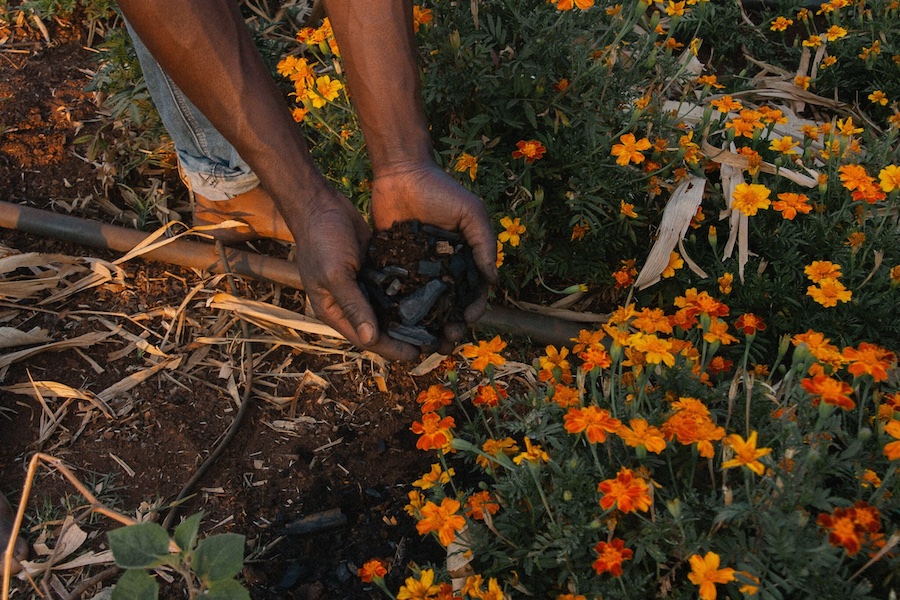
Better Cotton, the world’s largest cotton sustainability initiative, has teamed up with climate technology startup Planboo to help cotton farmers reduce greenhouse gas (GHG) emissions – and earn carbon credits for it.
Farmer holds biochar produced using crop waste © 2025 Planboo.


The partnership will involve biochar, a charcoal-like substance made from agricultural waste and other waste products that, when applied to soils, can improve their health, while helping them store carbon for more than a century.

Biochar is known to improve the structure of soil and enhance its ability to retain water and nutrients, while limiting chemical fertiliser use. In collaboration with Planboo, Better Cotton will support licensed farmers to produce this topical solution from farm waste and later apply it on the ground – providing environmental benefits in both phases.

Lars van Doremalen, Director of Impact at Better Cotton, said: “Planboo has championed biochar for over half a decade, and it is easy to see why. This age-old practice creates value from waste and boosts the climate resilience of land. Add to that the scope for farmers to be financially rewarded for their sustainability efforts, and this is an incredibly exciting proposition.”

Better Cotton will leverage Planboo’s digital Measurement, Reporting, and Verification (MRVin) system throughout this work, capturing data points from the production of biochar to the calculation of carbon reductions and removals.

This end-to-end software synchronises data to accurately calculate waste inputs, biochar volumes, carbon removals, and subsequent carbon allocation. As such, it unlocks new income streams for communities committed to reducing carbon emissions and improving their soil health.

Retailers and brands can also benefit, as their support to scale these efforts within the value chain would help mitigate Scope 3 emissions, which account for the vast majority of greenhouse gas release by the fashion and textile industries.

Freddie Catlow, Co-founder & CEO said: “From our very first days, Better Cotton stood out as the partner to deliver impact within fashion value chains. After seeing a 60% yield increase in cotton crops from our Solidaridad project in Zambia, it became clear this model was well-suited for cotton farming regions.

“With Better Cotton’s global reach and Planboo’s digital MRVin, we’re excited to embed carbon removal and soil health into the fabric of cotton farming, rooted in regeneration, and scaled by software.”

Better Cotton and Planboo will soon provide details of the scope of their first project, targeting smallholder cotton farming communities in India.


More News from Better Cotton

#Raw Materials

Better Cotton Initiative strengthens regenerative focus in standard update

The Better Cotton Initiative (BCI) has strengthened the regenerative focus of its field-level standard with the launch of a new version of its Principles & Criteria (P&C), which marks the next step in the organisation’s journey to becoming a regenerative standards system.

#Raw Materials

Better Cotton Initiative marks certification anniversary with progress update and accreditation

One year since becoming a certification scheme, the Better Cotton Initiative (BCI) has announced that more than 3,000 supply chain actors have been certified. At farm level, more than 30% of farms and producer units supplying BCI Cotton have received a positive audit outcome.

#Raw Materials

Better Cotton Initiative opens enrollment in the US with promising opportunities for producers

Producer enrollment for the US Program of the Better Cotton Initiative (BCI) is open until May 15 for the 2026-2027 season. With over 2,600 members spanning the cotton supply chain and more than 11,000 users of its Better Cotton Platform (BCP) as of 2025, BCI’s standard is implemented in 15 countries and covers one fifth of global cotton production.

#Natural Fibers

Better Cotton Initiative partners with Uzbek government agency to offset certification costs

The Better Cotton Initiative (BCI) has today announced a strategic agreement with Uzbekistan’s Light Industry Agency to increase financial support for cotton farming clusters adopting sustainable agricultural practices.

More News on Natural Fibers

#Raw Materials

New study shows low environmental impact by Cotton made in Africa Organic Cotton from Tanzania

Today, the Aid by Trade Foundation (AbTF) is announcing the results of a comprehensive life-cycle analysis (LCA) for cotton produced in Tanzania under the Cotton made in Africa Organic (CmiA Organic) standard. The study emphasises the small ecological footprint of CmiA Organic verified cotton. This can largely be traced back to the absence of synthetic pesticides, artificial fertilisers, and artificial irrigation. Consequently, CmiA Organic cotton can help the textile industry meet regulatory requirements as well as science-based targets. The results also show that the consequences of climate change threaten the livelihoods of these cotton farmers, even though the type of agriculture they practise barely contributes to climate change.

#Natural Fibers

Global Standard gGmbH launches second public consultation for GRTS Draft 2 for the textile industry (1–30 April 2026)

Global Standard gGmbH is pleased to announce the release of Draft 2 of the Global Responsible Textile Standard (GRTS) for its second public consultation. The consultation will be open from 1 April 2026 to 30 April 2026, inviting stakeholders across the textile and apparel value chain to provide input and contribute to the further development of this new Standard.

#Raw Materials

Global production expected to decline in 2026/27 as policy shifts and weak demand reshape trade

Early projections for the 2026/27 season indicate that global cotton lint production will decline by 4% to 24.9 million tonnes, while world consumption is expected to remain stable at approximately 25 million tonnes, according to the April 2026 issue of Cotton This Month.

#Raw Materials

Textile Exchange publishes cotton Life Cycle Assessment study to strengthen impact data

Textile Exchange has published the first in a series of seven Life Cycle Assessment (LCA) studies designed to improve the quality and robustness of environmental impact data for raw material production across the fashion, textile, and apparel industry. The first LCA study focuses on cotton and addresses critical data gaps and methodology variability through new high-quality data across key producing countries. The study includes organic, regenerative, recycled, and country averages for conventional cotton production systems, providing a clearer picture of the associated environmental impact.

Latest News

#Texprocess 2026

Kornit Digital expands digital production into footwear and technical textiles with Presto MAX PLUS

Kornit Digital (NASDAQ: KRNT) (“Kornit” or the “Company”), a global pioneer in sustainable, on-demand digital fashion and textile production, today unveiled the Kornit Presto MAX PLUS, a new roll-to-roll system expanding digital manufacturing into footwear, automotive interiors, military camouflage, high-performance sportswear, and high-end furnishings. Debuting at Texprocess 2026 in Frankfurt, Presto MAX PLUS enables entirely new applications for on-demand textile production.

#Textile processing

NATULON® zipper series surpasses 50% of YKK’s global zipper sales

YKK Corporation (Headquarters: Chiyoda-ku, Tokyo; President: Koichi Matsushima; hereafter, YKK) announces that the global sales share of its NATULON® zipper series—zippers that incorporate recycled materials—has exceeded 50%.

#Smart Textiles

Covestro, FILK Freiberg, and OUT e.V. develop flexible, conductive polymer smart textile system

As the smart textiles market continues to grow across healthcare, personal protection, sportswear, and automotive applications, developers are seeking new ways to integrate electronic functionality directly into textiles, without the rigidity and complexity of conventional wiring. To address this challenge, FILK Freiberg Institute, an independent research institution with expertise in polymer coatings for textile applications, collaborated with Optotransmitter-Umweltschutz-Technologie (OUT) e.V. The joint project, funded under the German Industrielle Gemeinschaftsforschung (IGF) program of the Bundesministerium für Wirtschaft und Energie (BMWE), focused on developing flexible, conductive polymer surfaces for next-generation smart textiles.

#HIGHTEX 2026

Global growth in the technical textile sector drives interest in HIGHTEX 2026 to its peak

The continued steady growth of the technical textiles and nonwoven sector worldwide is increasing interest every year in the HIGHTEX Exhibition, one of the sector’s most important meeting points. In this strong growth climate, HIGHTEX 2026 International Technical Textiles and Nonwoven Exhibition, which will bring together the sector’s leading manufacturers, technology providers, and international buyers, is preparing to open its doors at Tüyap Fair and Congress Center on June 9–13, 2026.

TOP