[pageLogInLogOut]

#Natural Fibers

Cotton made in Africa launches public consultation for standard revision
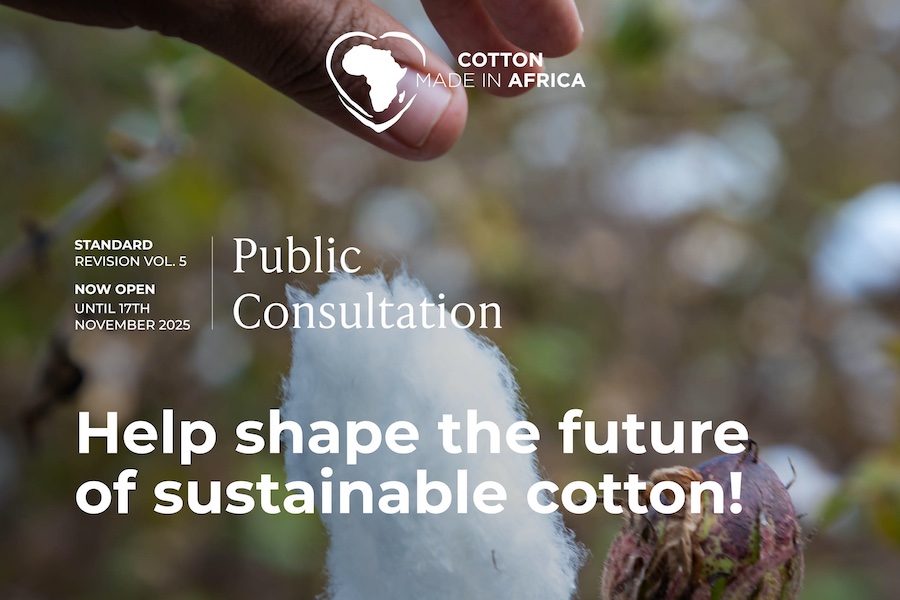
The Aid by Trade Foundation (AbTF) is opening public consultation on its Cotton made in Africa standard today. Interested parties will have 60 days to provide feedback, helping shape the future of one of the world’s largest standards for sustainable cotton. The latest update to the standard, Version 5.0, focusses on increasing Cotton made in Africa’s effectiveness and adapting its criteria and indicators to external factors, which currently include biodiversity loss and a growing set of reporting requirements for companies.
© 2025 Cotton made in Afrika


Public consultation launched on revision of the Cotton made in Africa standard

The public consultation on the draft of CmiA Standard Vol. 5.0 will run from 19 September to 17 November 2025. This revision revolves around three elements in particular. The first is precision, with indicators being reduced in number and reformulated to be more concise and easier to understand. Secondly, the standard’s objectives are being reprioritised, for instance, through new or reformulated indicators that strengthen biodiversity, climate change resilience, or cooperation between cotton companies and farmers. The third point of focus is to ensure that indicators for human rights and risk management meet the increasingly strict requirements regarding due diligence and corporate sustainability reporting. 

“Having received valuable feedback on CmiA Standard Version 4.0 from partners and stakeholders in recent months, we look forward to hearing the public response to our draft of Version 5.0,” says Alexandra Perschau, the head of the Standards & Outreach Department of AbTF, adding, “If this topic interests you, this is an excellent opportunity to actively participate in shaping our approach to supporting small-scale farmers producing cotton in Africa, to protecting biodiversity, and to giving companies access to the sustainable resources they need to fulfil their due diligence obligations.”

How the revision process works

The revision of the standard started in the spring of this year, with a two-day workshop in which partners and stakeholders in Côte d’Ivoire provided important input. Also taken into account were verification results from the last few years as well as additional findings from monitoring and evaluation processes and from innovations in sustainable cotton cultivation. After receiving feedback from the public consultation and from the technical advisory group, the approval of the AbTF Board of Trustees will be sought; if granted, Version 5.0 will enter into force in 2026.

How to participate

Public interest groups are invited to provide online feedback on the draft of CmiA Standard Vol. 5.0 between 19 September and 17 November 2025. A copy of the draft can be downloaded here. General feedback can be sent to standards@abt-foundation.org. To provide detailed feedback on specific standard requirements, an Excel version of CmiA Standard Vol. 5 is available through the online platform indicated above.

https://cottonmadeinafrica.org/en/standard-revision/


More News from Cotton made in Africa (CmiA)

#Natural Fibers

Cotton made in Africa partners receive top marks in independent verifications

Cotton made in Africa® (CmiA) and CmiA Organic are two internationally recognised standards that aim to promote sustainable development in the African cotton sector south of the Sahara. To ensure the standards’ credibility among brands, retailers, and consumers, independent verifiers evaluate compliance on the ground. The verification results for 2025, now published in the Aggregated Verification & Implementation Report, were very strong: The verifiers awarded consistently very good remarks regarding management, people, prosperity, and the environment.

#Raw Materials

New study shows low environmental impact by Cotton made in Africa Organic Cotton from Tanzania

Today, the Aid by Trade Foundation (AbTF) is announcing the results of a comprehensive life-cycle analysis (LCA) for cotton produced in Tanzania under the Cotton made in Africa Organic (CmiA Organic) standard. The study emphasises the small ecological footprint of CmiA Organic verified cotton. This can largely be traced back to the absence of synthetic pesticides, artificial fertilisers, and artificial irrigation. Consequently, CmiA Organic cotton can help the textile industry meet regulatory requirements as well as science-based targets. The results also show that the consequences of climate change threaten the livelihoods of these cotton farmers, even though the type of agriculture they practise barely contributes to climate change.

#Raw Materials

International Women’s Day: Cotton made in Africa strengthens equality for women through targeted investments

On the occasion of International Women’s Day—which will be observed on 8 March under the motto “Rights. Justice. Action. For ALL Women and Girls”—the Aid by Trade Foundation (AbTF), which is responsible for Cotton made in Africa® (CmiA), underlines its long-standing and ongoing commitment to the equality of women in African cotton production areas.

#Natural Fibers

Human Rights Day: Cotton made in Africa reinforces its commitment to ensuring respect for human rights in cotton production

The sustainable cotton standard Cotton made in Africa (CmiA) has always focussed on respect for human rights, including by prohibiting child labour and discrimination. With the new version of the CmiA standard coming into force, AbTF raises requirements for due diligence in the areas of human rights and risk management.

More News on Natural Fibers

#Natural Fibers

Woolmark: Merino wool innovation takes centre stage at Pitti Filati with The Wool Lab themes and Journal debut

Woolmark returns to Pitti Filati to lead AW27 sourcing conversations, spotlighting two new The Wool Lab trend-led themes, the debut of The Wool Lab journal for the European and Italian market and a stand centring the role of Merino wool as a high-performance technical fibre.

#Natural Fibers

Global cotton trade poised for recovery as India and China drive import demand

The July 2026 issue of Cotton This Month highlights a changing global cotton market, with consumption and trade expected to strengthen despite a modest decline in production during the 2026/27 season. The next issue of Cotton This Month will be released on August 1, 2026.

#Natural Fibers

Cotton ConneXions Insight to Impact brings supply chain leaders together around cotton innovation

Cotton Incorporated’s Cotton ConneXions Insight to Impact brought together more than 300 industry leaders from 140 companies across 10 countries, including more than 45 top global brands and sourcing organizations, underscoring strong global interest in cotton-rich product development, sourcing and supply chain collaboration.

#Natural Fibers

Cashmere specialist joins AbTF Board of Trustees

The Aid by Trade Foundation (AbTF) is pleased to welcome Brian Yu, the chief executive officer of the Artwell Group, to its board of trustees. As CEO, Brian Yu developed Artwell into the world’s largest supplier of responsibly produced cashmere knitwear.

Latest News

#Textile processing

YKK develops concept EXCELLA® zipper tape using nonwoven fabric partially derived from used clothing

YKK Corporation has developed a concept version of its premium EXCELLA® zipper series made from nonwoven fabric sheets created by fiberizing used clothing and other textile materials. Based on a proposal by fashion designer Yuima Nakazato, this item was created as a result of collaboration between Nakazato, Seiko Epson Corporation and YKK. The concept zipper was incorporated as a material component for pieces in the newest YUIMA NAKAZATO Couture Collection, “INFERNO,” which was unveiled in Paris, France on July 8, 2026.

#Textiles & Apparel / Garment

Texworld Apparel Sourcing Paris highlights evolving global sourcing landscape

From 31 August to 2 September 2026, Texworld Apparel Sourcing Paris will bring together more than 1,000 international exhibitors at Paris-Le Bourget Exhibition Centre. This edition reflects the new global balance of textile and apparel sourcing, highlighting a strong diversity of sourcing countries — some unexpected.

#Textile processing

Dedicated car seat model of SHIMA SEIKI’s P-CAM® R Cutting Machine unveiled

Leading Japanese textile solutions provider SHIMA SEIKI MFG., LTD. of Wakayama, Japan, showed a special version of its P-CAM® R multi-ply computerized cutting machine dedicated to the production of car seats for the first time, at a private exhibition held over two days on Thursday, July 2nd and Friday, July 3rd at the Kariya City Industrial Promotion Center in Aichi Prefecture.

#Research & Development

ALADIN paves the way for circular and demand-driven textile production in Europe

Textile production can be organized sustainably by utilizing short supply chains and preventing overproduction. This can already be achieved today by intelligently connecting and efficiently utilizing existing infrastructure. At the same time, production becomes circular when innovative technologies and materials are used that enable high-quality recycling. The ALADIN research project, launched in May 2026 and co-funded with five million euros under the EU Horizon Europe program, is creating the conditions for this.

TOP