[pageLogInLogOut]

#Spinning

Visco+ – innovative vacuum filter for IV setting
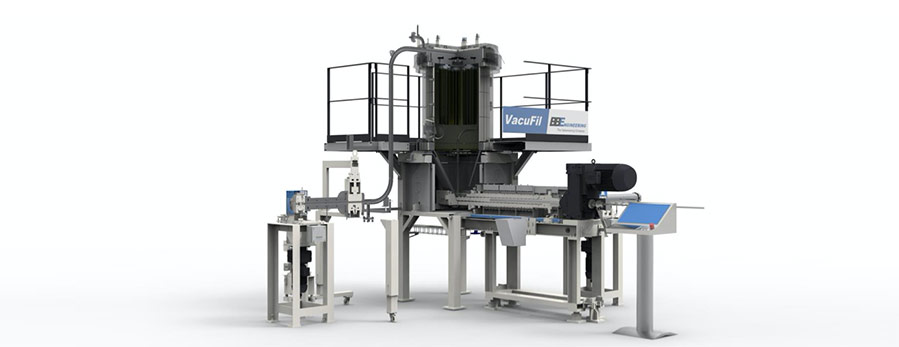
Graphical animation of Visco+ © 2021 BB Engineering
Under vacuum, the new BB Engineering large-area filter produces a homogeneous, pure melt with a targeted IV setting – for instance, for returning polyester production waste to the melt flow, but also for achieving a homogeneous viscosity in the case of virgin material.

BB Engineering has expanded its melt filter portfolio to include a patented large-area vacuum filter designed especially for processing polyester waste. The so-called Visco+ filter is already known as the key component of the BB Engineering VacuFil recycling system. Now, it is also available as a separate and easily-integratable upgrade component for existing systems. Within this context, the uses of the Visco+ are by no means limited to just decontamination. Here, the Visco+ offers the following solutions:

  • IV homogenization: if an existing production system is struggling with IV fluctuations, the Visco+ is able to actively intervene and balance out any irregularities;
  • IV increase: if the final viscosity is insufficient when processing recycled materials, the Visco+ can increase the IV without the negative impact of long residence times.

In this way, the Visco+ enables fast and flexibly-controllable viscosity build-up and reliable viscosity monitoring of the polyester melt using a to-date unique, patented process. Depending on the intended end use, the melt can be ad- justed to the further processing procedure in a targeted manner. The requisite melt properties – above all the intrinsic viscosity, but also the purity and homogeneity – are achieved in a reliable and reproducible manner and can also be adjusted during ongoing operation.


The BB Engineering process is both completely new and super-efficient. As a melt filter, the Visco+ operates like a liquid-state polycondensation unit. A maintenance-intensive reactor or a deposit-prone stirring unit are not required. Moisture is removed from the PET in the filter, which – in conjunction with an adjustable residence time – results in the desired IV increase in the vacuum. This enables a controlled IV build-up of up to 30%. The intrinsic viscosity is the central quality figure in PET recycling and rPET processing. It determines the melt performance in the downstream production process and the properties of the end products. The intrinsic viscosity is continually monitored by means of an integrated viscosity measurement unit and reliably adjusted in the event of deviations (caused by disparate input qualities, for example). At the same time, the filter provides an enormous material surface compared to the volume and continuously renews this. To this end, contamination can be removed particularly effectively from the starting material by means of automatically-regulated high-performance vacuum (1-30 mbar).

The result is a pure, homogeneous melt with controllable IV values and consistent quality. For this reason, the Visco+ is particularly suitable for recycling PET waste that is to be reused for high-end products.
More News from Barmag, Zweigniederlassung der Barmag GmbH & Co. KG

#Spinning

Object Carpet tests production of rPET BCF yarn on Neumag BCF line

In a joint project with Object Carpet GmbH, Denkendorf; the Institute for Textile Technology (ITA), Augsburg; and Next Generation Recyclingmaschinen GmbH (NGR), Feldkirchen, Austria, Barmag investigated the processing of recycled polyester for BCF yarn. The goal was to evaluate the fundamental suitability of 100% recycled carpet material for reuse in carpet yarn production to create a closed-loop system in carpet manufacturing. To date, commercial rPET BCF processes have been based solely on rPET from bottle pellets.

#Spinning

Barmag and Hitech Automation enter into partnership for an auto-doff system for texturing machines

Barmag (Suzhou) Technology Co., Ltd. and Hitech Automation Solutions PVT LTD. of Surat, India, have agreed to an exclusive partnership to jointly market Hitech’s Doffmatic automation solution for Barmag’s proven manual eFK texturing machines. In many texturing facilities, manual doffing processes remain heavily operator-dependent – resulting in issues such as increased scrap, inconsistent quality, and limited productivity.

#Spinning

Specialist in fine counts: New type 2777 ceramic oiler

With the new Type 2777 ceramic oiler, Barmag has added a solution for fine titers and microfilaments to its portfolio of original parts.

#ITM 2026

Barmag and Neumag showcase innovations across all manmade fiber processes

For the first time, Barmag is presenting itself alongside its new parent company, Rieter: At this year’s ITM in Istanbul, both companies will be represented from June 9 to 13 at the Tüyap Fair Convention and Congress Center in Hall 7, Booth 702B. As a technology leader in the field of chemical fiber equipment, Barmag will showcase its entire portfolio of systems for filament yarn, staple fiber, and nonwoven production, as well as solutions for the networked factory.

More News on Spinning

#Spinning

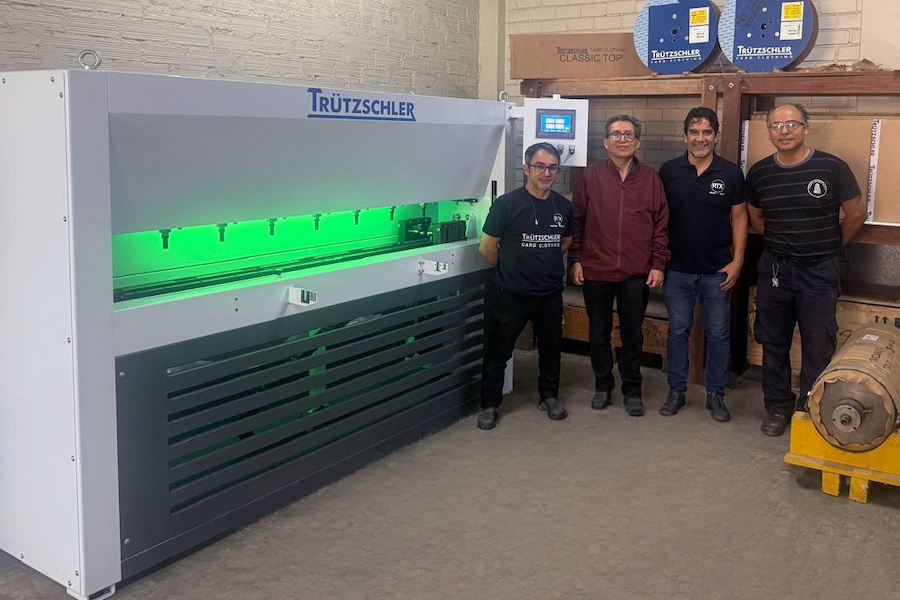
Ibrahim Fibres and Trützschler: A strong partnership enters its next phase with the TC 30Si

For more than two decades, Ibrahim Fibres and Trützschler have grown side by side, driven by a shared ambition to continuously improve spinning performance, strengthen technology leadership and set new benchmarks in the textile industry. Today, Ibrahim Fibres is a leading yarn and polyester staple fiber manufacturer in Pakistan. The company operates the largest number of Trützschler cards in the country, with more than 200 machines running across its mills in Faisalabad, and plays an important role in one of Asia’s largest textile industries.

#Spinning

New spinning package with two-step filtration for recycled yarns and more

At the ITM in Istanbul, BB Engineering unveiled its new, patented ValuePack spinning package for the first time, which features a two-stage filtration system. This is particularly beneficial for re-cycling processes. Until now, spinning packs have used either metal powder (“sand”) or filter candles as filter media. Both options are suitable for differ-ent applications, and each has its own specific advantages and dis-advantages.

#Research & Development

GenuTrace client advisory: Is your cotton supply chain UFLPA ready?

U.S. Customs and Border Protection has released updated operational guidance (CBP Publication No. 5560-0526) expanding its forced labor enforcement framework. The guidance supersedes the original 2022 UFLPA Operational Guidance and now covers all forced labor enforcement authorities — UFLPA, CAATSA, and WROs/Findings — in a single unified document. For cotton importers, the enforcement posture has not softened. It has become more structured, more documented, and more demanding. Learn more about UFLPA.

#Spinning

"We will become a recycling powerhouse"

The textile industry is now in its fourth consecutive year of crisis, while automation, artificial intelligence and recycling are reshaping the rules of the game. In this interview, Rieter CEO Thomas Oetterli discusses the first signs of a market recovery, reflects on his first three years at the helm of the company, explains the integration of Barmag, outlines Rieter’s vision of the fully automated spinning mill and highlights the strategic importance of recycling. In doing so, he explains why the new Rieter Group aims to play a leading role in transforming the textile value chain into a circular economy.

Latest News

#Research & Development

ALADIN paves the way for circular and demand-driven textile production in Europe

Textile production can be organized sustainably by utilizing short supply chains and preventing overproduction. This can already be achieved today by intelligently connecting and efficiently utilizing existing infrastructure. At the same time, production becomes circular when innovative technologies and materials are used that enable high-quality recycling. The ALADIN research project, launched in May 2026 and co-funded with five million euros under the EU Horizon Europe program, is creating the conditions for this.

#Nonwovens

Katharina Obergruber appointed to the Management Board of Sandler AG

The Supervisory Board of Sandler AG has appointed Katharina Obergruber to the company’s Management Board. Effective September 1, 2026, the Board will consist of Philipp Ebbinghaus (CEO), Dr. Ulrich Hornfeck (currently CCO, future COO), and Katharina Obergruber (CCO). Katharina Obergruber, currently Chief Sales Officer Hygiene and member of the Management Team of Sandler AG, will assume responsibility for all sales activities as Chief Commercial Officer. She will assume this role from Dr. Ulrich Hornfeck, who will focus primarily on production and supply chain topics.

#Recycling / Circular Economy

Ence and ShareTex begin initial testing of the ATENEA innovation project to promote textile recycling in Spain

Ence and ShareTex are making progress on the Atenea R&D project, which aims to develop a complete value chain for textile recycling in Spain. Specifically, the goal of the ATENEA project—which is funded by the Center for Technological Development and Innovation (CDTI)—is to connect all the necessary stages for the recovery of textile waste, from collection and management, through recycling and transformation into new raw materials, to their incorporation into new textile products.

#Recycling / Circular Economy

DePoly Inaugurates its Showcase Plant in Monthey Switzerland

What if used plastic bottles, PET packaging material and polyester textiles could become raw materials just as high performing as virgin resources? That is the ambition of DePoly, a circular materials company based in Sion, Switzerland which inaugurated its Showcase Plant in Monthey on July 6th & 7th. The first depolymerization facility of its kind and scale in Switzerland, this industrial Showcase Plant represents a major milestone in the company's growth and its journey toward commercialization.

TOP