[pageLogInLogOut]

#Research & Development

Aachen researchers develop BioTurf
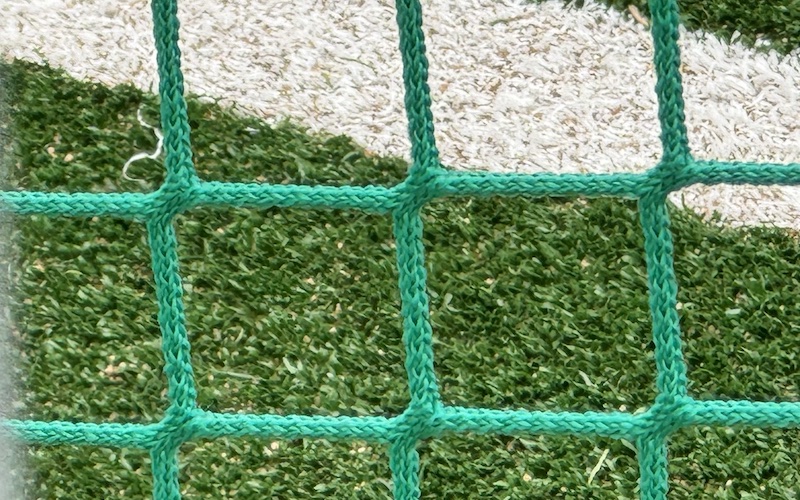
The current European Football Championships 2024 in Germany will be played on natural turf. This is very costly to maintain, does not tolerate high frequency of use and has a limited service life of only 6 months in some cases. Artificial turf is easier to maintain and correspondingly popular. In Germany alone, there are estimated to be more than 5,000 artificial turf pitches and as many as 25,500 across the EU. The huge drawback: the enormous annual emission of microplastics in the form of infill material, the high CO2 impact and the anything but environmentally friendly disposal.
The innovative artificial turf system consists of bio-based polymers and, for the first time, no longer requires any polymer infill material. This combination is a world first and the result of a project in the BIOTEXFUTURE innovation centre, which is funded by the German Federal Ministry of Education and Research  © 2024 TFI
The innovative artificial turf system consists of bio-based polymers and, for the first time, no longer requires any polymer infill material. This combination is a world first and the result of a project in the BIOTEXFUTURE innovation centre, which is funded by the German Federal Ministry of Education and Research © 2024 TFI


Just in time: Sustainable artificial turf! 

Researchers in Aachen have addressed this issue and presented a sustainable alternative in the form of BioTurf. BioTurf is a globally new artificial turf system made from bio-based polymers that no longer requires polymer infill material!

"Every year, around 500 kilograms of plastic granules are produced per artificial turf pitch, which have to be refilled as infill. This also corresponds to the amount that potentially enters the environment as microplastics per sports pitch," explains Dr Claudia Post from TFI. With an estimated 25,000 artificial turf pitches in the EU, artificial turf in Europe alone produces 12,750 tonnes of microplastics that end up in the environment every year! The TFI - Institut für Bodensysteme an der RWTH Aachen e.V., Institute for Research, Testing and Certification in Europe for Indoor Building Products, has developed the innovative artificial turf system together with the ITA (Institute for Textile Technology at RWTH Aachen University) and in collaboration with the company Morton Extrusionstechnik (MET), a specialist in artificial turf fibres. 

"New artificial turf pitches will be phased out by 2031 at the latest due to the ban on plastic granules. Even now, artificial turf pitches with infill material are no longer being subsidised," says Dr Claudia Post. For grassroots sports, clubs, cities and local authorities, converting their existing artificial turf pitches will be a mammoth task in the coming years, as artificial turf pitches have to be replaced every 10-15 years. With BioTurf, an environmentally friendly alternative is now available! The surface can be played on like any other, whether running, passing or kicking. Short, heavily crimped blades support longer blades and this simple approach increases playing comfort. BioTurf fulfils all quality requirements and standards for the highest footballing demands.
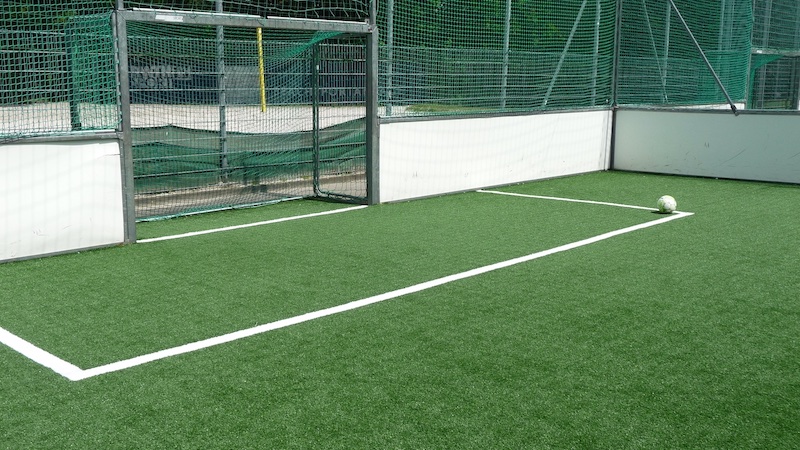
At the University Sports Centre (HSZ) in Aachen, the company Morton Extrusionstechnik GmbH has laid a cage soccer pitch with BioTurf. A perfect opportunity to make the results of the research project visible and tangible  © 2024 TFI
At the University Sports Centre (HSZ) in Aachen, the company Morton Extrusionstechnik GmbH has laid a cage soccer pitch with BioTurf. A perfect opportunity to make the results of the research project visible and tangible © 2024 TFI


BioTurf - an innovative, holistic solution

"BioTurf is an innovative, holistic solution," emphasises Dirk Hanuschik from TFI. "We use rapeseed oil and agricultural waste that does not compete with food production. BioTurf is also almost completely recyclable".

This is in stark contrast to conventional artificial turf, which can currently only be thermally utilised, i.e. burned to generate heat. 

As BioTurf does not require the traditional latex process at all, the energy-intensive drying process can be dispensed with, which has a positive effect on the price. Latex is also difficult to recycle. In contrast, BioTurf uses the new thermobonding technology, which does not require any latex at all. Here, the thermoplastic pile yarns are thermally fused to the backing. Further development steps still need to be taken in the endeavour to develop a 100% mono-material artificial turf, as a few percent polypropylene still needs to be processed in the backing in addition to the polyethylene fibre material in order to protect it during thermobonding. However, this does not hinder its recyclability.

BioTurf from Aachen is an environmentally friendly and playable alternative. Good prospects both for football and for popular sport as a whole, which can become more sustainable and therefore healthier with the Aachen development. BioTurf is a pioneering innovation for sports facilities in local authorities and clubs.

BioTurf is a world first and the result of a project in the BIOTEXFUTURE innovation centre, which is funded by the German Federal Ministry of Education and Research. Further information can be found at www.biotexfuture.info

More News from TFI - Institute for Soil Systems at RWTH Aachen University e.V.

More News on Research & Development

#Research & Development

The region of renewable raw materials: Central German Alliance for Bioplastics

The development of sustainable plastic solutions is rapidly gaining importance in light of global environ- mental pollution, dwindling fossil resources and ambitious climate protection targets. As part of the re- gional alliance RUBIO, which brings together 18 partners from central Germany and the Berlin-Branden- burg area, the bio-based and biodegradable plastic polybutylene succinate (PBS) was comprehensively investigated, starting with the raw material, through the manufacturing process, to industrial application.

#Nonwoven machines

Cooperation in the field of meltblown laboratory technology

The Nonwoven Institute (NWI) at North Carolina State University and Oerlikon Nonwoven will be collaborating in the field of meltblown laboratory technology in the future. This was announced by Professor Raoul Farer, Executive Deputy Director of the NWI and Professor at the Wilson College of Textiles at North Carolina State University, and Dr. Ingo Mählmann, Sales Director Nonwoven at Oerlikon Neumag, during this year's ITMA Asia and CITME in Singapore.

#Recycling / Circular Economy

European research project addresses textile waste through integrated recycling technologies

A major European research initiative coordinated by Fraunhofer UMSICHT has been launched to develop integrated solutions for textile waste recycling. The AUTOLOOP project aims to create a comprehensive system that could process 1.24 million tonnes of textile waste annually by 2050, whilst potentially creating over 130,000 green jobs across the EU. This project aims to develop, test and integrate automated sorting, tracing, and closed-loop recycling technologies for polyester-based textiles (NRT), addressing the pressing challenge of textile waste management.

#Research & Development

Feasibility study shows potential to convert textile waste into PHB bioplastic

Textile waste could serve as a valuable source of raw materials for sustainable plastics in the future, according to the joint TexPHB feasibility study conducted by the Fraunhofer Institute for Applied Polymer Research IAP, Beneficial Design Institute GmbH and matterr GmbH. The study will be presented to the public for the first time at a network meeting on 25 November 2025 at the State Chancellery in Potsdam.

Latest News

#Recycling / Circular Economy

Advanced Recycling Conference 2025 fuels innovation across key waste streams

The Advanced Recycling Conference (ARC) 2025 brought together nearly 220 experts from 28 countries to spotlight pioneering advancements and foster industry collaboration in recycling across diverse waste streams including plastics, textiles, automotive and other materials.

#Dyeing, Drying, Finishing

Navis TubeTex announces U.S. partnership with Icomatex

Navis TubeTex, a global leader in advanced dyeing and finishing machinery solutions, is pleased to announce a new partnership with Icomatex (www.icomatex.com), a respected European manufacturer of high-quality stenters and textile finishing equipment. Under this agreement, Navis TubeTex will exclusively represent the Icomatex stenter line in the United States.

#Recycling / Circular Economy

ADVANSA launches ADVA®tex: A new step toward textile-to-textile recycling

ADVANSA has introduced ADVA®tex, a new filling fibre made entirely from recycled pre-consumer textile waste, positioning the material as a significant step forward in textile-to-textile (T2T) recycling. The fibre is designed for use in duvets, pillows, mattresses, and furniture applications and is available in three versions.

#Knitting & Hosiery

KARL MAYER celebrates 35 years of EL pattern drive

KARL MAYER is celebrating an anniversary this year: on 30 November 1990, the first warp knitting machine with electronic guide bar control, the KS 4 EL, was delivered – another milestone for patterning. As early as 1980, the SU gearbox with the MRS42SU had initiated the transition from mechanical chains to digital data.

TOP


