[pageLogInLogOut]

#Research & Development

Monforts continues to support young talented textile technologists
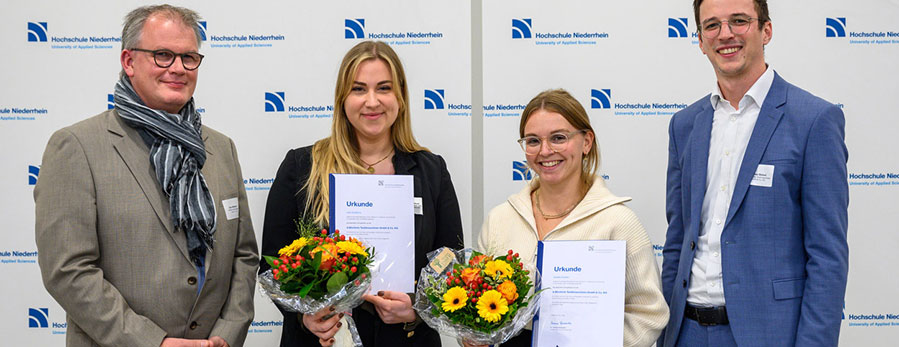
Pictured (left to right) are Claus Hiltmann (Monforts Head of R&D), new Niederrhein students Lisa Gudehus and Saskia Kuhlen, and Monforts Textile Technologist Jonas Beisel. © 2022 Monforts
A. Monforts Textilmaschinen, world-leading supplier of textile dyeing and finishing machines, is continuing to provide support to the Niederrhein University of Applied Sciences (Hochschule Niederrhein) located in Mönchengladbach, Germany, home to the company for nearly 140 years.

Having backed the University’s German Scholarship Programme (Deutschlandstipendium) since 2010, Monforts is granting scholarships to three students in the running student year 2022/2023. Wilm Scharlemann, Head of Human Resources, underlined Monforts‘ commitment to young talents: “One of our top priorities is finding well-qualified and dedicated staff. That is why we have been supporting the University’s scholarship programme since its beginning.“ He went on saying that Monforts provides opportunities for young talents and students studying for Bachelor or Masters degrees – with the goal of joining the Monforts team in future.

Nicole Croonenbroek, Marketing Manager at Monforts, specified: “Each of our textile machines is unique and designed according to the customers‘ special requirements. Young talents are often surprised when they hear of the many opportunities that a company like Monforts can offer. Our market is no longer just about textiles for clothing. The textile world of today covers airbags, blood filters, smartphone components, sun blinds, medical bandages or automotive headliners.“

Apart from its commitment to students at the Hochschule Niederrhein, Monforts is celebrating fifty years of membership in the Assocation of German Textile Experts (VDTF - Verband Deutscher Textilfachleute e.V.) – a pool of excellence in the textile finishing industry.


“Textile finishing in Germany has been strengthened through the VDTF association’s work. Some 65 supporting companies and approx. 850 members have created links to textile research centres at the universities in Aachen, Moenchengladbach and other places“, says Thomas Päffgen, Area Sales Manager at Monforts and former member of the VDTF’s Management Board for many years.

Jonas Beisel, one of Monforts‘ textile technologists, delivered a well-received lecture on the company’s integrated heat recovery and exhaust air system MonforClean at a VDTF meeting. “The VDTF is a great source of inspiration. Getting in touch with other experts in the textile finishing research business, company visits, lectures and informal meetings are an excellent opportunity for fruitful exchange.“
More News from A. Monforts Textilmaschinen GmbH & Co. KG

More News on Research & Development

#Research & Development

Textile cascade filter for removing microplastics from wastewater

Microplastics are now found almost everywhere, even in remote regions of Antarctica. They enter the human body through the food chain. Studies indicate that microplastics may have negative effects on the human health.

#Research & Development

Fraunhofer IAP paves the way for "Green" carbon fibers

A new pilot plant in Guben is set to enable the production of bio-based carbon fibers. The plant is part of the Carbon Lab Factory Lausitz and will make an important contribution to the transformation of the Lausitz region—from a traditionally raw material- and basic industry-oriented region to a hub for innovative high-performance materials. The German federal government and the state of Brandenburg are providing the Fraunhofer Institute for Applied Polymer Research IAP with 53.3 million euros for this purpose.

#Research & Development

Hof University develops sustainable textile coating for the fashion of tomorrow from mushrooms

Clothing is often treated as disposable: T-shirts for events, general merchandise, or short-term campaigns frequently end up in the trash after only a few uses. This is particularly problematic given that their production still largely relies on fossil-based materials. This is precisely where a new research project at Hof University of Applied Sciences comes in.

#Research & Development

Textilfabrik 7.0 launched: Mönchengladbach becomes a real-world lab for sustainable textile production

With the official kick-off event of the Textilfabrik 7.0 (T7), a major transformation project for the German textile and apparel industry has been launched in the Monforts Quarter in Mönchengladbach. At the “Textile Roundtable,” an event format organized by the Zukunftsagentur Rheinisches Revier, representatives from industry, research, politics, and the regional economy came together to jointly lay the foundation for CO₂-neutral, circular, and economically viable textile production in Germany.

Latest News

#Techtextil 2026

IVGT joint stand brings innovation and networking to Techtextil 2026

At Techtextil 2026 and the parallel Texprocess 2026, key transformation topics such as artificial intelligence, digitalisation, sustainability, recycling and the circular economy will be reflected across the show. Against this backdrop, the IVGT, together with 16 member companies, will present its joint stand in Hall 12.1 (Stand D62) as a platform for exchange and networking.

#Man-Made Fibers

Indorama Ventures supports Southeast Asia’s textile customers with reliable regional supply and global innovative portfolio

Indorama Ventures, one of the leading global polyester fiber and filament yarn suppliers globally, will participate in Indo Intertex 2026 in Jakarta this April, making its diverse global portfolio available to apparel, home textile, and hygiene customers across Southeast Asia.

#Raw Materials

New study shows low environmental impact by Cotton made in Africa Organic Cotton from Tanzania

Today, the Aid by Trade Foundation (AbTF) is announcing the results of a comprehensive life-cycle analysis (LCA) for cotton produced in Tanzania under the Cotton made in Africa Organic (CmiA Organic) standard. The study emphasises the small ecological footprint of CmiA Organic verified cotton. This can largely be traced back to the absence of synthetic pesticides, artificial fertilisers, and artificial irrigation. Consequently, CmiA Organic cotton can help the textile industry meet regulatory requirements as well as science-based targets. The results also show that the consequences of climate change threaten the livelihoods of these cotton farmers, even though the type of agriculture they practise barely contributes to climate change.

#Raw Materials

Better Cotton Initiative strengthens regenerative focus in standard update

The Better Cotton Initiative (BCI) has strengthened the regenerative focus of its field-level standard with the launch of a new version of its Principles & Criteria (P&C), which marks the next step in the organisation’s journey to becoming a regenerative standards system.

TOP