[pageLogInLogOut]

#Research & Development

Tested pet supplies
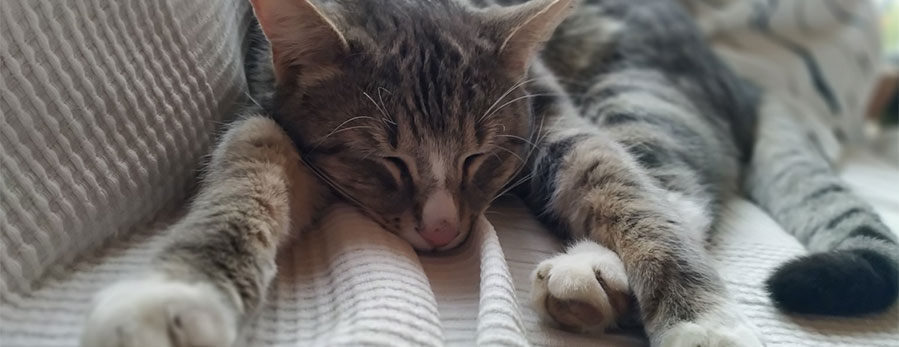
For many of us, our animal companions count as full members of the family and are cared for accordingly. © Hohenstein
To ensure that pets are also well equipped in terms of product safety, quality and durability of their cuddly blankets, cushions or favorite toys, the textile testing service provider Hohenstein has established its quality label for tested pet supplies. After all, the number of pets in private households is growing every year, and for many of us, our animal roommates count as full members of the family and are cared for accordingly.

Hohenstein quality label ensures animal trust

The label is explicitly designed for textile products such as blankets or pillows for sleeping areas, dog clothing, mats or even horse blankets. It provides consumers with clear product information on product safety, quality and durability, and also offers home/pets and their owners security against unwanted residues of chemical substances. Beyond its standard physical tests, the quality label can be flexibly extended: depending on the intended use, product properties such as chew resistance, scratch resistance, outdoor suitability, water repellence, waterproofness or air permeability play a major role in ensuring that pets feel completely comfortable. 
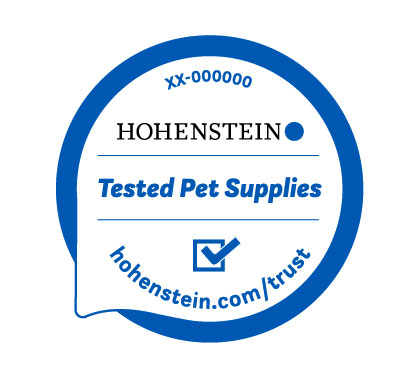
A Hohenstein quality label allows consumers to quickly and conveniently check a product's advertised properties and functions. © Hohenstein


The Hohenstein quality label Tested Pet Supply is an independent proof of quality and joins the ranks of the existing Hohenstein quality labels. These have long been highly credible and have a high recognition value in the trade and among consumers.

To ensure that our pets are also well equipped in terms of product safety, quality and durability of their cuddly blankets, cushions or favorite toys, the textile testing service provider Hohenstein has established the Hohenstein Quality Label for Tested Pet Supply. © Hohenstein


Detailed information can be found at:

https://www.hohenstein.com/en/trust.



More News from Hohenstein Institute

#Textiles & Apparel / Garment

Global size study for brands and retailers to optimize fit and market coverage

Hohenstein Apparel Fit Solutions, a global leader in apparel fit, sizing, and product development, today announces the launch of its Global Size Study, a new initiative designed to equip brands to better understand and serve their target consumers through more accurate, market-relevant sizing.

#Sustainability

A new standard to combat plastic waste in forests

With DIN SPEC 35808 “Tree Shelter for Forestry Applications,” the testing and research service provider Hohenstein, in collaboration with Rottenburg University of Forestry, as well as forestry authorities and industry partners, has established a clear framework for bio-based and fully biodegradable tree shelters. The pre-standard defines requirements and practical testing methods designed to reduce plastic waste in forests and strengthen the long-term protection of soil and the environment.

#Research & Development

Hohenstein publishes 2025 Sustainability Report

The testing and research service provider Hohenstein has published its latest sustainability report, outlining key progress and strategic initiatives. The report focuses on ambitious CO₂ reduction targets, the company’s new mission statement and the systematic expansion of sustainable services for customers worldwide.

#Research & Development

New DIN SPEC assesses environmental impact of textile fragments in soil

Textile products made from synthetic fibres, finished fabrics or dyed materials release fibre fragments into the environment at every stage of their life cycle. With the new DIN SPEC 19296, Hohenstein has developed a standardised testing method to analyse how these fragments behave in soil under natural conditions. Until now, little was known about their environmental behaviour or potential ecological effects once released.

More News on Research & Development

#Research & Development

GenuTrace client advisory: Is your cotton supply chain UFLPA ready?

U.S. Customs and Border Protection has released updated operational guidance (CBP Publication No. 5560-0526) expanding its forced labor enforcement framework. The guidance supersedes the original 2022 UFLPA Operational Guidance and now covers all forced labor enforcement authorities — UFLPA, CAATSA, and WROs/Findings — in a single unified document. For cotton importers, the enforcement posture has not softened. It has become more structured, more documented, and more demanding. Learn more about UFLPA.

#Research & Development

TERNAfil wins first place at PitchMiUp Night 2026 in Minden

The RWTH spin-off TERNAfil has developed MAXCarbon, a new high-performance hybrid fibre that combines the mechanical performance of carbon with the temperature and corrosion resistance of ceramic materials. For this development, TERNAfil was awarded first prize at the PitchMiUp Night in Minden on 21 May 2026.

#Research & Development

Carbon-ceramic hybrid fibre proves its worth – NRW Minister for Science Mona Neubaur congratulates ITA start-up TERNAfil

MAXCarbon technology, a novel carbon-ceramic hybrid fibre developed by ITA spin-off TERNAfil, secured third place at the HIGH-TECH.NRW Demo Day on the TÜV NORD campus in Essen. The technology combines the strength of carbon fibres with the temperature and corrosion resistance of ceramic materials. Mona Neubaur, Minister for Science in North Rhine-Westphalia, congratulated the team on their success and on winning prize money of 4,000 euros.

#Research & Development

“Production is a product”

From technical textiles and AI-driven robotics to the limitations of textile circularity: Professor Dr Thomas Gries looks back on more than two decades of development at ITA Aachen. In the interview, he explains why production technology remains a decisive success factor, discusses international collaborations and innovation ecosystems, and shares his views on the transformation of production landscapes and the challenges facing an increasingly regulated industry.

Latest News

#Natural Fibers

Bremen Cotton Exchange: Fritz A. Grobien re-elected as President

The members of the Bremen Cotton Exchange have re-elected Fritz A. Grobien as President during the association’s 152nd General Assembly on June 18, 2026. The election confirms the organization’s commitment to maintaining its role as a leading international platform for the cotton and fiber industry amid a period of geopolitical and economic uncertainty.

#Natural Fibers

Organic cotton at the crossroads: Ideology, evidence, and the road ahead

Organic cotton occupies one of the most contentious spaces in global agriculture. While praised by brands and consumers for its environmental ideals, it also faces persistent questions about yield stability, certification integrity, and scalability. The current edition of The ICAC Recorder cuts through the ideology to deliver a rigorous, evidence-based assessment of both sides of the debate.

#Spinning

New spinning package with two-step filtration for recycled yarns and more

At the ITM in Istanbul, BB Engineering unveiled its new, patented ValuePack spinning package for the first time, which features a two-stage filtration system. This is particularly beneficial for re-cycling processes. Until now, spinning packs have used either metal powder (“sand”) or filter candles as filter media. Both options are suitable for differ-ent applications, and each has its own specific advantages and dis-advantages.

#ITMA 2027

ITMA 2027 gains strong momentum

In line with the theme "Co-creating the future of textiles", ITMA continues to strengthen its support for start-ups, recognising their role in driving innovation and shaping the future of textile and garment manufacturing. Through the Start-Up Valley, emerging companies gain access to a global marketplace where they can connect with industry leaders, potential partners, investors and customers.

TOP