[pageLogInLogOut]

#Research & Development

Professor Gries laureate at FAMOS for Family
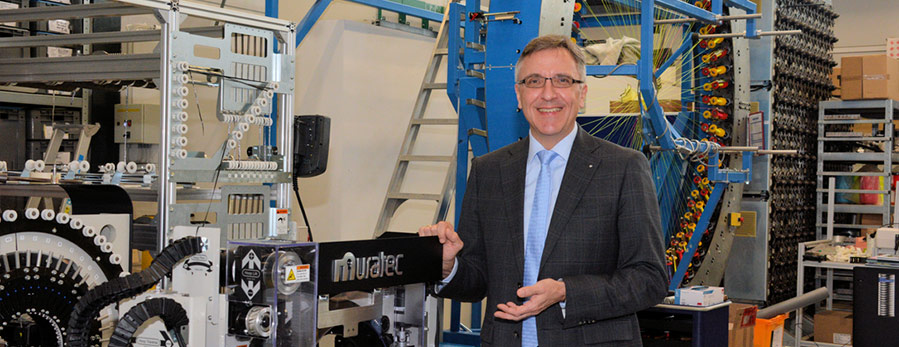
© 2021 ITA
Professor Thomas Gries from the Institut für Textiltechnik (ITA) was honoured with the "FAMOS for Family" award on 21 June 2021 for his family-friendly personnel management. RWTH awards this prize every year to RWTH executives for their family-friendly personnel work.

The family-friendly policy at ITA already begins at the start of the doctorate: employees are encouraged to start family planning during the doctoral period. To this end, the ITA offers its own counselling centre for expectant mothers and fathers. There are individual working time models for employees with children. This means that senior staff can also take parental leave. That is why ITA is proud of having the highest proportion of female doctoral students among the five largest RWTH institutes (measured by the number of employees).

"Thanks to this bundle of measures, we are able to welcome 5-10 newborn children at ITA every year." Professor Gries announces ITA's success statistics in the area of family policy with a smile and mentions a mystery at the end: "For inexplicable reasons, the twin rate at ITA is about 5 times higher than statistically expected."


The award winners of 2020 and 2021 were invited to this year's 14th presentation of the "FAMOS for Family" award. In 2020 and 2021, six leaders each were honoured. This year, the award ceremony took place digitally. RWTH Chancellor Manfred Nettekoven acknowledged the commitment of the award winners, and Pro-Rector Professor Doris Klee presented all award winners with a certificate and 500 euros in prize money for a team activity.



More News from TEXDATA International

#Techtextil 2026

Performance Apparels: Functional textiles drive innovation at Techtextil 2026

From high-performance fibres and advanced membranes to smart textiles and sustainable material concepts – functional apparel is becoming one of the most dynamic innovation fields in technical textiles. At Techtextil 2026, exhibitors demonstrate how new materials, finishing technologies and digital functions are shaping the next generation of protective, workwear and outdoor systems.

#Texprocess 2026

Texprocess 2026: Automation, digitalisation and AI reshape textile processing

Investment decisions in textile processing have become increasingly complex. Rising energy prices, labour shortages and geopolitical uncertainties are forcing companies to prioritise technologies that deliver measurable improvements in efficiency and process stability. This applies not only to apparel production, but also to the processing of technical textiles and high-performance materials. Modernisation projects are therefore being evaluated more selectively – but the pressure to upgrade production systems continues to grow. Texprocess 2026 reflects this tension between cautious investment behaviour and increasing technological demand.

#Techtextil 2026

Textile Chemicals & Dyes: Innovation in Textile Chemistry moves into focus at Techtextil 2026

From PFAS-free finishes and water-saving dyeing technologies to advanced coatings and recycling-compatible formulations, innovation in textile chemistry is accelerating across the industry. Reflecting this development, Techtextil 2026 introduces Textile Chemicals & Dyes as a dedicated product segment, highlighting the growing role of chemical solutions in shaping the next generation of technical textiles.

#Recycling / Circular Economy

textile.4U publishes special edition “Top 100 Textile Recycling Companies 2025”

With a comprehensive 176-page special edition, textile.4U is dedicating its latest issue entirely to one of the most dynamic and influential topics in today’s textile industry: textile recycling. The new issue, published exclusively in high-quality print, presents the Top 100 textile recycling companies researched and selected by TexData – organizations that already play a key role in the transition to circular textiles or are expected to have a significant impact in the near future.

More News on Research & Development

#Research & Development

Textile cascade filter for removing microplastics from wastewater

Microplastics are now found almost everywhere, even in remote regions of Antarctica. They enter the human body through the food chain. Studies indicate that microplastics may have negative effects on the human health.

#Research & Development

Fraunhofer IAP paves the way for "Green" carbon fibers

A new pilot plant in Guben is set to enable the production of bio-based carbon fibers. The plant is part of the Carbon Lab Factory Lausitz and will make an important contribution to the transformation of the Lausitz region—from a traditionally raw material- and basic industry-oriented region to a hub for innovative high-performance materials. The German federal government and the state of Brandenburg are providing the Fraunhofer Institute for Applied Polymer Research IAP with 53.3 million euros for this purpose.

#Research & Development

Hof University develops sustainable textile coating for the fashion of tomorrow from mushrooms

Clothing is often treated as disposable: T-shirts for events, general merchandise, or short-term campaigns frequently end up in the trash after only a few uses. This is particularly problematic given that their production still largely relies on fossil-based materials. This is precisely where a new research project at Hof University of Applied Sciences comes in.

#Research & Development

Textilfabrik 7.0 launched: Mönchengladbach becomes a real-world lab for sustainable textile production

With the official kick-off event of the Textilfabrik 7.0 (T7), a major transformation project for the German textile and apparel industry has been launched in the Monforts Quarter in Mönchengladbach. At the “Textile Roundtable,” an event format organized by the Zukunftsagentur Rheinisches Revier, representatives from industry, research, politics, and the regional economy came together to jointly lay the foundation for CO₂-neutral, circular, and economically viable textile production in Germany.

Latest News

#Raw Materials

New study shows low environmental impact by Cotton made in Africa Organic Cotton from Tanzania

Today, the Aid by Trade Foundation (AbTF) is announcing the results of a comprehensive life-cycle analysis (LCA) for cotton produced in Tanzania under the Cotton made in Africa Organic (CmiA Organic) standard. The study emphasises the small ecological footprint of CmiA Organic verified cotton. This can largely be traced back to the absence of synthetic pesticides, artificial fertilisers, and artificial irrigation. Consequently, CmiA Organic cotton can help the textile industry meet regulatory requirements as well as science-based targets. The results also show that the consequences of climate change threaten the livelihoods of these cotton farmers, even though the type of agriculture they practise barely contributes to climate change.

#Raw Materials

Better Cotton Initiative strengthens regenerative focus in standard update

The Better Cotton Initiative (BCI) has strengthened the regenerative focus of its field-level standard with the launch of a new version of its Principles & Criteria (P&C), which marks the next step in the organisation’s journey to becoming a regenerative standards system.

#Man-Made Fibers

Selenis and Kintra Fibers partner to scale 100% bio-based synthetic fiber technology

Selenis, a leading global specialty polyester manufacturer, today announced a strategic manufacturing partnership with materials science company Kintra Fibers to scale Kintra’s patented fiber-grade PBS resin - a 100% bio-based and biodegradable material designed for textile applications.

#Functional Fabrics

PERFORMANCE DAYS proves its relevance as the industry’s key meeting point

Held on March 18–19, 2026, PERFORMANCE DAYS once again confirmed its position as a leading international platform for functional textiles. A total of 3.366 trade visitors and around 560 exhibitors gathered in Munich, with the event already kicking off successfully on DAY 0, which received highly positive feedback for its interactive format. Despite challenging conditions caused by the public transport strike in Munich, the event saw strong attendance and a consistently high level of activity across both exhibition days.

TOP