[pageLogInLogOut]

#Recycling / Circular Economy

ReCircleTex

Transforming old textiles into new, high-quality materials on a large scale – that is the subject of a new innovation project by eeden, the Center Textile LogisticsCenter Textile Logistics (CTL) at the Niederrhein University of Applied Sciences and the Fraunhofer IML, and the Hohenstein Innovations gGmbH.

The project aims to promote a circular textile economy through technological and logistical optimizations. eeden's innovative fiber-to-fiber recycling process will be further developed to efficiently process textile waste from laundries. Additionally, logistics will be restructured from collection to recycling to ensure a resource-conserving and efficient supply of this material stream. With a total volume of over 625,000 euros, the project is co-financed by the Ministry for the Environment, Nature Conservation and Transport of the State of North Rhine-Westphalia and the European Union as part of the GreenEconomy.IN.NRW innovation competition.

“We are excited to enable circular laundry textiles with our exceptional partners. By optimizing our processes, we aim to significantly improve the recycling of end-of-life textiles and make the most of this valuable resource,” explains Ida Marie Brieger, Business Development at eeden.

Hohenstein and eeden jointly analyze the used textiles as part of analytical tests to accurately determine the properties of the textile waste after various cleaning cycles. Dr. Timo Hammer, Managing Director of Hohenstein, says: “Working with eeden and the Center Textile Logistics allows us to bring the latest technologies and scientific discoveries into real-world applications. We're excited to be part of this groundbreaking project.”

Subsequently, the Center Textile Logistics (CTL), supported by eeden, will develop a concept for the efficient procurement of raw materials and their integration into a sustainable business structure. Prof. Dr. Markus Muschkiet, Head of CTL, emphasizes: “This project is a fantastic opportunity to rethink logistics and make our supply chains not just more efficient, but also more sustainable. We're excited to leverage our expertise to build this future-proof supply chain.”

Finally, the further developed process will be validated by eeden on a technical scale. By 2026, the close collaboration between eeden, the Center Textile Logistics (CTL), and Hohenstein aims to promote the circular use of textiles and make a significant contribution to reducing textile waste.

ReCircleTex partners  © 2024 Hohenstein Institute
ReCircleTex partners © 2024 Hohenstein Institute


More News from Hohenstein Institute

#Sustainability

A new standard to combat plastic waste in forests

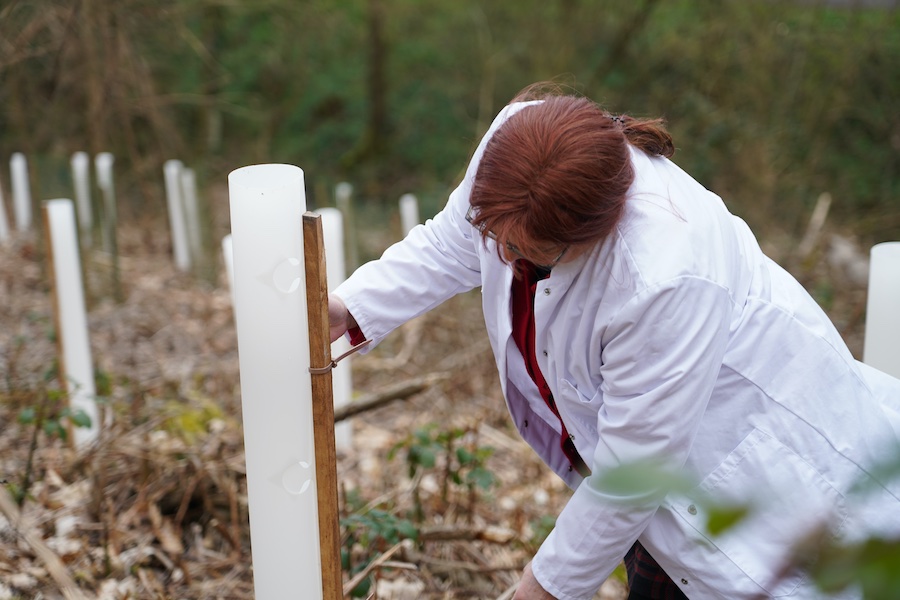
With DIN SPEC 35808 “Tree Shelter for Forestry Applications,” the testing and research service provider Hohenstein, in collaboration with Rottenburg University of Forestry, as well as forestry authorities and industry partners, has established a clear framework for bio-based and fully biodegradable tree shelters. The pre-standard defines requirements and practical testing methods designed to reduce plastic waste in forests and strengthen the long-term protection of soil and the environment.

#Research & Development

Hohenstein publishes 2025 Sustainability Report

The testing and research service provider Hohenstein has published its latest sustainability report, outlining key progress and strategic initiatives. The report focuses on ambitious CO₂ reduction targets, the company’s new mission statement and the systematic expansion of sustainable services for customers worldwide.

#Research & Development

New DIN SPEC assesses environmental impact of textile fragments in soil

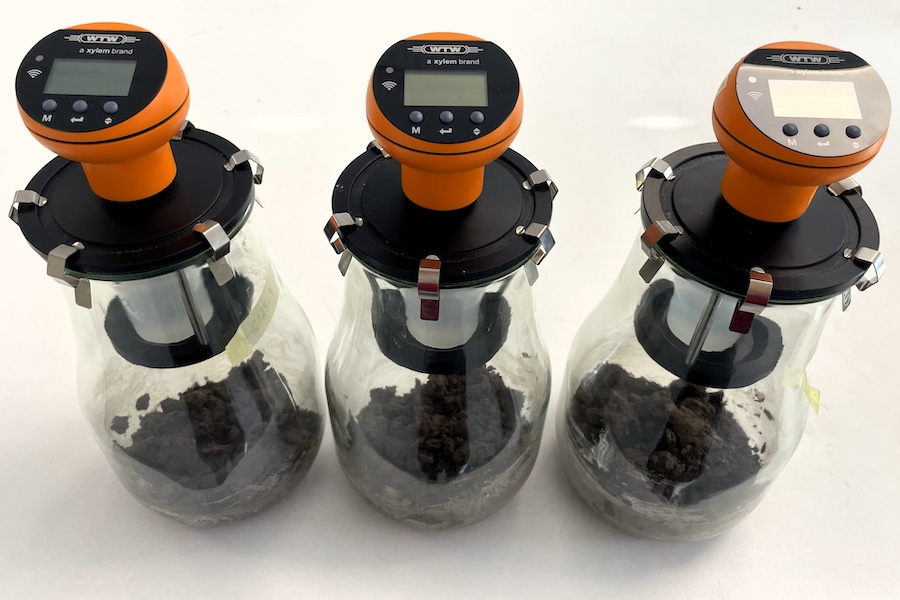
Textile products made from synthetic fibres, finished fabrics or dyed materials release fibre fragments into the environment at every stage of their life cycle. With the new DIN SPEC 19296, Hohenstein has developed a standardised testing method to analyse how these fragments behave in soil under natural conditions. Until now, little was known about their environmental behaviour or potential ecological effects once released.

#Research & Development

Testing and research laboratory ensures safe and more sustainable products worldwide

For 80 years, Hohenstein has stood for independent testing, scientific expertise and practical solutions. Today, the testing and research service provider supports manufacturers and brands worldwide in making textiles, hardlines and medical devices safe, more sustainable and market-ready – thereby building trust among consumers. With an international presence and interdisciplinary expertise, Hohenstein supports its customers from production through to market launch, helping them navigate an environment of growing regulatory and societal demands.

More News on Recycling / Circular Economy

#ITM 2026

BB Engineering unveils new, patented “Val-uePack” spin pack at ITM

At the upcoming ITM in Istanbul, taking place June 9–13 at the Tüyap Fair Convention and Congress Center in Hall 7, Booth 702B, BB Engineering will once again be represented at a joint booth with its parent company, Barmag, and its representative, Tekstil Servis. The German machine manufacturer will show-case its expertise in man-made fiber and recycling technology, presenting its entire product portfolio, which includes compo-nents such as extruders and filters, as well as complete sys-tems for spinning synthetic fibers, air-texturing, and PET recy-cling.

#Recycled Fibers

Syre expands partnership with Target to advance next-generation recycled materials at scale

Advancing next-generation materials to support scalable circular solutions across global retail Stockholm, May 2026 — Syre, the textile impact company hyperscaling textile-to-textile recycling today announced an expanded collaboration with Target to accelerate the adoption of next-generation recycled materials across retail at scale.

#Recycling / Circular Economy

Project REWEAR investigates diverse economies of rewear as a global practice of circularity

Every year, European households discard millions of tonnes of clothing. Around a quarter of what gets separately collected is exported, much of it classified as rewearable. A significant share ends up in markets like Kantamanto in Accra, Ghana, where an estimated 15 million garments arrive every week. New research published today reveals what happens when that clothing arrives.

#Recycling / Circular Economy

RE&UP contributes to Global Fashion Summit 2026 circularity discussion

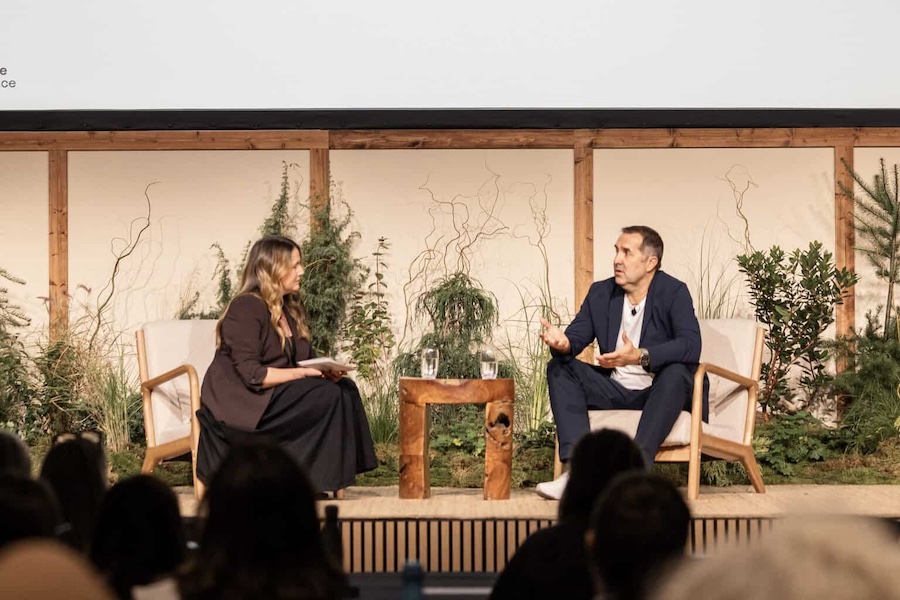
RE&UP contributed to the global conversation on textile circularity at Global Fashion Summit 2026 in Copenhagen, where Fatih Konukoğlu, Chairman of RE&UP and Vice Chairman of Sanko Holding, took part in both the keynote session “The New Rules” and the panel discussion “A Reckoning and Renewal for Circular Horizons”, alongside leaders from H&M Group, Looper Textile Co. and Sourcing Journal.

Latest News

#INDEX 2026

“We clearly see that reliability, flexibility, service and total cost of ownership are becoming increasingly important again.”

The nonwovens industry continues to face a challenging market environment. Nevertheless, AUTEFA Solutions reports successful projects, new line sales and growing demand for energy-efficient and flexible solutions. In this interview, André Imhof of AUTEFA Solutions talks about competitiveness against Chinese suppliers, new service and recycling concepts, the growing importance of application development and the opportunities created by countercyclical investments.

#INDEX 2026

“Needle punching technology is more universal and sustainable than ever!”

Needle punching technology was long regarded as a rather traditional and comparatively slow technology within the nonwovens industry. In this interview, Johann Philipp Dilo explains why needle punching is more relevant than ever today – ranging from energy efficiency and resource conservation to hygiene applications, new machine concepts and design-oriented nonwoven solutions.

#Research & Development

Textile climate control system in workwear – exhibition at the 2026 SME Innovation Day!

Conventional protective workwear often reaches its limits during strenuous physical activity. In particular, the transport of sweat and excess body heat poses a problem. The German Institutes of Textile and Fiber Research (DITF) conducted research on flow-optimized, air-conducting textile structures that enable targeted climate control directly on the body. These structures can be integrated straight into protective work garments. The textile climate control system supports the body’s natural thermoregulation. This contributes to improved workplace safety and comfort.

#Nonwovens

PET spunbond from China – EDANA welcomes imposition of provisional anti-dumping measures

On 13 May 2026, after eight months of investigation, the European Commission imposed provisional anti-dumping duties of 45.6-50.0% on imports of PET spunbond from China. EDANA welcomes this expression of the Commission’s clear determination to protect EU industries from the unfair trade practices of Chinese producers.

TOP