[pageLogInLogOut]

#Recycling / Circular Economy

Renaissance Textile successfully starts up the first textile recycling line in France delivered by ANDRITZ
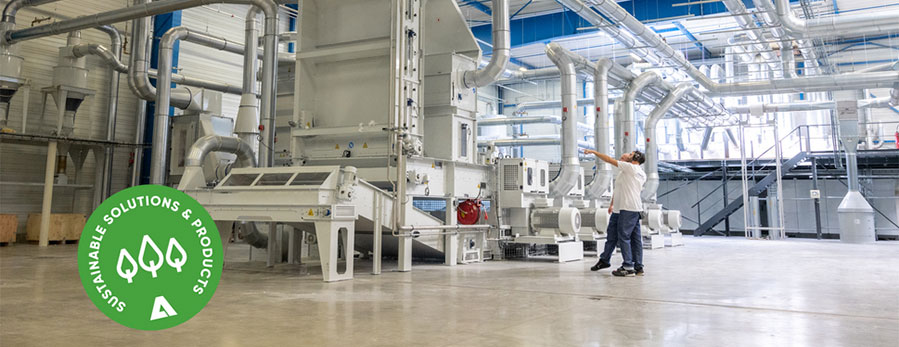
Tearing line by ANDRITZ in operation at the Renaissance Textile plant © Robin Inizan - Lucas Pavy Production
Renaissance Textile in Laval, France has successfully started up a complete textile recycling line, delivered, installed, and commissioned by ANDRITZ Laroche, part of the international technology group ANDRITZ.

Sustainable textile technology from ANDRITZ Laroche enables to carry out a breakthrough project based on the circular economy 

The state-of-the-art ANDRITZ textile recycling equipment enabled Renaissance Textile to become the first French recycling platform dedicated to industrial end-of-life textiles. The project aims to produce new fibers from the collected post-consumer apparel, which will be used to weave new recycled fabrics in the end.

The new 12,000 m² plant is equipped with a complete tearing line whose unique design is the result of close collaboration between R&D specialists from ANDRITZ Laroche and Renaissance Textile, as well as customized trials carried out jointly by the two parties at the ANDRITZ technical center in Cours, France.

The new clothing produced based on this type of circular economy model thus reflects the social and sustainability commitments of Renaissance Textile in terms of decarbonizing the textile industry, the fight against global warming, autonomy in raw material sourcing, and promotion of local staffing, particularly for people who have been unemployed for a long time or are seeking to enter the labor market for the first time.


It is the first milestone of a pioneering project that ANDRITZ is proud to actively support. By 2025, for example, Renaissance Textile plans to create no less than 110 direct jobs.

Nicolas Nojac, director of Renaissance Textile, comments: “Our first recycling line is dedicated to white polycotton textiles that mainly come from the healthcare and food processing industries. This equipment enables us to recycle 3,000 tons of textiles every year, representing 10 million items of clothing. We also plan to install two additional lines by the end of 2023 and 2025, respectively, to enlarge the range of recycled textiles by adding different colors and fibers”.



More News from Andritz Küsters GmbH

More News on Recycling / Circular Economy

#Recycling / Circular Economy

Reju secures €135 Million in Dutch NIKI Funding for industrial-scale textile-to-textile regeneration hub at Chemelot Industrial Park, the Netherlands

Reju™, the progressive textile-to-textile regeneration company, has been awarded €135 million in funding under the Netherlands’ Nationale Investeringsregeling Klimaatprojecten Industrie (NIKI) program. The funding will support Reju’s planned industrial-scale Regeneration Hub at Chemelot Industrial Park in Sittard-Geleen, covering both the investment phase and ongoing operations, and represents a critical milestone on the path toward final investment decision.

#Recycling / Circular Economy

eeden is now a Canopy partner

eeden is committed to enable circular textiles by developing recycling technologies that turn textile waste into valuable raw materials. But the commitment goes further – eeden advocates for supply chain solutions that uphold responsible environmental and ethical standards, protecting global ecosystems including Ancient and Endangered Forests.

#Recycling / Circular Economy

Infinited Fiber Company’s environmental permit for Kemi advances to statutory appeal phase

Infinited Fiber has reached an important regulatory milestone in Finland, as the environmental permit process for a potential facility in Kemi has progressed to the statutory appeal phase.

#Recycling / Circular Economy

Carbios confirms Longlaville plant in France following financing progress

Carbios has reaffirmed its plans to build its Longlaville plant in France within a project financing framework, targeting the start of production in the first half of 2028. The company also reports a solid cash position of around €60 million at the end of 2025 and has appointed Benoît Grenot as Deputy Chief Executive Officer to support the execution of its strategic projects.

Latest News

#Techtextil 2026

AI, Start-ups, Research: Techtextil and Texprocess bring together players in the textile industry

From start-ups to universities and research institutes: at Techtextil and Texprocess, the world’s leading innovation trade fairs in Frankfurt am Main, exhibitors present future-oriented concepts for the global textile industry. With the international Campus & Research area, a strong participation from start-ups and the latest AI applications for textile processing, both trade fairs showcase current developments in the textile industry. By bringing together innovation, research and application, they enable new partnerships across the textile value chain.

#Techtextil 2026

IVGT joint stand brings innovation and networking to Techtextil 2026

At Techtextil 2026 and the parallel Texprocess 2026, key transformation topics such as artificial intelligence, digitalisation, sustainability, recycling and the circular economy will be reflected across the show. Against this backdrop, the IVGT, together with 16 member companies, will present its joint stand in Hall 12.1 (Stand D62) as a platform for exchange and networking.

#Man-Made Fibers

Indorama Ventures supports Southeast Asia’s textile customers with reliable regional supply and global innovative portfolio

Indorama Ventures, one of the leading global polyester fiber and filament yarn suppliers globally, will participate in Indo Intertex 2026 in Jakarta this April, making its diverse global portfolio available to apparel, home textile, and hygiene customers across Southeast Asia.

#Raw Materials

New study shows low environmental impact by Cotton made in Africa Organic Cotton from Tanzania

Today, the Aid by Trade Foundation (AbTF) is announcing the results of a comprehensive life-cycle analysis (LCA) for cotton produced in Tanzania under the Cotton made in Africa Organic (CmiA Organic) standard. The study emphasises the small ecological footprint of CmiA Organic verified cotton. This can largely be traced back to the absence of synthetic pesticides, artificial fertilisers, and artificial irrigation. Consequently, CmiA Organic cotton can help the textile industry meet regulatory requirements as well as science-based targets. The results also show that the consequences of climate change threaten the livelihoods of these cotton farmers, even though the type of agriculture they practise barely contributes to climate change.

TOP