[pageLogInLogOut]

#Recycling / Circular Economy

Circle Economy launches Circularity Academy to close the green skills gap
The first gamified e-learning platform for mass immersive learning to accelerate the adoption of circular economy solutions © 2022 Circle Economy
Circle Economy, an impact organisation based in the Netherlands, launched Circularity Academy (CAMY) at the Web Summit 2022. CAMY is a gamified e-learning platform to assess, engage, train and activate people to enable the circular transition.

Developed in collaboration with Sustainability Games, Circularity Academy addresses the green skills gap: the lack of professionals able to fulfil the rapidly growing demand for circular jobs. 
© 2022 Circle Economy


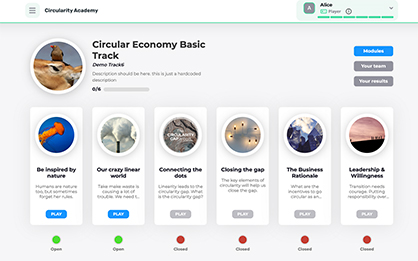
CAMY provides a continuous learning experience composed of journeys and minigames—fun and easy yet in-depth. It is geared towards assessing the circular assets of an organisation or a team, raising awareness about the circular economy, creating collective understanding, developing and certifying circular skills, and tracking progress along the pathway to sustainability. These modular elements can be used separately or all at once, depending on the needs of an organisation.

‘The green skills gap is one of the main bottlenecks for businesses engaged in the circular economy, from multinationals to small firms. With Circularity Academy, we are helping them to manage and assess their team’s knowledge and skills, putting these assets into action,’ points out Marc de Wit, Director Businesses at Circle Economy.

Our experts co-create learning tracks with clients to finetune game experiences according to the industry and team specifics. The result is simultaneous education and engagement for hundreds of people—helping close the green skills gap at scale.

The platform can be compared to a restaurant menu with lessons, minigames and tests for dishes. This allows one to pick and choose tracks and journeys for specific purposes: from a fun activity at an event to a fully-fledged training programme for employees. Learning journeys typically consist of reading materials, videos, questionnaires and minigames, both individually- and team-played. CAMY is well-suited for entities that are just embarking on their circular journey and want to make sure that all people involved are on the same page and equipped with basic knowledge.


‘Circularity Academy is based on 11 years of circular economy research by Amsterdam-based Circle Economy. In addition to conducting research, we develop and pilot circular solutions—and we know what works and what doesn't. Complemented by over 4,800 case studies around the world, the Circularity Academy learning tracks are relatable, understandable and practical. The gamification element makes it fun, challenging and engaging. It is our mission to close the green skills gap to close the global Circularity Gap. This is the second product we’ve launched in line with our strategy to leverage technology to accelerate the global transition to an economic system where the planet and all people can thrive,’ says Ivonne Bojoh, COO & Director Digital at Circle Economy.

Circle Economy believes that businesses around the world, as well as local and national governments, must join hands to accelerate the transition to a circular economy and avoid climate breakdown. Closing the Circularity Gap starts with bridging the knowledge gap. Circularity Academy provides the means to do this on a mass scale, encouraging not just education but also the adoption of circular narratives. The goal of the tool is to educate 100 million people over the next ten years, empowering businesses, cities and nations to go circular.

Learn more about Circularity Academy at:

http://www.circularityacademy.com. 


More News from Circle Economy

#Recycling / Circular Economy

Between 121 and 142 million people are employed in the circular economy globally, new study finds

Between 121 and 142 million people worldwide are employed in sectors that contribute to the circular economy, such as repair, recycling, second-hand trade and waste management. This represents roughly between 5 and 5.8 percent of total global employment (excluding agriculture), according to a new joint report by Circle Economy, the International Labour Organization (ILO) and the World Bank Group, in partnership with the UN Partnership for Action on Green Economy (UN-PAGE).

#Recycling / Circular Economy

Circulose welcomes Sara Diez Jauregui and Kalyan Madabhushi to its Board of Directors

Circulose is proud to announce the appointment of Sara Diez Jauregui and Kalyan Madabhushi to further strengthen its Board of Directors, following the recent appointment of Chair Helena Helmersson. These additions bring world-class expertise across the value chain: Sara offers extensive experience with leading fashion and apparel brands, while Kalyan brings a notable career at Aditya Birla Group, a global leader in cellulosic fiber production.

#Recycling / Circular Economy

Successful pilot: biodegradable plastic produced from textile waste

The 'Design for Transformation' (D4T) pilot project, led by Circle Economy and the Biomimicry Institute, has developed an innovative technology to produce bioplastics and gaseous products from textile waste. This set of technologies aims to enable companies to generate additional revenue streams from waste, whilst diverting it from landfills or incineration.

#Recycling / Circular Economy

Circle Economy and partners launch new textile 5R solutions project SOLSTICE

Launched on 28 May, 2024, the SOLSTICE project supports sustainable growth in the textile sector by raising customer awareness, enhancing recycling with new sorting methods, ensuring feedstock traceability using the Digital Product Passport, and providing data and guidelines to decision-makers. ?

More News on Recycling / Circular Economy

#Recycling / Circular Economy

AI Circular Economy Conference 2026 fuels innovation at the intersection of AI and Circular Economy

The AI Circular Economy Conference 2026, organised by nova-Institute, brought together 116 participants from 15 countries in Cologne and online to explore the transformation of the chemical and materials industry supported and accelerated by artificial intelligence. During the two-day event, leading experts from industry, research, start-ups and the investment community discussed how AI can maximise the potential of renewable carbon creating efficient circular value chains. The conference featured 24 presentations and multiple panel discussions, highlighting the growing convergence of digital technologies and circular material systems. It demonstrated how artificial intelligence is progressing from the experimental stage to real industrial implementation within the circular economy.

#Recycled_Fibers

Circ deepens access to recycled fibers with Xinxiang Bailu Chemical Fiber Co., Ltd. partnership agreement

Circ®, a global leader in textile‑to‑textile recycling, today announced a new partnership agreement with Xinxiang Bailu Chemical Fiber Co., a Canopy Dark Green Shirt producer and one of the world’s leading producers of viscose filament. The agreement marks a significant step in Circ’s continued expansion in China and strengthens its position within the country’s rapidly evolving circular textile ecosystem; further supporting Circ’s ability to supply recycled fibers near existing fashion supply chains.

#Recycled_Fibers

Worn Again Technologies unveils the Accelerator

Worn Again Technologies unveils the Accelerator, the next major step towards commercialising its pioneering Textile-to-Fibre recycling process and proving the technical and economic feasibility of polycotton recycling.

#Recycling / Circular Economy

Textile‑to‑textile recycling leader Circulose joins Spinnova’s ecosystem to accelerate technology scale‑up

Textile‑to‑textile recycling leader Circulose joins Spinnova’s ecosystem (consortium) to help advance the scale‑up of Spinnova’s technology. Spinnova has actively sought partners to accelerate commercial scale‑up, and Circulose, as a key player in textile recycling, strengthens the ecosystem by providing a raw material that is in high demand across the industry.

Latest News

#Techtextil 2026

Gebr. Otto highlights versatility at Techtextil with regional supply chains, yarn innovations and new hygiene segment

At this year’s Techtextil, Gebr. Otto places its versatility at the center of its presentation. In addition to spinning, twisting and dyeing – traditionally focused on fine cotton – textile processors will also find a competent development partner for technical specialty solutions. The Dietenheim-based spinning mill has now built up a decade of experience in the production of technical yarns, particularly from aramids. A new hygiene segment has also been established, where yarns for medical and hygiene products are currently being produced. In the future, this department could also develop textile products for the food sector. Gebr. Otto will once again be present at the BW-i joint stand, booth D81, hall 12.1. What is wound onto the spool is determined by the customer: Gebr. Otto develops according to specific customer requirements and transforms its own ideas into yarn innovations.

#Europe

Commission presents proposal for EU Inc. - unlocking the full potential of the Single Market for Europe's entrepreneurs

Today, the European Commission presented its proposal for EU Inc., a new single set of corporate rules, building the cornerstone and starting point for the EU's 28th regime. EU Inc. is an optional, digital-by-default European corporate framework. It will make it easier for businesses to start, operate and grow across the EU – incentivising them to stay in Europe, and encourage those who once looked elsewhere to return.

#Man-Made Fibers

OnceMore® from Södra brings end-to-end traceability for circular Man-made Cellulosic Fibers (MMCF) using TextileGenesis

OnceMore® from Södra, the world’s first large-scale process for recycling blended fabrics into high‐quality dissolving pulp, will begin using TextileGenesis, a Lectra company, to strengthen traceability from raw material to retail across the value chain. OnceMore® produces dissolving pulp made from blended textile waste and wood sourced from responsibly managed Swedish forests. By integrating TextileGenesis, OnceMore® supports the growing need for verified data and secure, transparent tracking throughout increasingly complex supply chain.

#Sustainability

Experts publish APAC policy priorities

Cascale today announced the publication of its APAC Policy Priorities Paper, developed by the Asia-Pacific (APAC) Policy Member Expert Team (MET) to identify key regional sustainability challenges and provide practical, aligned recommendations for policymakers and industry stakeholders across Asia-Pacific.

TOP