[pageLogInLogOut]

#Recycling / Circular Economy

BASF highlights progress in enabling plastics circularity at Plastics Recycling Show Europe 2022

Identify plastic types at the push of a button – with trinamiX’s Mobile NIR Spectroscopy Solution © 2022 BASF
BASF will present high-performance solutions that target the three key stages of the mechanical recycling process for plastics at the Plastics Recycling Show Europe 2022 in Amsterdam, Netherlands (booth D21) from June 22 to 23. State-of-the-art technology and products to identify the grade of plastic, to improve efficiencies in the cleaning processes for recycling, and to boost the quality of recycled polymeric materials will be featured. BASF’s Plastic Additives business unit has combined its technical competence with that of BASF subsidiaries trinamiX and Chemetall to deliver highly innovative solutions for plastic recyclers.
  • High-performance solutions target three key stages of the mechanical recycling process: sorting, washing and reprocessing
  • BASF at Plastics Recycling Show Europe 2022:  D21, Hall 12, RAI Amsterdam, Netherlands

Together, these businesses have the goal to drive innovations with leading-edge technologies and customer collaborations. BASF will also present a technical paper at the conference during the trade fair on “Advancing recycled polymers to survive multiple loops” which explains how additives solutions are contributing to the circularity of plastics.

Sorting made easy with trinamiX

With its Mobile Near-Infrared (NIR) Spectroscopy Solution, trinamiX enables swift on-the-spot plastic identification. At the push of a button, a broad range of plastic types can be rapidly identified using an easy-to-use handheld solution that combines patented NIR detectors, sophisticated data analysis and a user-friendly mobile app. In this way, trinamiX helps customers to sort plastic waste, enhancing the sorting quality and increasing the value of recyclates.

For the plastic recycling industry, Chemetall develops reliable solutions that process the PET material with efficient cleaners and defoamers in a water and material saving manner.  © 2022 BASF
For the plastic recycling industry, Chemetall develops reliable solutions that process the PET material with efficient cleaners and defoamers in a water and material saving manner. © 2022 BASF


While trinamiX helps collectors and recyclers, its solution also enables brand owners to design their products and packaging to be more easily sortable from the start. Since the technology built into trinamiX’s handheld device is also used in-line to sort plastic waste at large recycling facilities, designers can quickly simulate their product’s journey through such facilities to ensure recyclability. In doing so, trinamiX is contributing to a new generation of plastic products that are designed for circularity.

Sustainable cleaning process for recycling plastic waste

The Surface Treatment global business unit in BASF’s Coatings division, which operates under the Chemetall brand, is a leading supplier of applied surface treatment technologies for metal, plastic, and glass substrates. For the plastic recycling industry, Chemetall has developed solutions to process polyethylene terephthalate (PET) with efficient cleaners and defoamers, saving water and material. PET flakes processed with Chemetall technologies meet the strictest quality regulations and are compatible with the requirements of the food industry. The products Gardoclean®, Gardobond® additive, Gardo®Pure, and Gardofloc® offer the highest standards for exceptional results in washing and wastewater treatment – including savings in energy consumption, wastewater, and overall process costs compared to traditional processes.


Additives that improve properties of mechanically recycled plastics

The repeated use and processing of recyclates often damages the polymer chains, and the plastic becomes brittle or discolored. Impurities and polymer contaminants in recycled plastics accelerate polymer degradation, which changes the material properties. The IrgaCycle™ range of additive solutions have been designed to address specific quality issues associated with recycled resins such as limited processability, poor long-term thermal stability and insufficient protection against outdoor weathering. Recyclers and plastic converters can benefit from the IrgaCycle range to tackle quality and performance issues while processing recycled polymeric material and to increase the percentage of recycled content in end-use applications such as packaging, automotive as well as building and construction. The IrgaCycle range is offered as part of the VALERAS™ portfolio, the brand name under which BASF markets its range of sustainable plastic additive solutions.
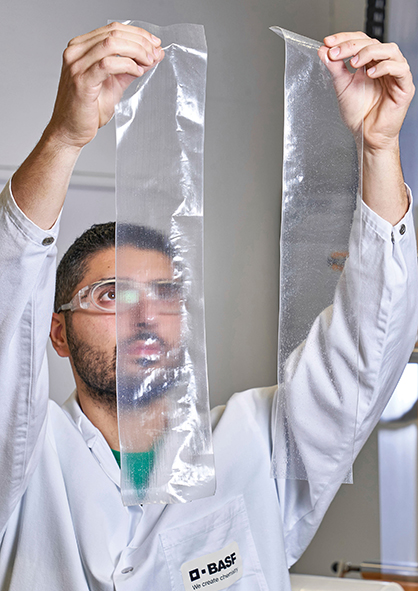

Burak Karadeniz, Lab technician at the Application Centre for BASF Plastic Additives in Kaisten, is comparing the optical properties of recycled film with and without a stabilizer package.  © 2022 BASF
Burak Karadeniz, Lab technician at the Application Centre for BASF Plastic Additives in Kaisten, is comparing the optical properties of recycled film with and without a stabilizer package. © 2022 BASF


More News from TEXDATA International

#Texprocess 2026

Texprocess 2026: Automation, digitalisation and AI redefine textile processing

Making investment decisions in textile processing has become significantly more demanding. Increasing energy costs, a shortage of skilled labour and ongoing geopolitical uncertainties are compelling companies to focus on technologies that deliver clear gains in efficiency and process reliability. This applies equally to apparel manufacturing and to the processing of technical textiles and high-performance materials. As a result, modernisation initiatives are assessed more carefully – even as the need to upgrade production systems continues to intensify.

#Techtextil 2026

Techtextil 2026: Between innovation pressure & market reality

From 21 to 24 April 2026, Techtextil in Frankfurt am Main will once again become the central meeting point for the international technical textiles and nonwovens industry. Running in parallel, Texprocess will focus on the industrial implementation of textile processing technologies as the leading platform in this field. Together, the two trade fairs form a closely integrated presentation and working platform along the entire textile value chain – from material development to finished applications.

#Techtextil 2026

Between geopolitical pressure and industrial resilience

In this interview, Dr. Janpeter Horn (VDMA) discusses the current challenges facing textile machinery manufacturers, shaped by geopolitical tensions, regulatory developments and subdued investment. He also outlines why innovation strength, integrated solutions and strategic positioning remain key to global competitiveness.

#Texprocess 2026

Between investment restraint and modernization pressure

Texprocess 2026 takes place in a complex market environment shaped by uncertainty and innovation pressure. In this interview, Elgar Straub (VDMA) explains why the trade fair is particularly relevant this year and which technologies are driving efficiency and competitiveness.

More News on Recycling / Circular Economy

#Recycling / Circular Economy

Efficient recycling of textile PET

At the upcoming Plastics Recycling Show Europe in Amsterdam on May 5–6, BB Engineering will present its portfolio of PET recycling technologies. The German machinery manufacturer will once again focus on textile recycling and melt filtration.

#Recycled Fibers

Circulose and CTA announce collaboration to enable lyocell fibers using CIRCULOSE® pulp

Circulose has announced an agreement with China Textile Academy Green Fibre (CTA) to offer lyocell fibers produced using CIRCULOSE® pulp. Producing lyocell from recycled pulp at commercial scale is an important step in making textile-to-textile recycled materials available across a wider range of textile applications.

#Recycling / Circular Economy

Solving the Feedstock Gap: Unlocking Post-consumer Feedstocks for Textile-to-Textile Recycling in Europe

Fashion for Good launches Project FAE (Feedstock Activation Europe) to develop the sorting and pre-processing infrastructure needed to channel non-rewearable post-consumer textiles into textile-to-textile (T2T) recycling at scale. The project is a practical response to one of the most pressing problems in textile circularity: making post-consumer waste a viable, commercially competitive raw material for recyclers.

#Techtextil 2026

BASF at Techtextil 2026: Helping to shape the future of the textile industry with tangible solutions

At the leading international trade fair for technical textiles and nonwovens from April 21 to 24, 2026 at the Messe Frankfurt, BASF will present numerous solutions and new projects in the textile sector to customers and partners at booth B 68 in hall 11.0. The focus is on product innovations and future-oriented technologies.

Latest News

#Associations

BTMA backs global growth while investing in future UK leaders

As one of a number of new initiatives launched this year, the British Textile Machinery Association (BTMA) is launching the UK-India Textile Machinery Coalition. The UK-India Free Trade Agreement, signed in July 2025, has implications that extend across sourcing, competitiveness and long-term trade dynamics, believes BTMA CEO Jason Kent.

#Raw Materials

China projected to increase cotton production, yields, and imports in 2026/27

World cotton production in the 2026/27 season is projected at 25.9 million tonnes, exceeding global consumption of 25.2 million tonnes, according to the May 2026 issue of Cotton This Month. That means both production and consumption are expected to remain close to current season levels, while global cotton trade is projected to decline by 2.7% to approximately 9.6-9.7 million tonnes.

#Raw Materials

ICAC launches Carbon Credits Initiative to deliver new income streams to cotton farmers

The International Cotton Advisory Committee (ICAC) has announced a new initiative designed to unlock additional income streams for cotton farmers through participation in carbon credit markets, linking sustainable production practices directly to financial returns.

#Sustainability

Number of GOTS-certified facilities grow 15% globally as demand for credible sustainability standards continues to strengthen

Global Organic Textile Standard (GOTS) certification continued to grow in 2025, with nearly 18,000 certified facilities worldwide, despite ongoing geopolitical uncertainty and rapidly evolving regulatory requirements across global textile supply chains.

TOP