[pageLogInLogOut]

#Recycling / Circular Economy

No more excuses: EU Commissioner Frans Timmermans stresses that effective recycling of high-tech plastics is possible
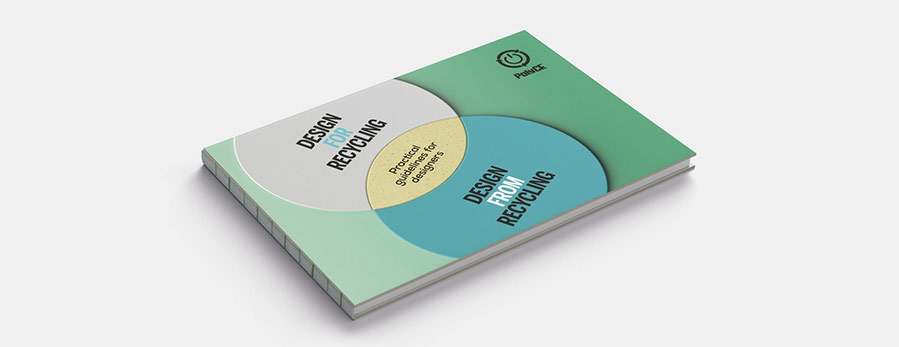
© 2021 Fraunhofer Institute for Reliability and Microintegration IZM
Almost 200 international participants joined the virtual workshop "Circular product development – the secrets to design for and from recycling" on April 15, 2021, which took place within the framework of the EU project PolyCE. The experts from the PolyCE consortium presented their experiences and findings on the holistic circular economy for high-tech plastics as well as best-practice strategies developed in line with the motto "Design for Recycling and Design from Recycling".

An additional highlight was the appearance of Frans Timmermans, Commissioner for Climate Action and Vice President of the EU Commission, who is responsible for the Green Deal. He was given recommendations for action for effective plastics recycling.

In 2017, PolyCE (Post-Consumer High-tech Recycled Polymers for a Circular Economy) started with the common goal of the 20 project partners* to activate a shift towards a circular economy for plastics. The aim is to use high-tech plastics that are already in use, such as those found in cell phones, televisions, vacuum cleaners and the like, as a source of raw materials and thus reuse them entirely, with an awareness of the entire value chain. These goals are highly topical for more than just research purposes, as the European Commission also sees the need for a movement towards the circular economy and has adopted a Europe-wide strategy with the help of which ten million tons of recycled plastics are to find their way back onto the market in the form of new products by 2025.
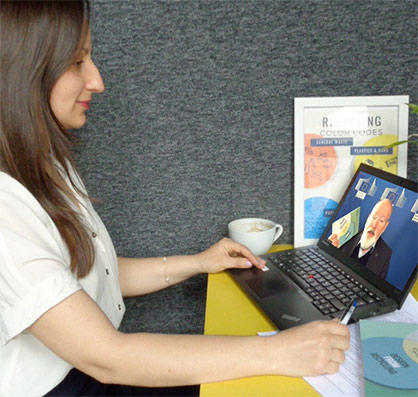
Gergana Dimitrova in conversation with EU Commissioner Frans Timmermans  © 2021 Fraunhofer
Gergana Dimitrova in conversation with EU Commissioner Frans Timmermans © 2021 Fraunhofer


In the current workshop, the focus was primarily on the design of WEEE plastics obtained through mechanical recycling. In keynote speeches, the experts explained the challenges of the last four years, but also showed that recycling of plastics is not a simple task, but it is a solvable one – a clear signal to manufacturers to use recycled plastics more intensively in the future.

It was a special honor that Frans Timmermans, one of the three Executive Vice Presidents of the EU Commission in charge of the Green Deal, participated in the interactive workshop. The project coordinator and environmental expert at Fraunhofer IZM, Gergana Dimitrova, virtually presented him with the guidelines "Design for and Design from Recycling", which were produced during the project and contain, among other things, practical guidelines for designers.

Frans Timmermans: “We need to move towards a circular economy. Wanting to be the first climate neutral continent as Europe is not a goal in itself. It is part of helping humanity understand that we need to live within planetary boundaries.


We also need to ensure that our products respect the highest sustainability standards. We need durable, re-usable, repairable products. Products made of recycled materials and designed for high quality recycling in turn. This is an essential discussion where your project makes such a timely contribution. The book you are launching today is crystal clear about what needs to be done.
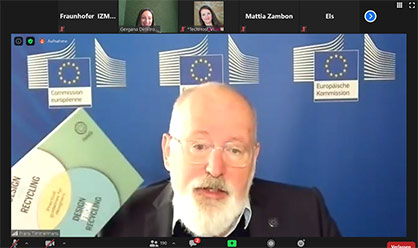
EU Commissioner Frans Timmermans  © 2021 Fraunhofer
EU Commissioner Frans Timmermans © 2021 Fraunhofer


It is clear: only with a circular economy we can reach climate neutrality.”

Continuing into the afternoon, a varied mixture of presentations, case studies and open question rounds allowed different approaches to be presented, showing how a move towards the reuse of recycled plastics can be implemented step by step and what design recommendations need to be taken into account. The guidelines include five categories:

1. the avoidance of hazardous substances

2. easy access to environmentally harmful product components

3. the use of recycled materials

4. the use of recyclable materials

5. the use of material combinations and connections that allow easy access to these materials.


These guidelines are considered the first coordinated guide for the electronics industry. They will help decision-makers in product design and manufacturing, as well decision-makers at the government level, to participate in the development of sustainable products.

The PolyCE consortium consists of: KU Leuven, Ona Product SI, Philips, ECODOM, the European Environmental Bureau (EEB), Ghent University, Imagination Factory, KunststoffWeb, MGG Polymers, PEZY Group, Prolabin & Tefarm, SITRAPLAS GmbH, TECNALIA Research & Innovation, TU Berlin, UL Environment, University of Northampton: Institute of Logistics, Infrastructure, Supply and Transportation, Whirlpool, UNU-VIE SCYCLE and Fraunhofer IZM.
More News from Fraunhofer-Institut für Zuverlässigkeit und Mikrointegration IZM

More News on Recycling / Circular Economy

#Recycled_Fibers

Leading fashion brands step up to unlock the next chapter of Circulose

Since 2024, under new ownership and leadership, Circulose has set a renewed strategic direction focused on securing long-term commitments with partner brands to bring CIRCULOSE® back to market at scale. This strategy has proven successful.

#Recycled_Fibers

Recycling mixed-fibre garments becomes a reality: RadiciGroup, The LYCRA Company and Triumph take circular fashion a step forward

The process, which is both economically and environmentally sustainable, has enabled the production of an underwear set made from 100% recycled nylon and LYCRA® fibre in a closed-loop system.

#Research & Development

How innovations drive BASF’s success

“Innovation has always been part of BASF’s DNA. Especially in these volatile times, it is crucial to leverage our innovative strength to develop competitive solutions that differentiate us as a company in our markets and give us a competitive edge,” said Dr. Stephan Kothrade, Member of the Board of Executive Directors of BASF and Chief Technology Officer, at the company’s Research Press Briefing held today. To achieve this, BASF implemented its “Winning Ways” strategy about a year ago with the clear goal of becoming the preferred chemical company to enable its customers’ green transformation.

#Recycling / Circular Economy

Textiles Recycling Expo announces collaboration with Future Fabrics Expo for 2026

The Textiles Recycling Expo has entered a major new collaboration with the Future Fabrics Expo which means that both events will run alongside each other at the Brussels Expo, Belgium on 24–25 June 2026. This co-location marks a significant step forward for the textile and fashion industries, bringing together two influential and complementary events under one roof.

Latest News

#Associations

Driving innovation in technical textiles, digitalisation and testing

Members of the British Textile Machinery Association (BTMA) can look back on 2025 as a year marked by notable technological advances and continued progress in global trade, despite an uncertain and volatile market.

#Heimtextil 2026

Artificial Intelligence in focus: Heimtextil 2026 prepares global textile industry for the future with strong content programme

Artificial intelligence (AI) rapidly transforms the textile industry - from creation and production to pricing, distribution and communication. But how can AI be applied successfully, and where does it truly add value? Heimtextil addresses these questions from 13 to 16 January 2026: The comprehensive programme dedicated to the key future field AI strengthens the global industry and opens up new business opportunities as well as practical applications for design, retail, industry, architecture, interior design and contract furnishing.

#Weaving

Lindauer Dornier announces leadership transition in weaving machine business

After more than ten successful years at Lindauer DORNIER GmbH, Mr Wolfgang Schöffl will leave the family-owned company at the end of the year to enter well-deserved retirement.

#Heimtextil 2026

Texpertise Focus AI: Messe Frankfurt puts Artificial Intelligence centre stage at its international textile and apparel trade fairs

Under the banner 'Texpertise Focus AI, Messe Frankfurt will place a strong emphasis on Artificial Intelligence (AI) across its international textile and apparel trade fairs from 2026 onwards, setting a future-shaping signal for the industry. The initiative highlights the responsible use of AI along the entire textile value chain, from fibre production to the point of sale. The programme will launch at Heimtextil in Frankfurt in January 2026.

TOP