[pageLogInLogOut]

#Recycling / Circular Economy

Toray develops recycling technology that retains carbon fiber strength and surface quality

- Promoting application development from carbon fiber nonwoven fabrics -

Toray Industries, Inc., announced today that it has developed a recycling technology that can decompose diverse carbon fiber reinforced plastics (CFRP) made from thermosetting resins while retaining the strength and surface quality of those fibers. The company drew on this technology to create a nonwoven fabric employing recycled carbon fibers.


Toray has started providing prototype samples to customers with a view to them developing performance and decorative materials for diverse applications, such as automobiles, construction, electricals and electronics, and daily necessities. The company will push ahead with technical assessments matching customer needs.

CFRP applications include aircraft and wind turbines. Chemical recycling as a reducing agent in steel furnaces is gaining traction for recycling CFRP. Technologies are emerging pyrolyzing waste CFRP at high temperatures to recover and reuse fibers, with the market expanding particularly for injection molding applications. To broaden applications, there is a need for technology that can suppress thermal damage (see note 1) to recycled carbon fibers and control resin residue (note 2) and that can be applied to diverse types of waste CFRP.
© 2025 Toray
© 2025 Toray


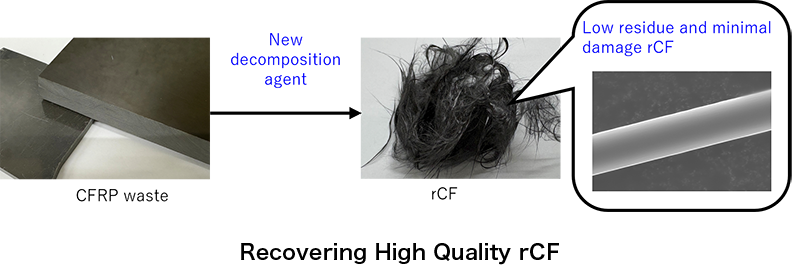
Toray applied its accumulated expertise in organic synthesis and polymer polymerization to innovate a decomposition agent that breaks down degradation-resistant, three-dimensionally crosslinked (note 3) thermosetting resins at lower temperatures than conventional methods. The company used this agent to decompose CFRP waste from aircraft, wind turbines, automobiles, and other sources. The recycled carbon fiber from this process retains over 95% of the single-fiber tensile strength of petroleum-derived virgin carbon fiber. Toray expects carbon dioxide emissions from this technology to be less than half those from manufacturing virgin carbon fiber.

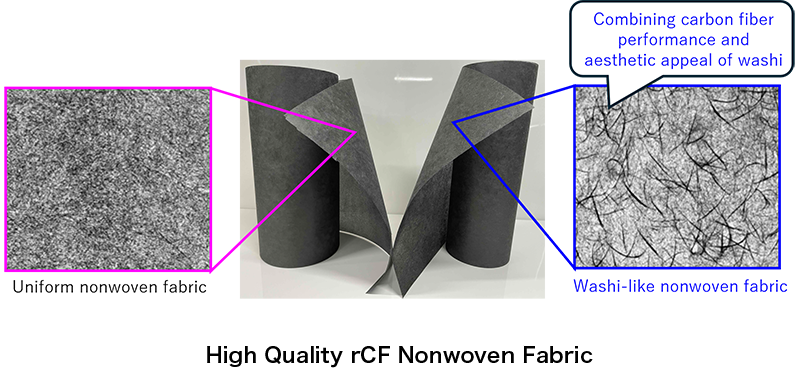
Recycled carbon fiber from this technology is stronger than conventional counterparts and minimizes fiber breakage in post-processing. Its low resin residue and excellent surface quality enables processing for more diverse applications. In particular, efforts to disperse short fibers and process them into sheet-form nonwoven fabrics have led to success. The recycled carbon fibers produced using this technology exhibits controllable water dispersibility, allowing for the fabrication of uniform nonwoven structures as well as those with distinctive texture reminiscent of washi (traditional Japanese paper). This fabric combines the functionality of carbon fiber, including radio frequency shielding and thermal conductivity, with the aesthetic appeal of washi. Toray aims to expand applications for this new material across many industries.
© 2025 Toray
© 2025 Toray


This innovative fabric features in the interior and exterior components of the concept car (vision model) that Mazda Motor Corporation will exhibit at the Japan Mobility Show at Tokyo Big Sight from October 30 through November 9.

Toray developed its recycling technology and carbon fiber nonwoven fabric processing technology as part of a fiscal 2024 through 2025 Ministry of the Environment program to promote establishment of decarbonized and circular economy.

One goal of the Toray Group Sustainability Vision for 2050 is to contribute to “a world where resources are sustainably managed.” The company will continue to progress with R&D to help create a circular society, in line with its corporate philosophy of “contributing to society through the creation of new value with innovative ideas, technologies and products.”


Notes

Thermal damage (degraded physical and chemical properties) occurs when exposing carbon fibers to high temperatures or oxidization during pyrolysis.

Residue refers to undecomposed or partially decomposed resin on carbon fiber surfaces during separation.

Three-dimensional cross-linking results from chemical or physical bonding between polymer chains.


Reference

Japan Mobility Show 2025

Organizer: Japan Automobile Manufacturers Association, Inc.

Dates: October 30 (Thu), through November 9 (Nov), 2025

Venue: Tokyo Big Sight

Website: https://www.japan-mobility-show.com/en/


More News from Toray Engineering Co. Ltd.

#Composites

HEAD launches more sustainable(1) BOOM RAW racquet on Earth Day by using Toray’s bio-circular carbon fibers

HEAD continues to innovate with the launch of the BOOM RAW tennis racquet, an encouraging development in the search for a more sustainable future for racquet sports. All of the carbon fibers are bio-circular carbon fibers in the limited-edition and highly innovative BOOM RAW racquet, which offers the same explosive power - along with the same fun, feel and easy playability - as the regular, in-line BOOM racquet. The bio-circular carbon fibers are manufactured by Toray and its subsidiary Toray Carbon Fibers Europe.

#Recycling / Circular Economy

Companies in Japan initiate demonstration to expand the automotive recycling process

DENSO CORPORATION and other partners have been chosen by an industry-government-academia collaborative project aiming to expand the recycle content for automobile in the fiscal year 2023 supported by Ministry of the Environment, Japan.

#Yarn & Fiber

Toray develops durable reverse osmosis membrane

Toray Industries, Inc., announced today that it has developed a highly durable reverse osmosis (RO) membrane (see glossary note 1). This innovative offering guarantees the long-term provision of high-quality water. It also maintains the superior removal performance of Toray’s existing membranes vital for reusing industrial wastewater and treating sewage.

#Yarn & Fiber

Toray develops revolutionary Ion-Conductive polymer membrane for batteries that could dramatically extend vehicular cruise ranges

Toray Industries, Inc., announced that it has developed an ion-conductive polymer membrane that delivers 10-fold the ion conductivity of predecessors. This new offering could accelerate the deployment of solid-state batteries (see glossary note 1), air batteries (glossary note 2), and other lithium metal batteries, greatly expanding the cruising ranges of electric vehicles, industrial drones, urban air mobility systems, and other transportation modes.

More News on Recycling / Circular Economy

Latest News

#People

Happy Holidays!

Dear reader, the year 2025 is drawing to a close. We are entering what we hope will be a peaceful holiday season, spending time with our families and taking a moment to pause and reflect. We hope we have been able to support you once again this year with relevant news and articles, and we look forward to surprising you with many innovations in the coming year. Enjoy the festive season, stay healthy, and we wish you a happy and joyful holiday season.

#Weaving

Lindauer Dornier announces leadership transition in weaving machine business

After more than ten successful years at Lindauer DORNIER GmbH, Mr Wolfgang Schöffl will leave the family-owned company at the end of the year to enter well-deserved retirement.

#Heimtextil 2026

Texpertise Focus AI: Messe Frankfurt puts Artificial Intelligence centre stage at its international textile and apparel trade fairs

Under the banner 'Texpertise Focus AI, Messe Frankfurt will place a strong emphasis on Artificial Intelligence (AI) across its international textile and apparel trade fairs from 2026 onwards, setting a future-shaping signal for the industry. The initiative highlights the responsible use of AI along the entire textile value chain, from fibre production to the point of sale. The programme will launch at Heimtextil in Frankfurt in January 2026.

#Technical Textiles

Autoneum and Polestar set new benchmarks for passenger experience and sustainability

As the global market leader in sustainable acoustic and thermal management, Autoneum is a key supplier of interior and exterior components for the highly anticipated Polestar 5 model. The successful collaboration between Autoneum and Polestar marks a significant milestone in sustainable automotive engineering: the electric grand tourer sports car features several innovations in lightweight, fully recyclable polyester-based components that ensure a superior driving experience. Polestar 5 was revealed at the IAA Mobility 2025 in Munich and is available in 24 markets.

TOP