[pageLogInLogOut]

#Recycling / Circular Economy

Industry heavyweights join Samsara Eco to accelerate its enzymatic recycling technology
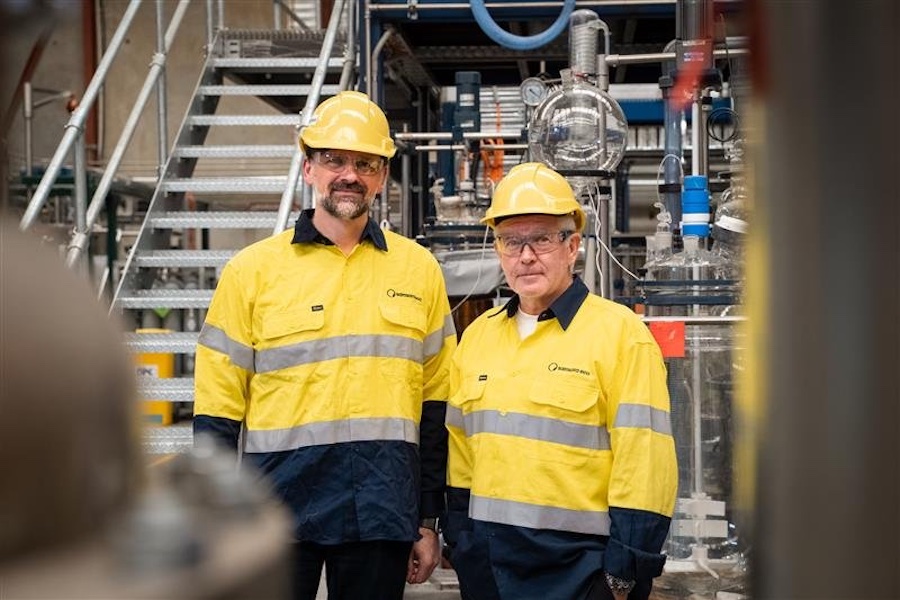
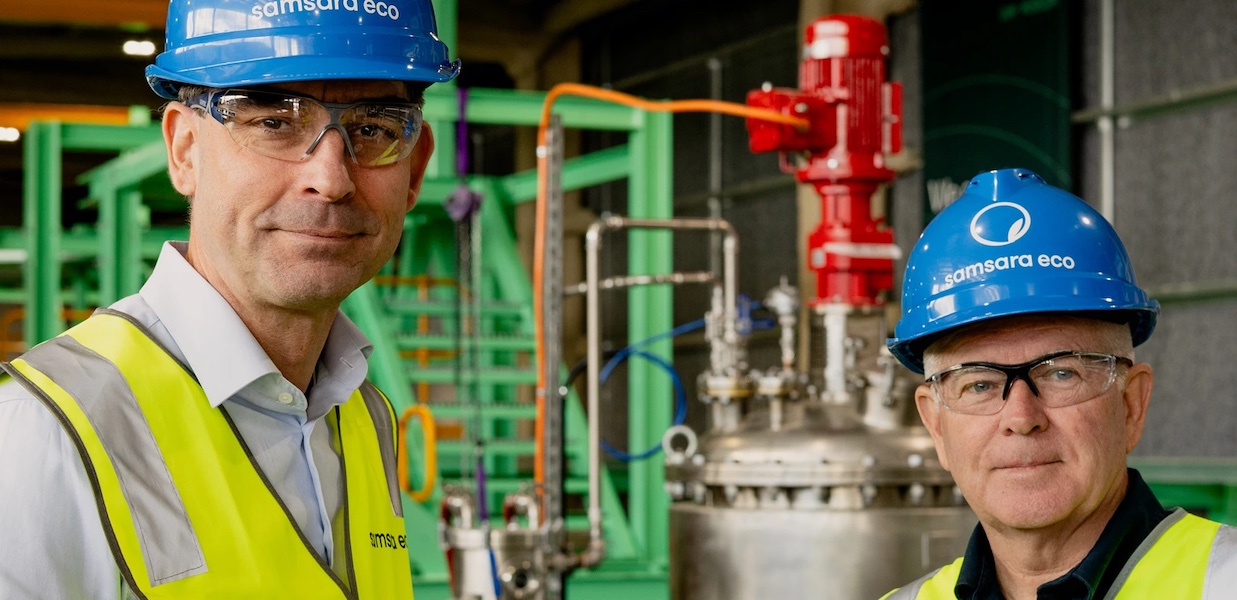
Australian biotech innovator, Samsara Eco, has expanded its global leadership team with the appointment of material science and engineering veterans, Brock Thomas as Chief Innovation Officer and Isaac Iverson as Executive Director of Product. Thomas and Iverson bring decades of experience working within the polymer space in the US and will lead the scaling of the company’s enzymatic recycling technology and first-of-a-kind facilities.
Brock Thomas, CIO and Paul Riley, Founder and CEO, Samsara Eco © 2025 Samsara Eco


Chief Innovation Officer and Executive Director of Product appointed to drive forward commercialisation and first-of-a-kind facilities 

Thomas joins from global speciality materials company, Eastman, where he spent almost 15 years. During his time at Eastman, he worked with tire additives, speciality copolyesters, and led the Polyester Renewal Technology platform He was most recently the Director of Plastics and Circular Development where he provided technology support to build the company’s polyester depolymerisation facility and led cross-functional teams to improve and scale production across the copolyester stream.

Iverson joins with an extensive background in nylon. He spent 15 years at INVISTA in a number of research and development and commercial roles, building out the company’s nylon product offering across various industries. 

On the appointments, Paul Riley, CEO and Founder of Samsara Eco said, “We’re at a pivot point in our scale-up journey. We need the best minds with both deep technical knowledge and commercial acumen to lead us forward. Thomas’ proven track record in scaling lab operations, building and starting up pilot facilities, and providing technology support to commercial depolymerisation plants will be vital as we continue to refine our technology processes, build new facilities and scale operations in the coming years.” 

"Likewise, Iverson’s unique blend of technical and commercial expertise and extensive global network will be invaluable as we continue to build out our offerings and work with customers and partners to meet their circularity goals.” 

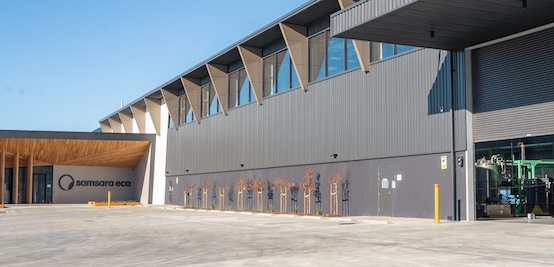
The company’s new plant in Jerrabomberra, New South Wales is set to open mid-year and will become the home base for Samsara Eco as it scales up production and furthers develops its suite of AI-crafted enzymes. Its first-of-a-kind nylon 6,6 enzymatic recycling plant is also planned to be operational by 2027. Thomas and Iverson will play an important role in both developments. More broadly, they will focus on accelerating innovation, enhancing Samsara’s enzymatic recycling process and supporting commercial growth. 

On joining Samsara Eco Brock Thomas, Chief Innovation Officer said, “Enzymatic recycling has the potential to redefine circularity. Recycling is no longer limited by material composition but opens a range of possibilities to keep more plastics in circulation, without emitting additional carbon in the process. The science, technical and operations teams at Samsara Eco are second to none, and I look forward to working closely with them as we scale operations and push the boundaries of innovation to help transform the future of sustainable materials.” 

Isaac Iverson, Executive Director of Product, also commented, “I’m proud to join Samsara Eco and help achieve its ambitions to make plastics truly circular. The company has already made great strides in four short years, working with brands to bring enzymatically recycled materials to market. I’m looking forward to further opening new pathways to market and unlocking the potential of enzymes to infinitely recycle plastics.” 

Since launching in 2021, Samsara Eco has led world-first discoveries in enzymatic recycling, pioneering the ability to recycle mixed plastics and fibres including nylon 6,6, nylon 6 and polyester to keep plastics and textiles in circulation and out of landfill. In 2024, it created the world’s first enzymatically recycled nylon 6,6 garment with lululemon, the Swiftly top, and also launched a jacket range made from its enzymatically recycled polyester. 

Thomas and Iverson will divide their time between Australia and the United States.


More News from Samsara Eco

#Recycled_Fibers

Samsara Eco and European Outdoor Group launch the Nylon Materials Collective

Australian biotech, Samsara Eco and the European Outdoor Group (EOG) today launched the Nylon Materials Collective, a collaboration designed to make high-performance, virgin-identical recycled nylon accessible to more outdoor brands and accelerate the industry’s shift toward a truly circular textiles future.

#Recycling / Circular Economy

Samsara Eco appoints first General Manager of Asia to lead expansion

Samsara Eco has announced the appointment of Dr Lars Kissau as its first General Manager of Asia. Based in Singapore, Kissau will lead the company's expansion across Asia as it scales operations and sprints towards the opening of the company's first commercial nylon 6,6 facility in 2028.

#Recycling / Circular Economy

Samsara Eco opens first plant to scale circular plastics

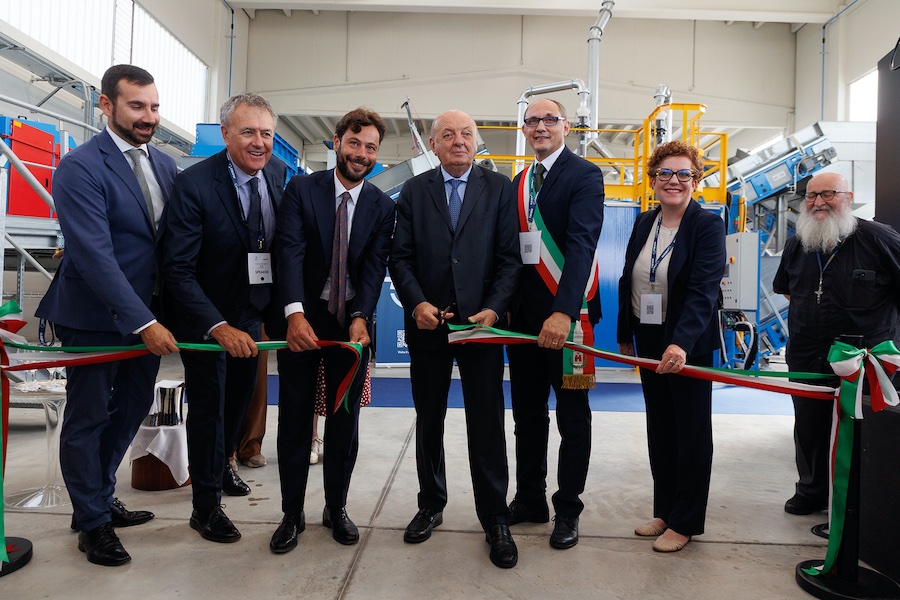
Australian biotech innovator, Samsara Eco, has today opened its first plant, representing a significant milestone in the fight against plastic waste. The new plant will exponentially increase the company’s ability to produce virgin-identical, low-carbon circular materials like recycled nylon 6,6 and polyester with broad applications across apparel, packaging and automotives, at scale.

#Recycling / Circular Economy

KBR selected as key commercialization partner for Samsara Eco’s first-of-a-kind enzymatic recycling plant

KBR (NYSE: KBR) announced today it will support biotech innovator, Samsara Eco, to design its first-of-a-kind plastics and textile enzymatic recycling plant, due for completion in early 2028.

More News on Recycling / Circular Economy

#Recycling / Circular Economy

AI Circular Economy Conference 2026 fuels innovation at the intersection of AI and Circular Economy

The AI Circular Economy Conference 2026, organised by nova-Institute, brought together 116 participants from 15 countries in Cologne and online to explore the transformation of the chemical and materials industry supported and accelerated by artificial intelligence. During the two-day event, leading experts from industry, research, start-ups and the investment community discussed how AI can maximise the potential of renewable carbon creating efficient circular value chains. The conference featured 24 presentations and multiple panel discussions, highlighting the growing convergence of digital technologies and circular material systems. It demonstrated how artificial intelligence is progressing from the experimental stage to real industrial implementation within the circular economy.

#Recycled_Fibers

Circ deepens access to recycled fibers with Xinxiang Bailu Chemical Fiber Co., Ltd. partnership agreement

Circ®, a global leader in textile‑to‑textile recycling, today announced a new partnership agreement with Xinxiang Bailu Chemical Fiber Co., a Canopy Dark Green Shirt producer and one of the world’s leading producers of viscose filament. The agreement marks a significant step in Circ’s continued expansion in China and strengthens its position within the country’s rapidly evolving circular textile ecosystem; further supporting Circ’s ability to supply recycled fibers near existing fashion supply chains.

#Recycled_Fibers

Worn Again Technologies unveils the Accelerator

Worn Again Technologies unveils the Accelerator, the next major step towards commercialising its pioneering Textile-to-Fibre recycling process and proving the technical and economic feasibility of polycotton recycling.

#Recycling / Circular Economy

Textile‑to‑textile recycling leader Circulose joins Spinnova’s ecosystem to accelerate technology scale‑up

Textile‑to‑textile recycling leader Circulose joins Spinnova’s ecosystem (consortium) to help advance the scale‑up of Spinnova’s technology. Spinnova has actively sought partners to accelerate commercial scale‑up, and Circulose, as a key player in textile recycling, strengthens the ecosystem by providing a raw material that is in high demand across the industry.

Latest News

#Techtextil 2026

Gebr. Otto highlights versatility at Techtextil with regional supply chains, yarn innovations and new hygiene segment

At this year’s Techtextil, Gebr. Otto places its versatility at the center of its presentation. In addition to spinning, twisting and dyeing – traditionally focused on fine cotton – textile processors will also find a competent development partner for technical specialty solutions. The Dietenheim-based spinning mill has now built up a decade of experience in the production of technical yarns, particularly from aramids. A new hygiene segment has also been established, where yarns for medical and hygiene products are currently being produced. In the future, this department could also develop textile products for the food sector. Gebr. Otto will once again be present at the BW-i joint stand, booth D81, hall 12.1. What is wound onto the spool is determined by the customer: Gebr. Otto develops according to specific customer requirements and transforms its own ideas into yarn innovations.

#Europe

Commission presents proposal for EU Inc. - unlocking the full potential of the Single Market for Europe's entrepreneurs

Today, the European Commission presented its proposal for EU Inc., a new single set of corporate rules, building the cornerstone and starting point for the EU's 28th regime. EU Inc. is an optional, digital-by-default European corporate framework. It will make it easier for businesses to start, operate and grow across the EU – incentivising them to stay in Europe, and encourage those who once looked elsewhere to return.

#Man-Made Fibers

OnceMore® from Södra brings end-to-end traceability for circular Man-made Cellulosic Fibers (MMCF) using TextileGenesis

OnceMore® from Södra, the world’s first large-scale process for recycling blended fabrics into high‐quality dissolving pulp, will begin using TextileGenesis, a Lectra company, to strengthen traceability from raw material to retail across the value chain. OnceMore® produces dissolving pulp made from blended textile waste and wood sourced from responsibly managed Swedish forests. By integrating TextileGenesis, OnceMore® supports the growing need for verified data and secure, transparent tracking throughout increasingly complex supply chain.

#Sustainability

Experts publish APAC policy priorities

Cascale today announced the publication of its APAC Policy Priorities Paper, developed by the Asia-Pacific (APAC) Policy Member Expert Team (MET) to identify key regional sustainability challenges and provide practical, aligned recommendations for policymakers and industry stakeholders across Asia-Pacific.

TOP