[pageLogInLogOut]

#Recycling / Circular Economy

PUMA and RE&UP announce a multi-year collaboration to scale circular textile solution

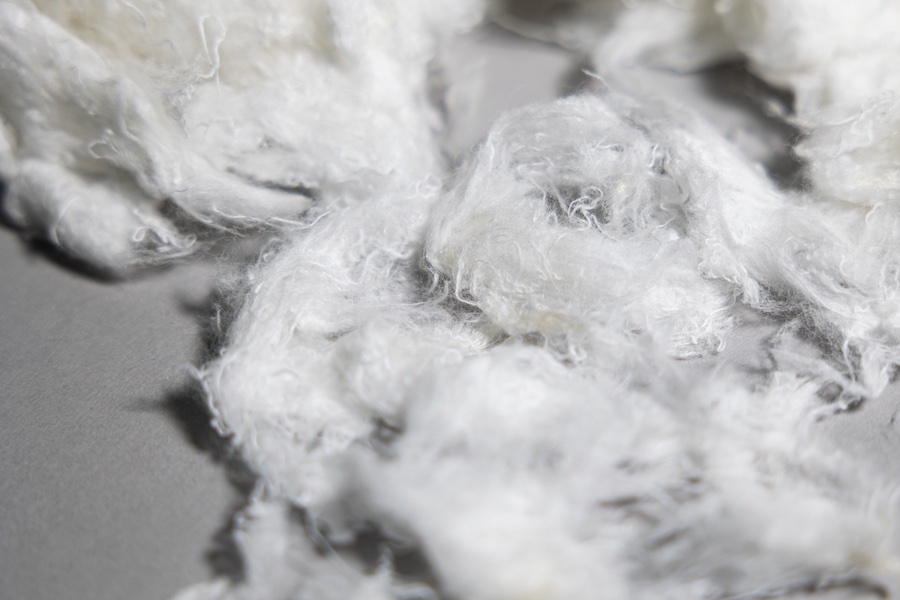
Sports company PUMA and RE&UP Recycling Technologies have signed a Letter of Intent (LoI) to scale a fully circular textile solution, transforming textile waste into RE&UP’s Next-Gen Recycled Cotton Fibers and Recycled Polyester Chips. Circularity is one of the focus areas of PUMA’s Vision 2030 sustainability goals and the company has already scaled up its RE:FIBRE textile-to-textile recycling program, producing millions of football jerseys made out of an increasing share of recycled textiles.

RE&UP has become a key Next-Gen raw material partner in the RE:FIBRE program supporting PUMA’s ambition to reduce reliance on bottle-recycled polyester, enhancing true circularity while minimizing textile waste. Due to its previous success, this collaboration has now evolved into a broader global commitment to fully enabling circularity.

As part of the expansion, PUMA will introduce RE:FIBRE to the Americas, leveraging RE&UP’s recycled raw materials within its local supply chain. Both companies have a long-term commitment to scaling sustainable solutions in the textile industry. By 2030, PUMA aims to use 30% fiber-to-fiber recycled polyester fabric for its apparel products. RE&UP’s revolutionary recycling technology is a key enabler of the circular transition of the industry, especially due to its unique capability to process diverse textile feedstocks, including post-consumer and post-industrial waste, as well as complex blended textiles like polycotton and polyester-elastane-materials, traditionally difficult to recycle.

Powered with 100% renewable energy and leveraging advanced technologies such as decolorization processes, RE&UP sets a new benchmark for sustainable, low-impact recycled textile fibers. “As part of our Vision 2030 goals, we want to have 30% of our polyester fabric in apparel fiber-to-fiber recycled by 2030 and our collaboration with RE&UP opens exciting possibilities for integrating virgin-equivalent recycled materials into our products,” said Howard Williams, Director Global Innovation Apparel & Accessories at PUMA. “These materials offer the performance we need while helping us achieve our circularity goals.”

“We are proud to elevate our collaboration with PUMA to the next level, building on our existing work through PUMA’s RE:FIBRE program,” said Özgür Atsan, Chief Commercial Officer at RE&UP.

“PUMA, as one of the most forward-thinking brands in the industry, shares our vision for closing the recycled material gap. The proven quality of our products, our ability to process diverse textile compositions, our annual capacity of 80,000 tons, and our commitment to renewable energy reinforces our mission to produce Next-Gen materials and establish circularity as the standard for the textile industry. We proudly define our products as Next-Gen materials, as they are designed to meet the needs of the next generation in the textile industry.”
More News from RE&UP

#Recycling / Circular Economy

RE&UP contributes to Global Fashion Summit 2026 circularity discussion

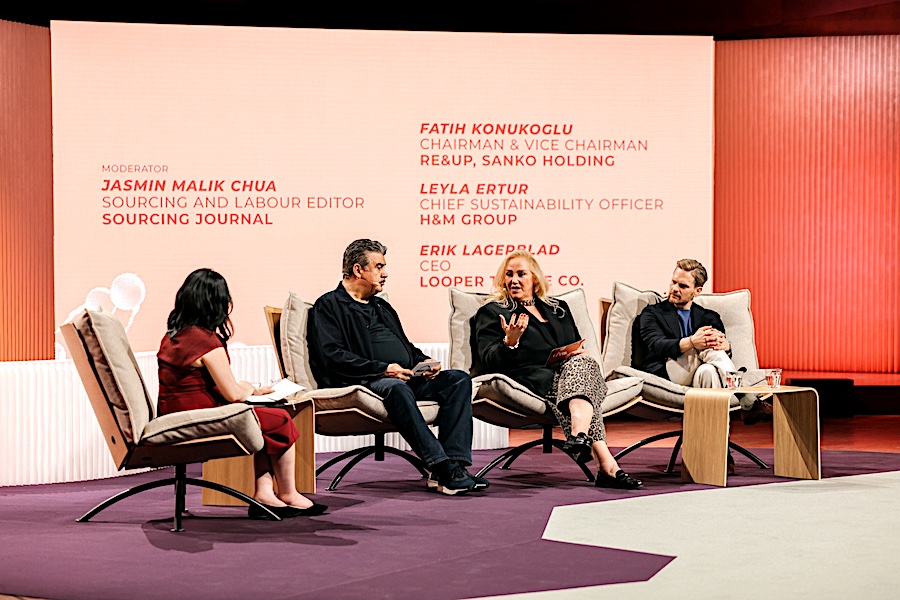
RE&UP contributed to the global conversation on textile circularity at Global Fashion Summit 2026 in Copenhagen, where Fatih Konukoğlu, Chairman of RE&UP and Vice Chairman of Sanko Holding, took part in both the keynote session “The New Rules” and the panel discussion “A Reckoning and Renewal for Circular Horizons”, alongside leaders from H&M Group, Looper Textile Co. and Sourcing Journal.

#Techtextil 2026

RE&UP to showcase Next-Gen circularity in ISKO Pro workwear at Techtextil

RE&UP takes part in Techtextil 2026, where the team will be present at the ISKO Pro booth (Hall 9, Booth D31). Together, RE&UP and ISKO Pro are demonstrating how textile-to-textile solutions meet the non-negotiable specifications of the workwear sector.

#Recycled Fibers

RE&UP partners with Madewell and ISKO on textile-to-textile denim capsule

RE&UP Recycling Technologies is accelerating the shift toward a closed-loop textile economy through a collaboration with American denim brand Madewell and global fabric manufacturer ISKO. By transforming approximately 20,000 pairs of post-consumer jeans into recycled feedstock for a textile-to-textile denim capsule, RE&UP demonstrates the commercial viability of circular systems in the denim sector.

#Recycling / Circular Economy

RE&UP debuts at Ecomondo 2025 to showcase circular fashion innovation

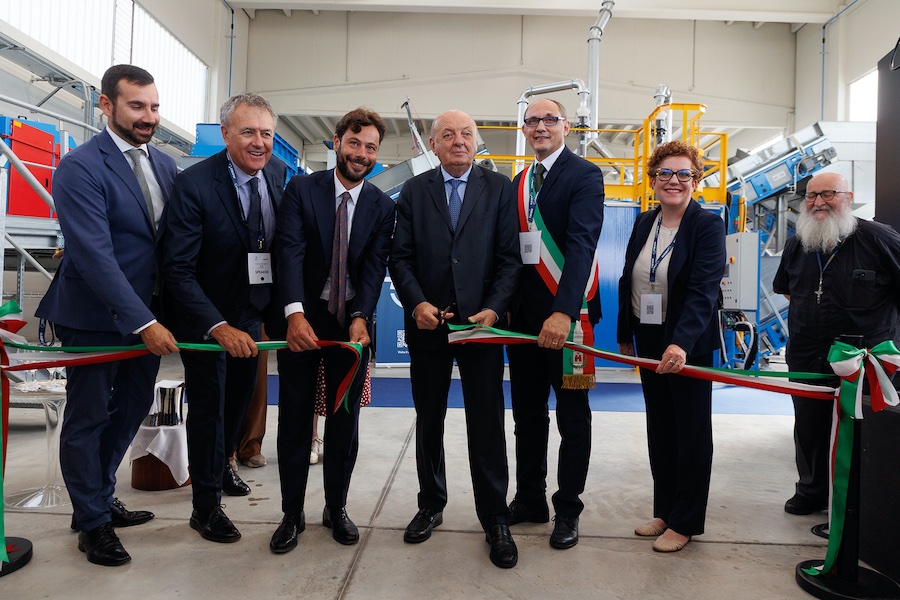
RE&UP makes its first appearance at Ecomondo – The Green Technology Expo, Europe’s leading event for ecological transition and circular economy. Specializing in textile-to-textile recycling, RE&UP transforms end-of-life fabrics into Next-Gen recycled cotton fibers and polyester chips, giving new life to materials that would otherwise go to waste.

More News on Recycling / Circular Economy

#ITM 2026

BB Engineering unveils new, patented “Val-uePack” spin pack at ITM

At the upcoming ITM in Istanbul, taking place June 9–13 at the Tüyap Fair Convention and Congress Center in Hall 7, Booth 702B, BB Engineering will once again be represented at a joint booth with its parent company, Barmag, and its representative, Tekstil Servis. The German machine manufacturer will show-case its expertise in man-made fiber and recycling technology, presenting its entire product portfolio, which includes compo-nents such as extruders and filters, as well as complete sys-tems for spinning synthetic fibers, air-texturing, and PET recy-cling.

#Recycled Fibers

Syre expands partnership with Target to advance next-generation recycled materials at scale

Advancing next-generation materials to support scalable circular solutions across global retail Stockholm, May 2026 — Syre, the textile impact company hyperscaling textile-to-textile recycling today announced an expanded collaboration with Target to accelerate the adoption of next-generation recycled materials across retail at scale.

#Recycling / Circular Economy

Project REWEAR investigates diverse economies of rewear as a global practice of circularity

Every year, European households discard millions of tonnes of clothing. Around a quarter of what gets separately collected is exported, much of it classified as rewearable. A significant share ends up in markets like Kantamanto in Accra, Ghana, where an estimated 15 million garments arrive every week. New research published today reveals what happens when that clothing arrives.

#Recycling / Circular Economy

Europe’s textile future at a turning point: New 2030 Circularity Blueprint aims to scale recycling and unlock investment opportunities

The EU textile system is at a critical crossroads. Today, less than 1% of discarded garments are recycled into new garments, despite EU-wide obligations for separate collection. In response, Global Fashion Agenda (GFA) is launching the 2030 Circularity Blueprint, in partnership with ReHubs. This ambitious initiative is designed to support the transformation of the EU textile ecosystem to advance textile-to-textile recycling and drive the transition to a circular economy.

Latest News

#INDEX 2026

“We clearly see that reliability, flexibility, service and total cost of ownership are becoming increasingly important again.”

The nonwovens industry continues to face a challenging market environment. Nevertheless, AUTEFA Solutions reports successful projects, new line sales and growing demand for energy-efficient and flexible solutions. In this interview, André Imhof of AUTEFA Solutions talks about competitiveness against Chinese suppliers, new service and recycling concepts, the growing importance of application development and the opportunities created by countercyclical investments.

#INDEX 2026

“Needle punching technology is more universal and sustainable than ever!”

Needle punching technology was long regarded as a rather traditional and comparatively slow technology within the nonwovens industry. In this interview, Johann Philipp Dilo explains why needle punching is more relevant than ever today – ranging from energy efficiency and resource conservation to hygiene applications, new machine concepts and design-oriented nonwoven solutions.

#Research & Development

Textile climate control system in workwear – exhibition at the 2026 SME Innovation Day!

Conventional protective workwear often reaches its limits during strenuous physical activity. In particular, the transport of sweat and excess body heat poses a problem. The German Institutes of Textile and Fiber Research (DITF) conducted research on flow-optimized, air-conducting textile structures that enable targeted climate control directly on the body. These structures can be integrated straight into protective work garments. The textile climate control system supports the body’s natural thermoregulation. This contributes to improved workplace safety and comfort.

#Nonwovens

PET spunbond from China – EDANA welcomes imposition of provisional anti-dumping measures

On 13 May 2026, after eight months of investigation, the European Commission imposed provisional anti-dumping duties of 45.6-50.0% on imports of PET spunbond from China. EDANA welcomes this expression of the Commission’s clear determination to protect EU industries from the unfair trade practices of Chinese producers.

TOP