[pageLogInLogOut]

#Recycling / Circular Economy

Toray and Honda start jointly validating chemical Nylon 6 recycling for automotive applications

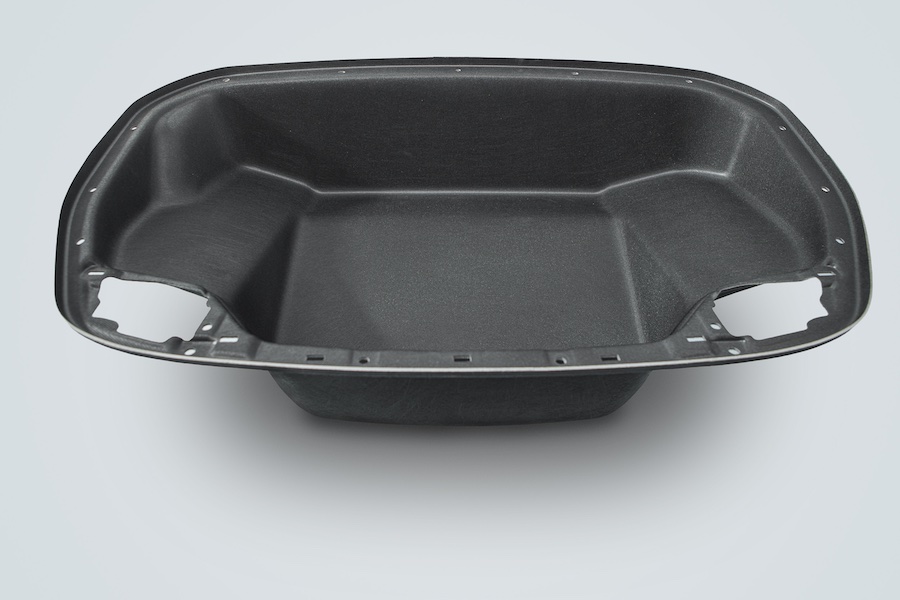
Toray Industries, Inc., announced today it signed an agreement with Honda Motor Co., Ltd., to jointly develop a chemical recycling technology for glass-fiber reinforced nylon 6 parts recovered from end-of-life vehicles. The two have begun verifying this technology, which entails depolymerizing with subcritical water (see note) and regenerating the materials as caprolactam, a raw monomer.

The two companies focused on such subcritical water characteristics  as its high permeability, dissolving power , and hydrolysis effect in resins in developing a technology that successfully depolymerizes nylon 6 with that water. Subcritical water is water at high temperatures and pressures. It is free of catalysts, additives do not affect it, and it can depolymerize nylon 6 in several dozen minutes to create high yields of raw monomer. Separating, refining, and repolymerizing that monomer makes it possible to regenerate nylon 6 that performs like a virgin material.

The Ministry of the Environment adopted this technology for a fiscal 2023 project to establish a decarbonized circular economy system, including to validate recycling systems for plastics and other resources. Toray and Honda look to employ that project to set up a pilot facility with a processing capacity of 500 metric tons annually of raw resin, conducting validation testing with it.

The first step with this work is to recycle used automotive plastic parts into the same automotive materials. The two companies will develop depolymerization and monomer separation and refining technologies by employing intake manifolds as raw materials for engine intake system parts. They seek to apply these technologies for recycling chemicals in automotive resin parts by around 2027.


Down the track, they look to broaden the scope of their chemical recycling technology to encompass apparel, films, and other non-automotive applications. They also envisage inviting other companies to take part in their effort and a set up a chemical recycling scheme for nylon 6 in Japan. This endeavor would help realization a circular economy and cut greenhouse gas emissions.

One goal of the Toray Group Sustainability Vision for 2050 is to contribute to a world in in resources are sustainably managed. Toray will keep pursuing research and development to contribute to a sustainable, circular economy and thereby realize its corporate philosophy of contributing to social progress by delivering new value while attaining sustainable growth.



More News from Toray Industries, Inc.

More News on Recycling / Circular Economy

#Research & Development

How innovations drive BASF’s success

“Innovation has always been part of BASF’s DNA. Especially in these volatile times, it is crucial to leverage our innovative strength to develop competitive solutions that differentiate us as a company in our markets and give us a competitive edge,” said Dr. Stephan Kothrade, Member of the Board of Executive Directors of BASF and Chief Technology Officer, at the company’s Research Press Briefing held today. To achieve this, BASF implemented its “Winning Ways” strategy about a year ago with the clear goal of becoming the preferred chemical company to enable its customers’ green transformation.

#Recycling / Circular Economy

Textiles Recycling Expo announces collaboration with Future Fabrics Expo for 2026

The Textiles Recycling Expo has entered a major new collaboration with the Future Fabrics Expo which means that both events will run alongside each other at the Brussels Expo, Belgium on 24–25 June 2026. This co-location marks a significant step forward for the textile and fashion industries, bringing together two influential and complementary events under one roof.

#Recycling / Circular Economy

Between 121 and 142 million people are employed in the circular economy globally, new study finds

Between 121 and 142 million people worldwide are employed in sectors that contribute to the circular economy, such as repair, recycling, second-hand trade and waste management. This represents roughly between 5 and 5.8 percent of total global employment (excluding agriculture), according to a new joint report by Circle Economy, the International Labour Organization (ILO) and the World Bank Group, in partnership with the UN Partnership for Action on Green Economy (UN-PAGE).

Latest News

#Spinning

First PA66 spinning plant with EvoQuench successfully commissioned

With the successful commissioning of a multi-digit PA66 spinning line for microfiber yarns, Chinese textile company Shandong Nanshan Fashion Technology Co., Ltd. has added yarn production to its textile value chain.

#Knitting & Hosiery

SHIMA SEIKI returns to ShanghaiTex

Leading flat knitting solutions provider SHIMA SEIKI MFG., LTD. of Wakayama, Japan, together with its Hong Kong and Chinese market subsidiary SHIMA SEIKI (HONG KONG) LTD., will exhibit at the ShanghaiTex 2025 exhibition (Booth No.: Hall N3, Booth A20) held in Shanghai, China this month. This marks the return of SHIMA SEIKI to ShanghaiTex after a 14-year hiatus, its last exhibit at the show having been in 2011.

#Research & Development

Fraunhofer CCPE presents the “Monomaterial Design Set” – Innovative solutions for circular product design

Composite materials made from different types of plastic often extend the lifetime of products but make recycling more difficult in the circular economy. That is why Fraunhofer CCPE has developed the “Monomaterial Design Set”. This new approach helps to reduce the variety of plastics used in durable products and offers circular solutions for designers and product developers.

#Man-Made Fibers

arena introduces renewable LYCRA® EcoMade fiber in its latest swimwear collection

Italian swimwear specialist arena has unveiled a new collection that brings sustainability and performance even closer together. Launched on December 4, the line features swimsuits made from recycled nylon and renewable LYCRA® EcoMade fiber — the first time the bio-based spandex has been used commercially in swimwear.

TOP