[pageLogInLogOut]

#Nonwovens / Technical Textiles

BMW M Visionary Materials Seat wins 2024 Altair Enlighten Award in the Sustainable Process category
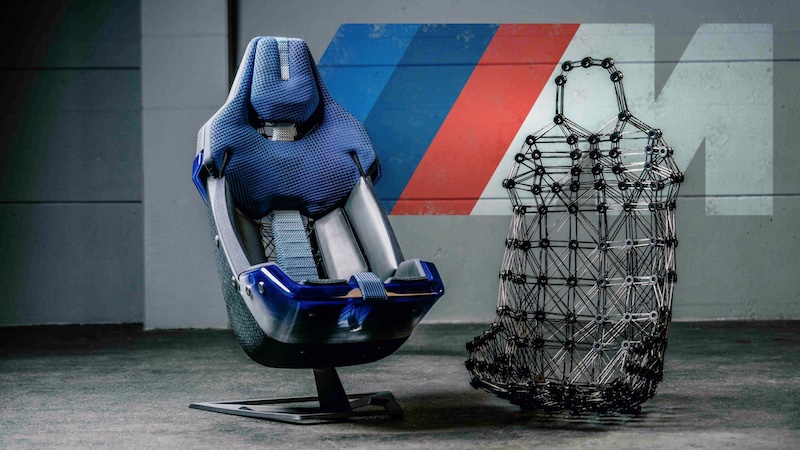
At an award ceremony at the 2024 Center for Automotive Research Seminar, Altair presented the BMW Group with this year’s prestigious Enlighten Award in the Sustainable Process category, celebrating the premium manufacturer’s progress in innovation. The annual award recognizes innovative lightweight construction and sustainability solutions across the global automotive industry that reduce carbon emissions, minimize water and energy consumption, and promote materials reuse and recycling.
BMW M Visionary Materials Seat  © 2024 BMW
BMW M Visionary Materials Seat © 2024 BMW


The BMW Group received the award for the BMW M Visionary Materials Seat on the grounds that the research project is a precursor of future product development: Standout achievements were the sustainable seat design and the focus on the entire product lifecycle, making it one of the most innovative and visionary sustainable developments in the global automotive sector.

In addition to BMW M GmbH as the project owner, BMW Group Designworks was responsible for the design, color and material concept of the seat in collaboration with the BMW design team. The project was realized in close cooperation with several partners: Automotive Management Consulting GmbH, Bcomp Ltd, Gradel Lightweight Sàrl and Lasso Ingenieurgesellschaft mbH.

Key themes: design for circularity, lightweight construction and attractive product

As a platform for research on the development of future materials, the award-winning seat focuses on the following key themes: 

First, driving the use of plant-based materials and, as part of design for circularity, raising the share of secondary raw materials and increasing recyclability at the end of the lifecycle.

In addition, the team aimed to develop an attractive product in terms of its appearance, quality, lightweight construction and functionality. The minimalist design leaves the lightweight seat structure visible, highlighting its status as a core component. Intensive lifecycle assessments (LCA) complemented the design at each stage of development.

Falco Hollmann, Innovation Manager Lightweight Design & Sustainability at BMW M GmbH, accepted the award: “We are showing today what will be possible tomorrow with existing technologies and materials in order to take our efforts to reduce emissions and conserve resources to the next level. This is about more than just substituting materials; it is above all about designing for circularity.”

Use of natural materials

The core premise of the project was to make the leap to the future while working within today’s framework. The evaluation of available material classes with a high SQR (secondary raw material quota) showed that natural materials are the ideal complement. For example, the seat features natural fibers, fiber composites, leather alternatives and algae-based polymers.

Carbon footprint reduced by 90 percent

The seat’s CO2e footprint is 90 percent lower than a BMW M carbon bucket seat made today, thanks to the use of ultra-light, robotically-wound fiber composite seat support structures and materials of natural origin as well as the high recycling rate. In addition, lower module complexity and the use of materials grouped by type make it easier to recycle the seat at the end of its lifecycle. The additive manufacturing processes used are also groundbreaking: A new technology made it possible to completely eliminate support structures, chemical post-treatment and finishing from the M BMW Visionary Materials Seat. Other priorities included a flat value creation chain and a minimum of finishing steps to save energy and conserve resources.

Lessons learned for future processes 

“One of our biggest lessons was the balancing, in other words, how to model our process chain to generate missing primary data,” explains Roberto Rossetti, Head of Development Total Vehicle-Lifecycle at the BMW Group. “The data obtained provides new insights, both in terms of today’s negative contributing factors and the design of tomorrow’s processes. This experience provides a solid foundation for continuously improving sustainability and developing innovative solutions for forward-thinking mobility.”
More News from BMW

More News on Nonwovens / Technical Textiles

#ITMA Asia + CITME Singapore 2025

ANDRITZ sets focus on textile recycling and durable nonwoven production technologies at ITMA Asia 2025

International technology Group ANDRITZ will be presenting its innovative nonwovens production and textile solutions at ITMA ASIA + CITME 2025 in Singapore, from October 28 to 31, 2025 (Hall 2, D106). ANDRITZ will showcase its MMCF production plants, textile sorting and recycling, bast fiber processing, needlepunch, airlay, and life-cycle service technologies, with a focus on sustainable solutions. Discover how these innovations can grow your business opportunities and support a greener future.

#ITMA Asia + CITME Singapore 2025

Dilo Group at ITMA ASIA Singapore 2025

At ITMA ASIA Singapore, the Dilo Group will exhibit at Booth No. H2 – D202. Together with Kansan Materials, Izmir, the company will present its latest developments and looks forward to welcoming visitors to exchange ideas and explore innovations in needling technology.

#Nonwovens

OUTLOOK™ 2025: Charting a sustainable and innovative future for the Nonwovens Industry

EDANA concluded its flagship event, OUTLOOK™ 2025, last week, marking it as a major success and addressing the biggest questions facing the industry. The three-day conference highlighted the urgent need for a unified approach to sustainability, regulation, and innovation in the absorbent hygiene and wipes sectors.

#Nonwovens

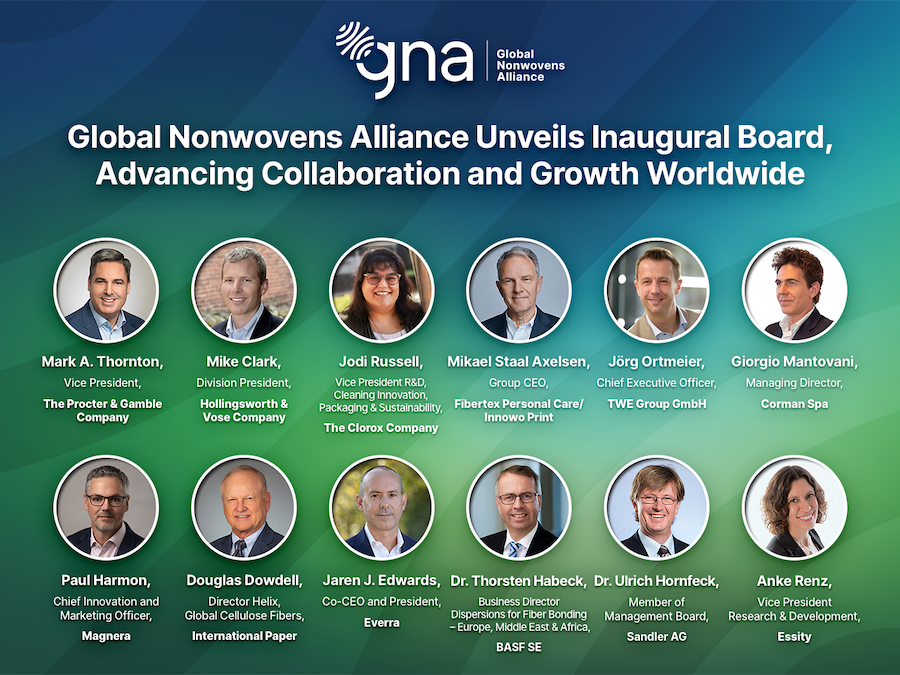
Global Nonwovens Alliance unveils Inaugural Board, advancing collaboration and growth worldwide

The Global Nonwovens Alliance (GNA), a tax-exempt federation jointly founded by INDA, the Association of the Nonwoven Fabrics Industry, and EDANA, the Voice of Nonwovens, announces the appointment of its founding Board of Directors. This group of leaders represents some of the most influential executives across the nonwovens value chain and reflects GNA’s mission to foster global collaboration, innovation, and growth in the industry.

Latest News

#Textile chemistry

A flagship for chemical production: BASF inaugurates world-scale Verbund site in China

BASF today (March 26, 2026) celebrated the official inauguration of its newly built, world-scale Verbund site in Zhanjiang, Guangdong Province in southern China. Covering an area of around four square kilometers, it is more than a major BASF project in the chemical growth market of China. “Zhanjiang shows what the future of chemistry looks like: efficient, digital and sustainable by design. The site showcases a smart integrated Verbund structure on an industrial scale,” said Dr. Markus Kamieth, CEO of BASF, at the ceremony attended by representatives from government, customers, business partners and employees.

#Nonwovens

VEOCEL™ Lyocell production expands to Asia – Launching a new chapter for nonwovens in the region

VEOCEL™, Lenzing's flagship specialty nonwovens brand, expands production at its Thai plant in Prachinburi. This is the first-ever production of its nonwoven-grade lyocell fibers in Asia. Built in 2022 with a 100,000-ton annual production capacity, the facility - previously focused on fibers for textile applications - now can directly meet the demand for VEOCEL™’s biodegradable¹, wood-based lyocell fibers for nonwovens products. These fibers are an essential ingredient for high-quality nonwovens products, ranging from baby wipes to facial sheet masks and everyday personal hygiene items.

#Research & Development

Hof University develops sustainable textile coating for the fashion of tomorrow from mushrooms

Clothing is often treated as disposable: T-shirts for events, general merchandise, or short-term campaigns frequently end up in the trash after only a few uses. This is particularly problematic given that their production still largely relies on fossil-based materials. This is precisely where a new research project at Hof University of Applied Sciences comes in.

#Raw Materials

Fashion for Good mobilises industry to adopt mass balance attribution and accelerate decarbonisation

Fashion for Good launches today the Mass Balance Demonstrator project, a collaborative industry initiative to implement and scale the mass balance attribution (MBA) chain-of-custody model for biomass-attributed PET in textile applications. The project represents a concrete step toward accelerating brand-driven decarbonisation across the apparel value chain.

TOP