[pageLogInLogOut]

#Nonwovens / Technical Textiles

Brexit: EU-UK nonwovens trade facilitated with specific rules of origin
EDANA welcomes the Trade & Cooperation Agreement (TCA) signed in December 2020 between the European Union and the United Kingdom and, in particular, its specific rules of origin for nonwovens.

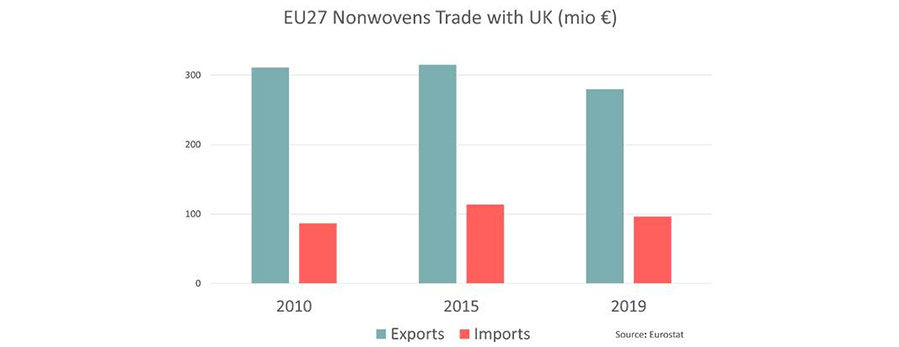
The most recent available figures cover 2019, when the UK exported nonwoven roll goods worth €96 million to the EU, while export traffic in the other direction reached a value of €280 million. The UK remains the second biggest trade partner for EU local manufacturers after the US.

Jacques Prigneaux, EDANA’s Market Analysis and Economic Affairs Director, said “this trade agreement not only guarantees that nonwoven roll goods will be able to continue to travel between EU member states and UK without customs duties, but also recognizes that a nonwoven process is sufficient to confer the origin on the product.

“In order to qualify for the zero preferential tariff under the EU-UK Trade and Cooperation Agreement, products classified in HS 5603 must originate in the EU or the United Kingdom. According to the specific rule for nonwovens, devised and promoted by EDANA, and included in the TCA, any nonwovens produced locally will be considered as originating in the EU or United Kingdom, even if it has been produced using non-originating materials.”


Jacques Prigneaux added “obviously, EDANA member companies can contact me and I will be pleased to guide them through the procedure to claim a preferential import tariff.”

Pierre Wiertz, General Manager of EDANA said “In this news, I see two key achievements and subjects of satisfaction for nonwoven producers whom we value as the core of EDANA’s membership. On one hand, the ability for all of them to keep doing ‘business as usual’, or even expand trade opportunities, whether they trade from the EU or the UK, and on the other hand, the official recognition, hopefully once and for all, of the fact that manufacturing nonwoven roll goods is a substantial enough operation to confer origin status of the country where the resulting goods are obtained. This latter event marks another step in the independence of the nonwovens industry from the traditional textile customs rules which too often unnecessarily constrained its development.”

More News from EDANA

#Associations

Businesses urge European Commission to allow continued sale of products already lawfully placed on the market before the Empowering Consumers Directive’s application to avoid unnecessary waste and costs

EDANA, the voice of nonwovens, alongside a coalition of leading European business associations, has issued a joint statement urging the European Commission to introduce a "grandfathering clause" to the Empowering Consumers for the Green Transition (ECGT) Directive. The coalition warns that without transitional provisions for products already lawfully placed on the market, the new rules could inadvertently lead to massive waste and economic disruption.

#Nonwovens

EDANA wraps up its Sustainability & Policy Forum 2025: Uniting the industry and EU policymakers to navigate the future of nonwovens

Against a backdrop of rapidly evolving environmental legislation, the EDANA Sustainability & Policy Forum 2025 concluded the past week in Brussels, marking a step forward in the dialogue between the nonwovens industry and European policymakers. Held from 9-10 December at the historic Residence Palace, the two-day event successfully brought together business leaders, sustainability experts, and EU officials to address the dual challenges of circularity and industrial competitiveness.

#Associations

Joint Statement: Urgent clarification needed on scope of Textiles EPR for PPE and Medical Devices

EDANA, the voice of nonwovens, alongside fellow industry associations CIRFS (European Man-Made Fibres Association), EURATEX (The European Apparel and Textile Confederation), ESF (European Safety Federation), and EuroCommerce (Retail & Wholesale), has issued a joint statement raising critical concerns regarding the transposition of Directive (EU) 2025/1892, the targeted revision of the Waste Framework Directive.

#Nonwovens

European Commission imposes registration on imports of PET spunbond from China

On 15 September 2025, the European Commission opened an Anti-dumping (AD) investigation into imports of PET spunbond from China following a complaint by the EU industry (AD738). On 2 December 2025, the Commission made imports of PET spunbond from China subject to registration. This is an important milestone in the proceedings.

More News on Nonwovens / Technical Textiles

#ITMA Asia + CITME Singapore 2025

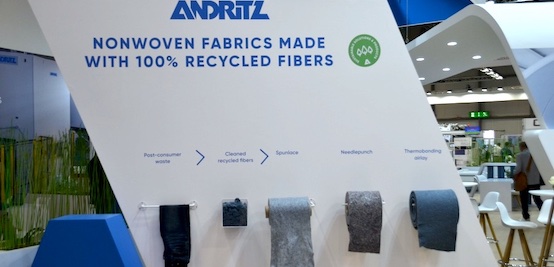
ANDRITZ sets focus on textile recycling and durable nonwoven production technologies at ITMA Asia 2025

International technology Group ANDRITZ will be presenting its innovative nonwovens production and textile solutions at ITMA ASIA + CITME 2025 in Singapore, from October 28 to 31, 2025 (Hall 2, D106). ANDRITZ will showcase its MMCF production plants, textile sorting and recycling, bast fiber processing, needlepunch, airlay, and life-cycle service technologies, with a focus on sustainable solutions. Discover how these innovations can grow your business opportunities and support a greener future.

#ITMA Asia + CITME Singapore 2025

Dilo Group at ITMA ASIA Singapore 2025

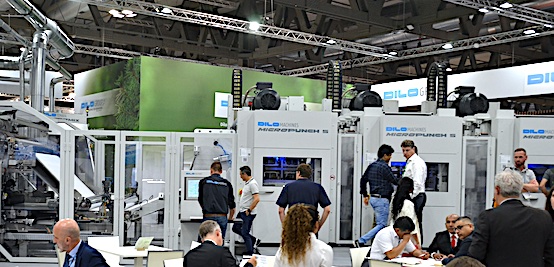
At ITMA ASIA Singapore, the Dilo Group will exhibit at Booth No. H2 – D202. Together with Kansan Materials, Izmir, the company will present its latest developments and looks forward to welcoming visitors to exchange ideas and explore innovations in needling technology.

#Nonwovens

OUTLOOK™ 2025: Charting a sustainable and innovative future for the Nonwovens Industry

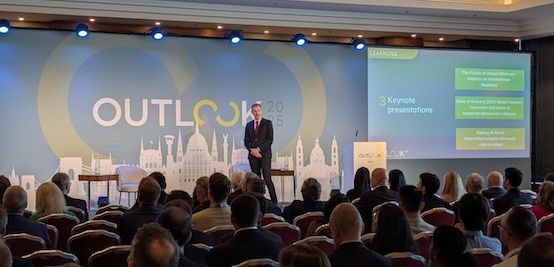
EDANA concluded its flagship event, OUTLOOK™ 2025, last week, marking it as a major success and addressing the biggest questions facing the industry. The three-day conference highlighted the urgent need for a unified approach to sustainability, regulation, and innovation in the absorbent hygiene and wipes sectors.

#Nonwovens

Global Nonwovens Alliance unveils Inaugural Board, advancing collaboration and growth worldwide

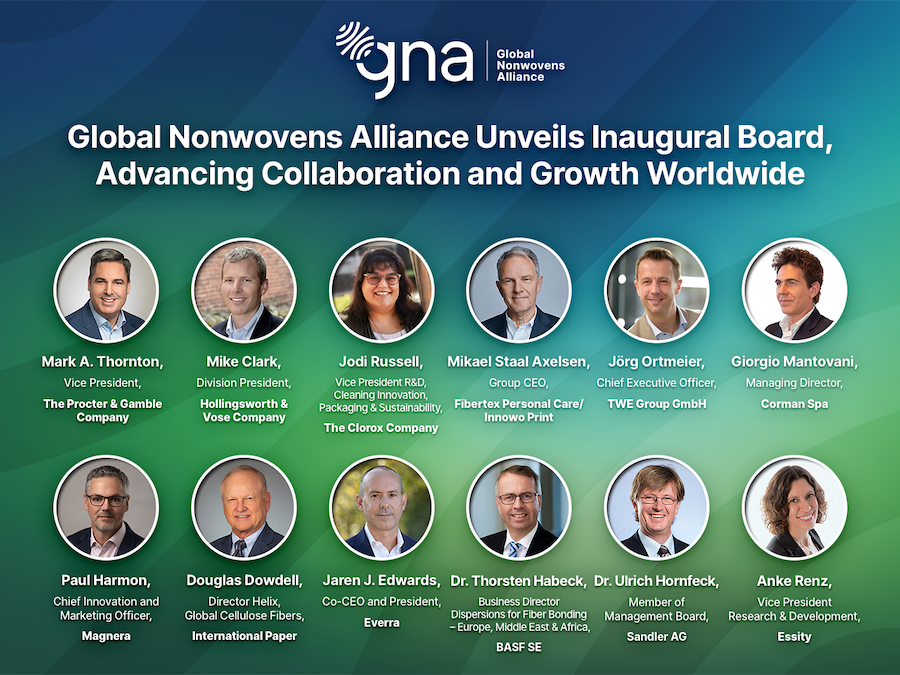
The Global Nonwovens Alliance (GNA), a tax-exempt federation jointly founded by INDA, the Association of the Nonwoven Fabrics Industry, and EDANA, the Voice of Nonwovens, announces the appointment of its founding Board of Directors. This group of leaders represents some of the most influential executives across the nonwovens value chain and reflects GNA’s mission to foster global collaboration, innovation, and growth in the industry.

Latest News

#Dyeing, Drying, Finishing

Orthopac RVMC-20 plus: German Engineering for Smarter Weft Straightening

In times of rising cost pressure and growing quality demands, textile producers worldwide are searching for solutions that combine precision, efficiency, and sustainability. With its latest innovation, the Orthopac RVMC-20 plus, Mahlo once again demonstrates the strength of German engineering: improving proven technology to meet today’s challenges.

#Knitting & Hosiery

KARL MAYER and Lenzing partner to advance warp knitting with scalable cellulose fiber solutions

The Lenzing Group, a leading supplier of regenerated cellulosic fibers for the textile and nonwovens industries, together with KARL MAYER, the global market leader in warp knitting machines and warp preparation systems, debut a joint innovation project during Premiere Vision, Paris.

#Textile chemistry

RUDOLF gets the exclusive global distribution rights for Sanitized® textile technologies

With effect from today, RUDOLF officially assumes exclusive global distribution rights for Sanitized® textile technologies from SANITIZED AG. This is the next milestone in the strategic collaboration announced in 2025, with the partnership between the two companies now fully implemented and expanded worldwide.

#Europe

ICAC to support European Commission on pending PEF legislation

The International Cotton Advisory Committee (ICAC) is proud to announce that it has been included as a member of the European Commission’s Technical Advisory Board (TAB) on the Product Environmental Footprint methodology. The Commission developed the Product Environmental Footprint (PEF) to assess and communicate the life cycle environmental performance of products and organizations.

TOP