#Knitting & Hosiery
The fastest path from yarn to champion shoe
Footwear innovation enabled by warp knitting technology– insights from New Balance

To succeed in the footwear market, you need technology
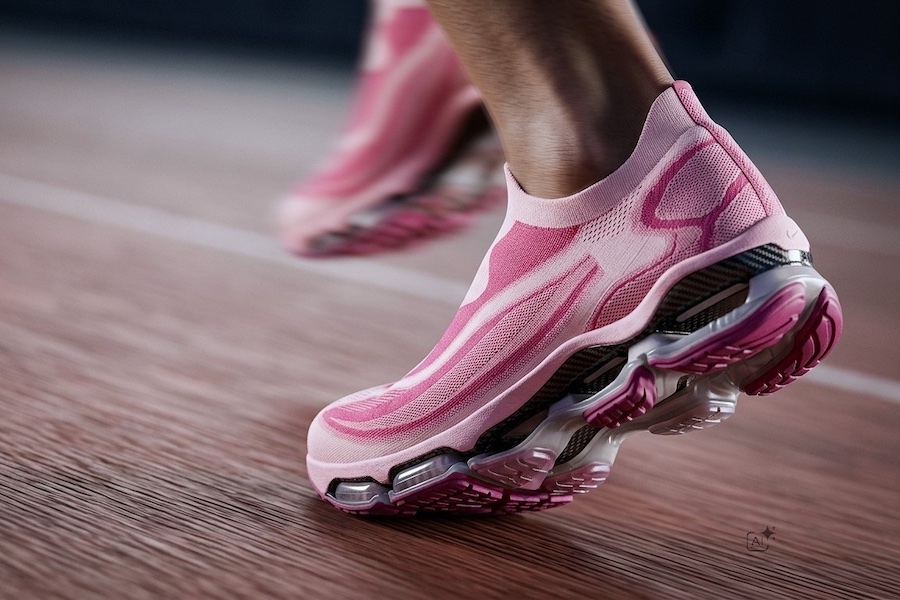
The footwear sector is one of the most demanding areas of the textile and apparel industry. Today’s modern athletic shoes must meet a wide range of requirements simultaneously: they need to be lightweight and durable, offer optimal comfort, stabilize the foot, be breathable, and be produced sustainably.
“From a technical standpoint, a modern athletic shoe is like a mini-car packed into a tiny space,” explained Vishnu Prakash Muthusamy in his presentation. In fact, a single shoe often contains up to 30 individual components that must work together perfectly to achieve the desired performance.
At the same time, pressure on manufacturers is growing. Development cycles are expected to become shorter, production more resource-efficient, and processes less complex. This is precisely where warp knitting technology offers new perspectives. It transforms textile manufacturers into far more than mere material suppliers: they become development partners and co-creators of the product.
“All the products we develop today are designed with a specific supplier and a specific material in mind,” says Vishnu Prakash Muthusamy.
For brands like New Balance, innovative textile solutions are thus becoming a decisive competitive factor – and warp knitting technology is becoming a key technology for the next generation of shoes.
Less complexity, more speed
Traditional athletic shoes consist of a multitude of individual components: upper parts, overlays, reinforcements, and appliqués are cut to size, glued together, and assembled in several steps. This makes production time-consuming, increases the shoe’s weight, results in material waste, and lengthens development cycles.
Warp knitting technology takes a different approach: functions such as breathability or support, as well as aesthetic elements, are integrated directly into the textile structure rather than added later. This creates an integrated system instead of a collection of individual components.
“It’s not just about simplification and greater speed. By reducing complexity, we also improve the product’s performance,” emphasized Vishnu Prakash Muthusamy.
For brands like New Balance, this is a decisive advantage. At the same time, warp knitted fabrics offer technical properties that are particularly in demand in performance footwear – including high dimensional stability, controlled stretch, and an excellent strength-to-weight ratio.
Multiple functions and designs in a single piece of fabric
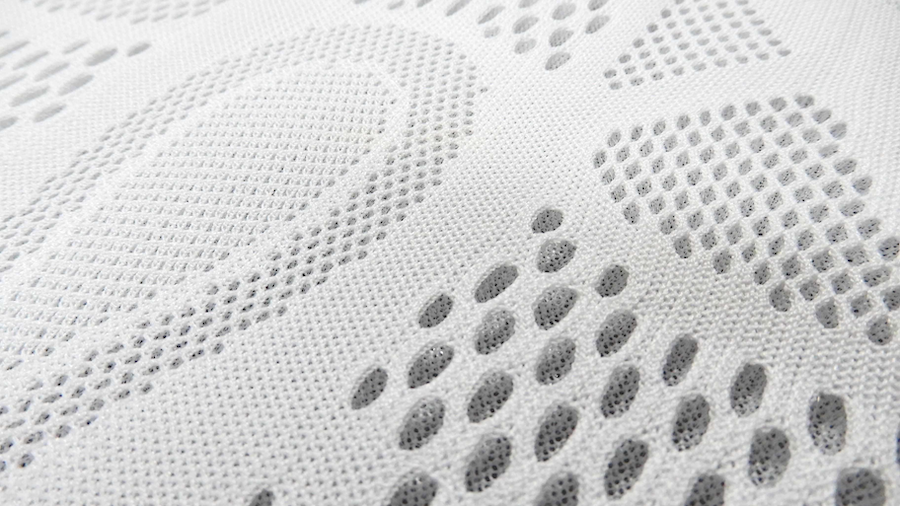
New Balance sees particularly great potential in what is known as “Zonal Engineering.” On warp knitting machines, stitch density can be precisely controlled, and yarns can be placed with pinpoint accuracy using Jacquard technology. This allows different functional zones, textures, and designs to be specifically tailored within a single upper material to meet the shoe’s requirements.
The result is breathable zones exactly where ventilation is needed. Reinforcements and varying levels of elasticity provide additional support in the midfoot area and greater stability at the heel. Around the lacing area, extra-strong sections prevent the fabric from tearing, while integrated graphic elements, patterns, and logos add a stylish touch to the look.
All these features are created in a single production step directly on the machine. Additional printing, laminating, or application processes are eliminated. This saves time and resources while enhancing the product’s durability.
Faster product development, shorter time-to-market
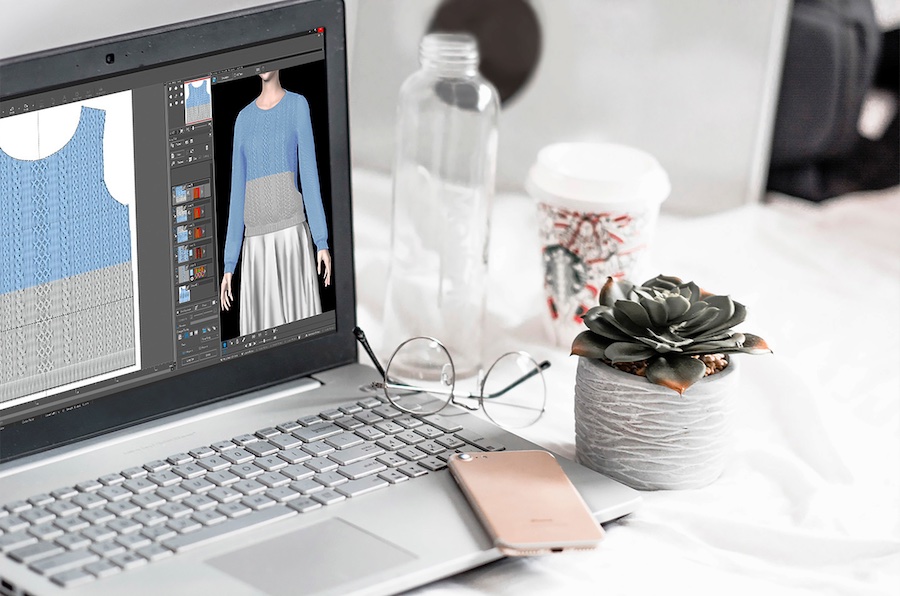
The enormous time savings achieved with design updates are particularly relevant for international footwear brands. Design adjustments can be made digitally and transferred directly to the production machines. Here, new patterns can be implemented in a matter of seconds using the EN pattern drive – without additional tools. At the same time, the product can be validated even during production.
This speed and flexibility are decisive advantages for New Balance in the race against time.
“We only have seven days to switch from Design A to Design B. Thanks to the EN function, we can seamlessly transfer the pattern without any new pattern discs or additional tools,” explains Vishnu Prakash Muthusamy.
The new material must be evaluated within 14 days, and the shoe must be manufactured from it within 45 days. There is no room for wasting time here!
Greater sustainability
In addition to performance and speed, warp knitting technology also excels in terms of sustainability.
“For us, warp knitting is at the top of the list of technologies we use to integrate sustainability into our products,” confirms Vishnu Prakash Muthusamy.
A key advantage lies in what is known as near-net-shape production. In this process, textile components are manufactured in a form that is nearly identical to their final shape. Compared to traditional cut-and-sew processes, there is significantly less waste, which allows for more efficient use of materials and reduces waste.
At the same time, the entire value chain is simplified. Multiple components of a shoe – such as the upper, tongue, and collar – do not need to be manufactured separately and then assembled; instead, they can be produced as a single piece of fabric. Additional processing steps are eliminated, which reduces labor and energy costs and streamlines production processes.
Durability also benefits from this approach. Constructions made from a single piece are less prone to wear and tear, while mono-material solutions made from recycled or bio-based yarns facilitate the subsequent recycling of used shoes.
Added to this is the technology’s high energy efficiency. Thanks to the high production speed of modern warp knitting machines, warp knitting ranks among the most efficient textile manufacturing methods in terms of energy consumption per kilogram of fabric produced, according to Vishnu Prakash Muthusamy.
Material savings of up to 28 percent
Vishnu Prakash Muthusamy illustrated just how significant these savings can be in practice using a recent development project as an example. By optimizing the layout of the cut pieces within the material, the yield was increased from four to five pairs of shoes per yard of fabric.
The result is remarkable: material costs fell by up to 28 percent, while at the same time there was virtually no waste.
The basis for this efficiency is high-precision manufacturing. Thanks to Jacquard technology and “zonal engineering,” upper material can be placed on the fabric with a precision of plus or minus 2 mm.
The next step: From 2D to 3D
Vishnu Prakash Muthusamy envisions a complete shift in the future from traditional two-dimensional design and manufacturing processes to three-dimensional, biomechanically optimized structures.
Since the human foot itself has a three-dimensional structure, shoe production must also be thought of in 3D in the future. Textile structures should be able to respond directly to movements, stresses, and pressure points by being tailored to real human biomechanical data
“Warp knitting allows you to conceptually shift from 2D patterning to 3D structural engineering. Your machine should be capable of producing textiles in 3D form,” Vishnu Prakash Muthusamy advised the audience.
For brands, this approach opens up entirely new possibilities for performance optimization, differentiation, and a competitive edge in the race for the world’s best shoe. In this field, every thousandth of a second and every gram counts: In a 100-meter dash, as little as 0.09 milliseconds can decide the winner. If a shoe is just two grams lighter, that can be the decisive factor.
Conclusion
The future of the footwear industry lies in intelligent, functionally integrated, and three-dimensionally designed textile structures. Warp knitting technology is set to become one of the key technologies of the next generation.