[pageLogInLogOut]

#ITMA 2023

Flexible warp knitting machine with weft insertion and more
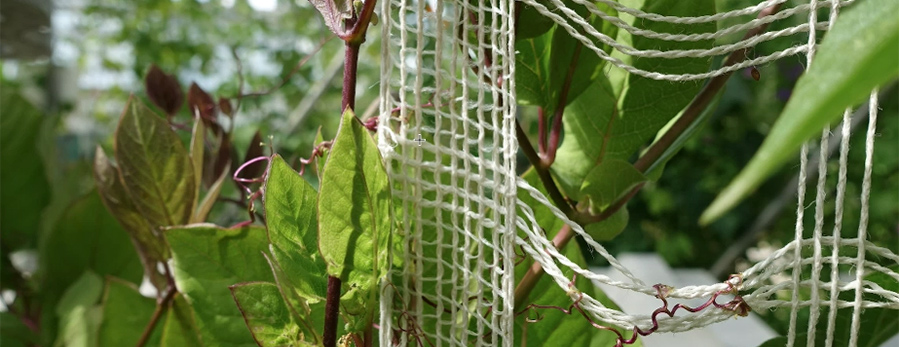
Vertical urban greening with nets from weft knitting machines © 2023 KARL MAYER
At ITMA, the KARL MAYER GROUP will be exhibiting solutions for the topics that move its customers. For manufacturers of technical textiles, the KARL MAYER GROUP (Hall 4 B119) will be presenting a WEFTTRONIC® II G at the ITMA with new features and upgrades for even greater efficiency.

This warp knitting machine with weft insertion produces lattice structures from high-strength polyester, which are firmly established in the construction industry in particular. With a working width of 213", it offers unique productivity and further advantages through design innovations. New features include weft thread tension monitoring, management and the new VARIO WEFT laying system. The component for the weft insertion aims at maximum flexibility. It allows the patterning of the weft yarn to be changed quickly and easily electronically, without mechanical intervention during yarn insertion and without limits on repeat lengths. In addition, there is less waste. This means that the WEFTTRONIC® II G also scores points in terms of sustainability and costs.
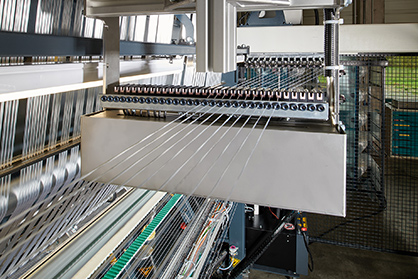

WEFTTRONIC II G weft yarn tension monitoring  © 2023 KARL MAYER
WEFTTRONIC II G weft yarn tension monitoring © 2023 KARL MAYER


The KARL MAYER GROUP also supports its customers with well thought-out Care Solutions. The new support offers include retrofit packages for retrofitting control and drive technology for weft insertion and composite machines, and service packages that bundle various services. These include machine inspections and the replacement of all drive belts. The customer benefits from fixed prices that cover the costs of technician assignments, various discount options and transparent services.

A completely new solution for the vertical greening of cities Is presented from the field of application for technical textiles. The core of the innovation is a grid textile produced on warp knitting machines with weft insertion by KARL MAYER Technische Textilien GmbH. The knitted lattice fabric is made of flax.


It is used as a climbing aid for fast-growing plants, and after the greening phase, in autumn, it can be recycled together with these plants as biomass in pyrolysis plants to produce electricity and activated carbon. In summer, the planted sails lower the ambient temperature through evaporation effects.

In addition, photosynthesis creates fresh air and binds CO2. Other important advantages are low soil requirements and flexible placement in public spaces. The greening system was developed by the company Micro Climate Cultivation, OMC°C, with the support of KARL MAYER Technische Textilien.

The KARL MAYER GROUP will also be exhibiting a sustainable composite solution made from natural fibres. The reinforcing textile of the innovative lightweight material is a multiaxial non-crimp fabric, which was also produced from the bio-based raw material flax on a COP MAX 4 from KARL MAYER Technische Textilien. The boatbuilding specialist GREENBOATS uses natural fibre composites to achieve more sustainable products. The fact that it succeeds in this is shown, for example, by the Global Warming Potential (GWP): 0.48 kg of CO2 per kilogram of flax reinforcement compares with 2.9 kg of CO2 per kilogram of glass textile.
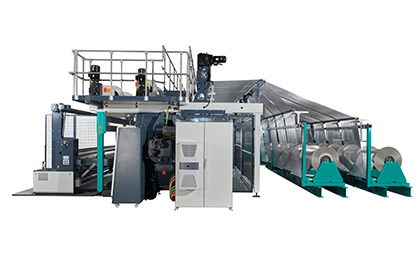
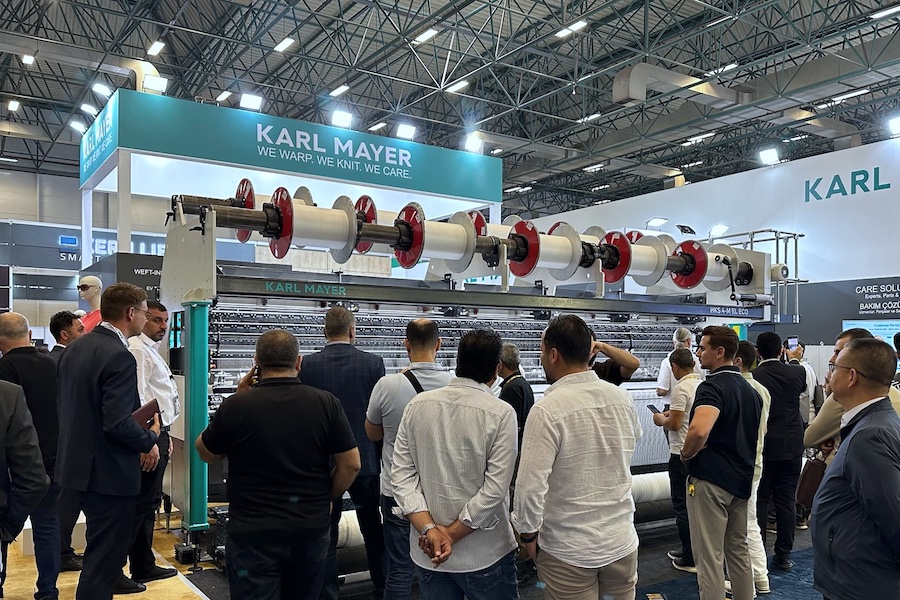
WEFTTRONIC II G © 2023 KARL MAYER


More News from KARL MAYER Textilmaschinenfabrik GmbH

#Knitting & Hosiery

The new RDJ 7/3 defines the design footprint of modern athletic shoes

Stylish, functional, and efficient to produce – spacer fabrics are the all-arounders among textile materials. These versatile fabrics are particularly in demand in the sports and casual footwear sector, as they combine comfort, breathability, and design freedom. At the same time, this industry is trend-driven, dynamic, and price-sensitive like few others. Innovations are therefore a decisive factor for success. With the RDJ 7/3, KARL MAYER offers a solution specifically tailored to these requirements. The particular strength of the new double raschel machine: its exceptional flexibility, thanks to its three jacquard bars.

#Knitting & Hosiery

Significantly greater versatility and productivity with the HKS 4-S EL from KARL MAYER

With the new HKS 4-S EL, KARL MAYER is introducing an innovation to the market that impresses in two ways: with outstanding speed and maximum flexibility.

#Knitting & Hosiery

More Jacquard. More functionality. More fashion.

With the addition of another member to its successful RASCHELTRONIC® family, KARL MAYER is opening up new possibilities for creative product development for warp knitting mills and brands. The RJ 4/2 EL offers with two stitch-forming Jacquard bars entirely new design options for functional sportswear and bi-elastic lingerie. Available in gauges E 28 and E 32, this new model helps manufacturers set their collections apart from the competition. The fine E-32 gauges, in particular, impress with their clean surface, a pleasantly soft feel, and an exceptionally elegant look.

#Knitting & Hosiery

KARL MAYER's HKS 2-SE Expands Possibilities for Premium Stretch WARP KNITS

Warp knitted fabrics with a woven look are more in demand than ever in the fashion and apparel industries. Stretch WARP KNITS, in particular, impress with their freedom of movement, breathability, and virtually wrinkle-free wear – thereby opening up new style worlds such as smart casual or business casual. When it comes to the highly efficient production of premium-quality stretch WARP KNITS, the HKS 2-SE has long been the machine of choice. KARL MAYER’s best-selling tricot machine produces standard elastic fabrics characterized by high gauges, smooth, delicate surfaces, and a soft hand feel.

More News on ITMA 2023

Latest News

#Research & Development

Smart textiles reversibly change shape in an energy-efficient manner in response to ambient temperature

Self-actuating textile structures are used in a wide range of applications, such as medical technology, automation, architecture, agriculture, and the apparel industry. An example is the use of shading nets in greenhouses, which can be deployed and retracted depending on the sunlight intensity. The German Institutes of Textile and Fiber Research Denkendorf (DITF) are developing textiles based on shape-memory polymers with reversibly controllable geometry.

#Spinning

Barmag expands its portfolio for PA6/PA6.6 applications — also available as a retrofit solution

With the new type 6020 ceramic oiler, Barmag is introducing a powerful addition to its product portfolio for processing PA6 and PA6.6 yarns. The solution is specifically designed for low-titer applications in the range of 5 to 100 denier.

#Spinning

Pre-Cleaner CL-X: Proven in cotton cleaning – creating value beyond the spinning mill

Since its market launch, the CL-X has firmly established itself in blowroom lines worldwide. Hundreds of installations confirm its ability to deliver superior cleaning efficiency, lower waste, higher productivity and significant energy savings. Now, new customer applications show that the CL-X not only continues to excel in spinning preparation – it is also entering a completely new field of application: ginning.

#Natural Fibers

2026 ICAC report projects World cotton trade to reach 10.3 million tonnes by 2028/29

The International Cotton Advisory Committee has released the 2026 World Cotton Trade Report, which provides analysis of global cotton trade patterns, key trading relationships, import and export trends, and the geopolitical and policy developments shaping cotton trade flows.

TOP