[pageLogInLogOut]
TRÜTZSCHLER SPINNING - FROM WASTE TO VALUE

#Industry 4.0 / Digitalization

Teijin raises equity stake in Floadia to enhance business capabilities with AI know-how

Teijin Limited announced today that it has raised its equity stake in Floadia Corporation, a Tokyo-based start-up company that develops, consults, licenses and sells non-volatile memory. This type of memory is indispensable in the rapid processing of big data by artificial intelligence (AI) capabilities thanks to its suitability for deployment in edge computing environments and its ability to process information without access to the cloud.

Reflecting its increased shareholding, Teijin has seconded a representative to serve on Floadia’s board of directors and an engineer to work on the company’s advanced technologies and products.

By combining its special capabilities as a materials supplier with Floadia’s non-volatile memory know-how, Teijin aims to strengthen its expertise in products and solutions that use AI for enhanced quality of life in diverse fields. More specifically, the two companies plan to jointly develop AI chips and other products for practical applications, targeting commercial launch by 2025. Teijin also expects to strengthen its materials business, including technologies and safety management for autonomous driving, and solutions addressing for demographic change and increased health consciousness.

Teijin has been developing mobility solutions to address demands in aging societies. Established in 2011 to develop and license semiconductor intellectual property, Floadia has been developing low-cost non-volatile memory that significantly reduces the power consumption and raises the heat resistance of electronic and semiconductor devices. Floadia is also developing semiconductor devices that enable power-saving AI arithmetic processing.


Products for daily life are being digitized for greater usefulness and sustainability. Examples include automobiles designed to be more connected, autonomous, shared and electric (CASE), mobility as a service (MaaS) solutions that augment consumer-owned cars, and smart homes that offer extra safety, reliability and comfort. At the same time, markets for the internet of things (IoT) and AI are expanding briskly. 

Teijin is contributing to the realization of the United Nation’s Sustainable Development Goals (SDGs) as well as creating value for enhanced quality of life under a long-term vision of being a company that supports the society of the future.

Teijin is seeking to add value in a wider range of areas beyond its cultivated tough and lightweight high-performance materials capabilities, with AI-related technology becoming increasingly indispensable. Teijin rates Floadia’s semiconductor devices highly as they do not require cloud access in order to carry out AI arithmetic processing.

More News from Teijin Aramid

#Yarn & Fiber

Teijin Aramid: Taiichi Machida to succeed Peter ter Horst as CEO

Peter ter Horst will step down as Chief Executive Officer at the end of 2025, after 19 years of dedicated service. Effective October 1, 2025, Taiichi Machida will take over as CEO.

#Yarn & Fiber

Teijin announces availability of DPP-compliant products aligned with Europe’s ESPR Environmental Regulation

Teijin Limited announced today that it has started rolling out initiatives to enable aramid fibers and carbon fibers to be accompanied by Digital Product Passport (DPP) technology, which enhances supply chain transparency by verifying the origins of materials and supporting sustainability claims. The company is using the supply chain traceability system from Netherlands-based Circularise B.V., in which Teijin has invested since November 2024, to develop DPPs for each product.

#Composites

Teijin Carbon showcases new eco-friendly Tenax Next™ R2S 513 6mm short carbon fiber at JEC World 2025

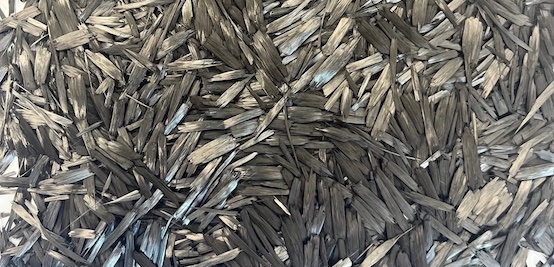
Teijin Carbon, a leading manufacturer of carbon fiber products, is presenting its latest development in sustainable materials at JEC World 2025 (hall 6, G22). New Tenax Next™ R2S 513 6mm is a short carbon fiber product in rice-shaped form for reinforcing thermoplastic compounds that not only offers exceptional performance characteristics but also reinforces the company’s commitment to environmental responsibility and circularity.

#Recycling / Circular Economy

Teijin to invest in Circularise B.V. and adopt its supply chain traceability platform to promote the Circular Economy

Teijin Limited announced today that it will invest in Circularise B.V., a company based in The Hague, Netherlands, which develops product traceability management systems using blockchain technology. Teijin will also implement Circularise’s software to improve visibility into its global supply chain. Circularise’s proprietary “Smart Questioning”(*) solution, which utilizes Zero-Knowledge Proof (ZKP) technology, provides both anonymity and transparency to ensure a highly reliable product traceability system.

More News on Industry 4.0 / Digitalization

#Research & Development

Textilfabrik 7.0 launched: Mönchengladbach becomes a real-world lab for sustainable textile production

With the official kick-off event of the Textilfabrik 7.0 (T7), a major transformation project for the German textile and apparel industry has been launched in the Monforts Quarter in Mönchengladbach. At the “Textile Roundtable,” an event format organized by the Zukunftsagentur Rheinisches Revier, representatives from industry, research, politics, and the regional economy came together to jointly lay the foundation for CO₂-neutral, circular, and economically viable textile production in Germany.

#Man-Made Fibers

OnceMore® from Södra brings end-to-end traceability for circular Man-made Cellulosic Fibers (MMCF) using TextileGenesis

OnceMore® from Södra, the world’s first large-scale process for recycling blended fabrics into high‐quality dissolving pulp, will begin using TextileGenesis, a Lectra company, to strengthen traceability from raw material to retail across the value chain. OnceMore® produces dissolving pulp made from blended textile waste and wood sourced from responsibly managed Swedish forests. By integrating TextileGenesis, OnceMore® supports the growing need for verified data and secure, transparent tracking throughout increasingly complex supply chain.

#Denim

Jeanologia launches Billy

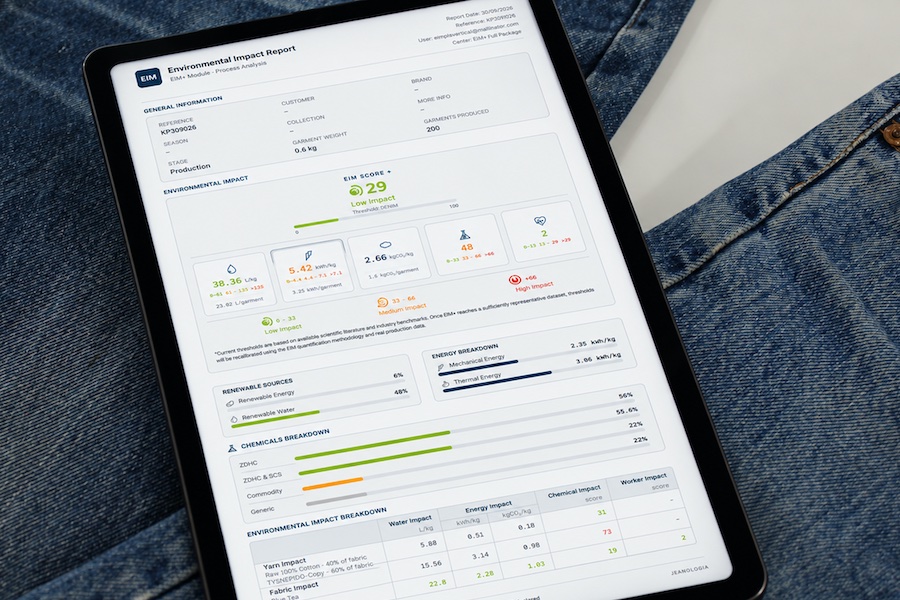
The new AI extracts precise laser designs from a garment image in minutes, transforming how vintage denim is recreated for production. If Jeanologia’s laser changed the way jeans were made at the end of the last century, its AI now takes the next step: moving from reproducing wear to designing it. / archive photo © 2026 Jeanologia

#Dyeing, Drying, Finishing

Monforts unveils interactive digital platform for textile finishers

Monforts has launched a new digital platform designed to give textile manufacturers faster, more intuitive access to the company’s finishing technologies, technical expertise and aftersales support worldwide.

Latest News

#INDEX 2026

“We clearly see that reliability, flexibility, service and total cost of ownership are becoming increasingly important again.”

The nonwovens industry continues to face a challenging market environment. Nevertheless, AUTEFA Solutions reports successful projects, new line sales and growing demand for energy-efficient and flexible solutions. In this interview, André Imhof of AUTEFA Solutions talks about competitiveness against Chinese suppliers, new service and recycling concepts, the growing importance of application development and the opportunities created by countercyclical investments.

#INDEX 2026

“Needle punching technology is more universal and sustainable than ever!”

Needle punching technology was long regarded as a rather traditional and comparatively slow technology within the nonwovens industry. In this interview, Johann Philipp Dilo explains why needle punching is more relevant than ever today – ranging from energy efficiency and resource conservation to hygiene applications, new machine concepts and design-oriented nonwoven solutions.

#Research & Development

Textile climate control system in workwear – exhibition at the 2026 SME Innovation Day!

Conventional protective workwear often reaches its limits during strenuous physical activity. In particular, the transport of sweat and excess body heat poses a problem. The German Institutes of Textile and Fiber Research (DITF) conducted research on flow-optimized, air-conducting textile structures that enable targeted climate control directly on the body. These structures can be integrated straight into protective work garments. The textile climate control system supports the body’s natural thermoregulation. This contributes to improved workplace safety and comfort.

#Nonwovens

PET spunbond from China – EDANA welcomes imposition of provisional anti-dumping measures

On 13 May 2026, after eight months of investigation, the European Commission imposed provisional anti-dumping duties of 45.6-50.0% on imports of PET spunbond from China. EDANA welcomes this expression of the Commission’s clear determination to protect EU industries from the unfair trade practices of Chinese producers.

TOP