[pageLogInLogOut]

#Industry 4.0 / Digitalization

ANDRITZ collaborates with Microsoft to drive innovation in the manufacturing industry

International technology group ANDRITZ is collaborating with Microsoft to co-innovate the future of the process industry by enabling fully autonomous factories and by creating a trusted data ecosystem based on the ANDRITZ Metris digital platform and Microsoft Cloud for Manufacturing.

Collaboration will also foster modern working methods within ANDRITZ, speeding up internal processes for prompt and seamless customer support. This marks a significant step forward in accelerating the digital transformation in the manufacturing industry.

Joachim Schönbeck, President & CEO of ANDRITZ, highlights the significance of this initiative: "This collaboration represents a milestone in our digital transformation. By combining our industry knowledge with Microsoft's digital solutions, we elevate our Metris digital platform and provide our employees with an optimized working environment, enabling groundbreaking business models and enhanced customer service."

The ANDRITZ Metris digital platform, which forms the basis for the journey towards autonomy, provides full support for industrial plants throughout their entire lifecycle, addressing customers’ main challenges such as operating costs, process stability, plant reliability, and sustainability. ANDRITZ has integrated a Copilot solution based on Microsoft Azure OpenAI Service into Metris. The Metris Copilot simplifies anomaly detection and streamlines communication between operators and machines. Operators will gain real-time machine insights via a chat interface, facilitating informed decision-making. This helps to boost plant efficiency, product quality, and resource utilization in manufacturing.

The collaboration also gives a significant boost to ANDRITZ's internal digitization journey. ANDRITZ's use of Copilot for Microsoft 365 underscores its commitment to embracing modern working methods and driving product improvement. By automating repetitive tasks and providing actionable insights, it helps to streamline internal processes and allows employees to focus more on strategic tasks and customers’ needs.

Rohit Pant, Chief Automation Officer at ANDRITZ, highlights the customer benefits: "Integrating Microsoft’s digital expertise into our Metris platform enables data-driven decision-making for our customers, unlocking a range of advantages. Through skilling programs and specialized training, ANDRITZ's teams are evolving to meet the demands of a digitally driven market.”

“ANDRITZ is helping to shape the future by using Microsoft Azure to further enhance its autonomous factory solutions,” says Ralph Haupter, President of Microsoft EMEA. “The deep integration of their products with Azure cloud services is the type of technological innovation that drives sustainable and efficient change in the industry.”
More News from ANDRITZ Nonwoven

#Nonwoven machines

MENANG rapidly resumes production with new ANDRITZ airlay line after major fire

MENANG, a Malaysian manufacturer of nonwoven automotive components, has resumed production after a major fire severely damaged its airlay line in mid-March 2026. A new airlay line supplied by ANDRITZ enabled production to restart within only four months.

#Nonwoven machines

A Penteadora starts up ANDRITZ textile recycling and needlepunch nonwoven lines in Portugal

A Penteadora SA has successfully started up a complete mechanical textile recycling line and a needlepunch nonwoven line supplied by ANDRITZ at its production site in Unhais da Serra, Portugal. This investment enables A Penteadora to expand its industrial capabilities and develop a new generation of solutions based on pre- and post-consumer recycled textiles. The input materials originate from its own production waste and other textile waste streams. Both lines are fully operational, and the first products are expected to reach the market in July.

#Nonwoven machines

ATCO Hygienics, Uzbekistan, orders baby diaper production line from ANDRITZ

International technology group ANDRITZ has received an order from ATCO Hygienics to supply a new baby diaper production line for its plant in Tashkent, Uzbekistan. The order is included in ANDRITZ’s order intake for the first quarter of 2026. Commissioning of the production line is scheduled for the end of 2026.

#Nonwoven machines

Kruger, Canada, orders first nonwovens line for sustainable wipes from ANDRITZ

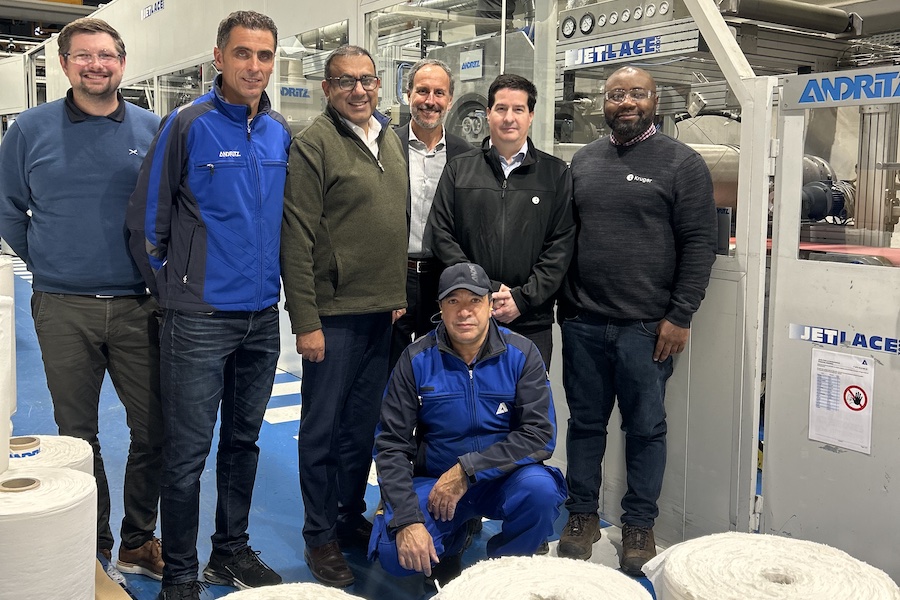
International technology group ANDRITZ has received an order from newly established Kruger Nonwovens to deliver a complete WetlaceTM hybrid line for the Wayagamack mill in Trois-Rivières, Quebec, Canada. With this investment, pulp and paper producer Kruger is preparing to enter the nonwovens market with a new generation of plastic-free, chemical-free materials for sustainable wipes. The line is the first of its kind in Canada and is scheduled to start production in 2028.

More News on Industry 4.0 / Digitalization

#Industry 4.0 / Digitalization

Smartex.ai names Tony Fadell chairman and previews new fabric inspection system

Smartex.ai has appointed Tony Fadell as chairman and will present its new fabric inspection hardware and software at SmartCollab Hong Kong on 27 November. Fadell co-designed Inspect, the hardware at the centre of the system, which Smartex developed with a supplier in H&M Group’s network.

#Industry 4.0 / Digitalization

Coats Digital wins SaaS award for AI in apparel manufacturing

Coats Digital has been named Best Company in AI-Powered Fashion Technology at the 2026 Best in SaaS Awards. The company’s AI applications cover garment costing, the analysis of operational data and the use of computer vision to study how tasks are performed on the factory floor.

#Industry 4.0 / Digitalization

Jeanologia and BCome connect factory data with Life Cycle Assessment and Digital Product Passports

A new white paper by EIM by Jeanologia and BCome demonstrates how primary environmental data from denim finishing processes can be integrated into a garment's Life Cycle Assessment (LCA) and prepared for use in a Digital Product Passport (DPP). A comparative case study highlights significant improvements at the production stage while also showing how these translate into the environmental performance of the finished garment.

#Industry 4.0 / Digitalization

White House reduces production planning time by up to 80% with Coats Digital’s FastReactPlan

Indian garment manufacturer White House has reduced its production planning cycle by 60–80% following the implementation of Coats Digital’s FastReactPlan software. The integrated planning solution provides greater visibility across production, capacity and material requirements while supporting faster decision-making and improved delivery performance.

Latest News

#Textile processing

Jeanologia combines digitalisation, laser and ozone technology to strengthen China’s textile competitiveness

At ITMA Asia + CITME 2026 in Shanghai, Jeanologia showcased how the combination of digitalisation, laser technology and G2 Ozone can help China’s textile industry improve productivity, speed, quality and efficiency. With its Compact Super Flash laser system and integrated production concepts, the Spanish technology specialist demonstrated how connecting product development and industrial production can enable faster, more automated and sustainable manufacturing processes.

#Textile chemistry

Flame protection and OEKO-TEX® certification: Gulec Chemicals clears an important hurdle

Three halogen-free flame retardants from German specialist Gulec Chemicals have been included in the OEKO-TEX® list of accepted Active Chemical Products (ACP). The listing opens up additional opportunities for textile finishers, coaters and manufacturers of technical textiles seeking to combine demanding fire protection requirements with certification according to OEKO-TEX® STANDARD 100.

#Dyeing, Drying, Finishing

PLEVA improves dyeing consistency with inline microwave measurement of liquor pick-up

Consistent shades are essential in continuous textile dyeing. Yet variations in fabric absorbency or uneven padder pressure can go unnoticed until the end of the line. By then, hundreds of metres of fabric may already be affected and may become second-choice or rejected.

#Recycling / Circular Economy

DITF establishes CYCLOTEXUM recycling center to advance mechanical and solvent-based textile recycling

As part of the CYCLOTEXUM research project, the German Institutes of Textile and Fiber Research Denkendorf (DITF) established the CYCLOTEXUM recycling center. There, in collaboration with industry partners, the center develops application-oriented solutions for mechanical and solvent-based recycling processes. The technologies developed make a significant contribution along the textile value chain toward the efficient use of textile resources in the future and the transition of production in the German textile sector to a circular economy. The project was funded by the Ministry for the Environment, Climate and Energy Sector of the State of Baden-Württemberg.

TRÜTZSCHLER SPINNING - FROM WASTE TO VALUE
TOP