[pageLogInLogOut]

#ITMA Asia + CITME 2020

DiloGroup machines for a wide range of applications at ITMA Asia
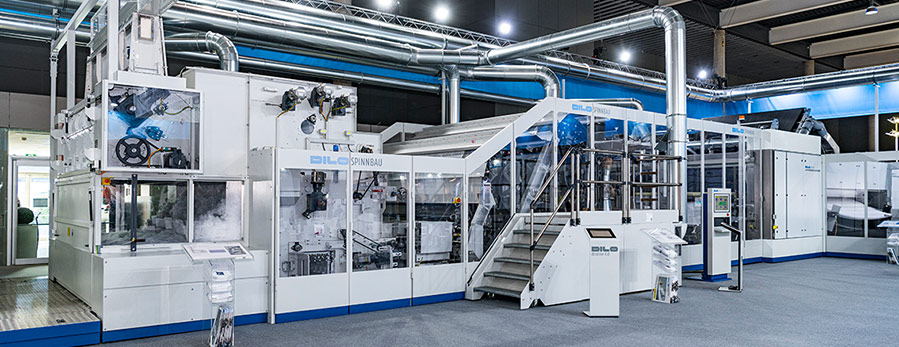
DiloGroup production line © 2021Dilo
As a machine manufacturer DiloSystems provides production lines for any nonwoven process and all types of staple fibre products. Looking back on a difficult year 2020, positive developments and a recovery in many industry sectors are now underway. DiloGroup with DiloSpinnbau, DiloTemafa, DiloMachines and DiloSystems as the general contractor delivers the complete range of machinery needed to produce needled nonwovens, and together with partners, thermobonded and hydroentangled nonwovens.

All over the world, Dilo lines produce nonwovens for a wide range of applications including geotextiles, housing and roofing, automotive products, filtration, acoustics, artificial leather and medical or hygiene products.

DiloGroup lines can be supplied turnkey from the general contractor DiloSystems as your partner for a coordinated, professionally managed investment with a single responsibility to fulfil all needs technically and commercially. The complete staple fibre process equipment, starting at fibre preparation (DiloTemafa), continuing with webforming by carding (DiloSpinnbau), up to crosslapping and needling (DiloMachines) is built in-house by Dilo’s highly specialized departments. These complete line projects are developed in close contact with our customers and on the basis of textile technological research and studies carried out in our technical centre in Eberbach, Germany. 

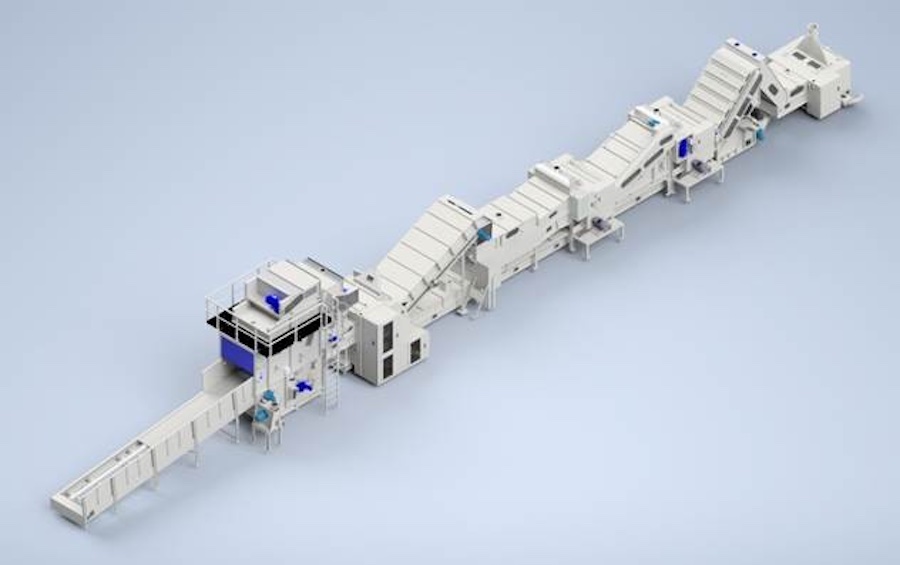
DiloGroup 3D-Lofter © 2021 Dilo


Recently Dilo added water entanglement lines to its portfolio by cooperating with SICAM S.r.l., a well-known producer of high- quality machinery for the nonwovens industry. Apart from state of the art spunlace lines, DiloGroup is able to fulfill demands and requirements for products having improved tensile strength ratios with Dilo high-speed carding and layering technology.

In 119 years of history, the company has always set new standards regarding machine performance and efficiency. Innovative technologies like DI-LOUR, DI-LOOP and Hyperpunch-needling have created new markets for the nonwovens industry and pushed needlepunch technology to be one of the most important and versatile entanglement processes. New approaches promise higher productivity, quality and ground breaking possibilities for nonwoven textiles.


“diloline 4.0” smart manufacturing is available to be used on every line. Numerous information modules can be recalled via mobile apps and cloud data (mindSpheres). These methods allow the user to improve control of the machines and to generate production data to further secure the complex functions within the production system independently of personnel and shift. Standstill times are decreased.

The 3D-Lofter technology is adding numerous possibilities to nonwovens. It works like a 3D- printer whose ink consist of fibres and the addition of adjustable amounts of fibre in a specific pattern on top of fibre mats or needled felts enables applications like decorative features, precise reinforcement or improved fibre mat quality. Furthermore, nearly all fibres like PES, carbon or natural fibres are usable. 
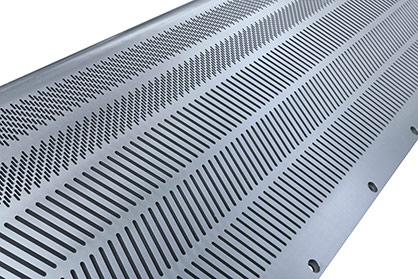
DiloGroup needle pattern 8000X © 2021 Dilo


Also in the classical needling process Dilo achieves steady improvements. The recently developed needle pattern 8000X generates a new level of homogenous surface based on even distribution of stitches. At the same time, this needleboard allows a high stitching density at high line speeds, due to the high number of needles. Furthermore, related patterns like 6000X are ready to be used in Hyperpunch needlelooms.

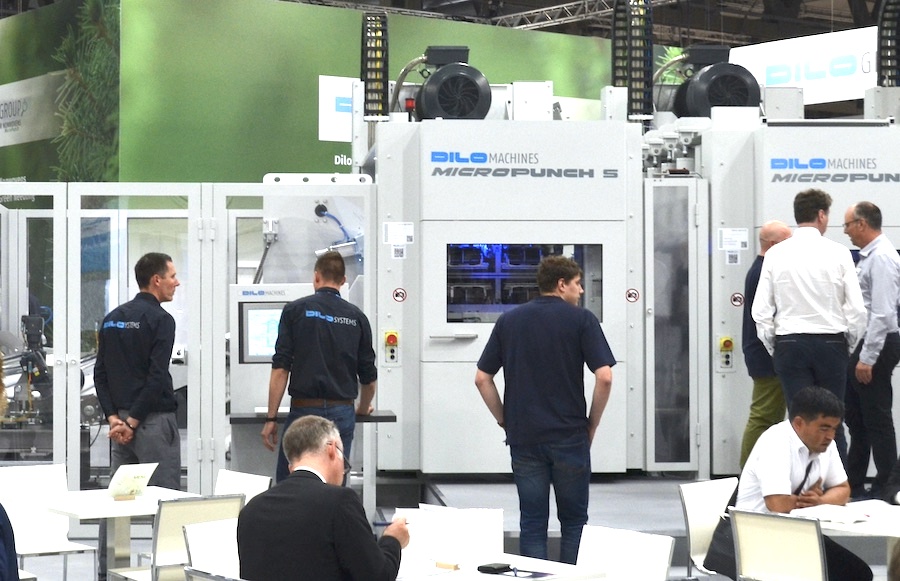
“Microneedling” has been developed as an alternative to water entanglement. Optimized kinematics and maxed out stitch density generate intense but gentle needling at a high line speed. These fabrics can match water jet products regarding quality and productivity at a weight of 60 g/m2 and more. The main advantage here is the low energy consumption, since no high pressure and water processing is needed, which will gain importance in upcoming challenges to the industry for a low CO2 footprint.

These and other fibre processing and nonwoven fabric related topics can be discussed in detail with DiloGroup during ITMA Asia from June, 12 to 16 , 2021 at our booth No. A09 in hall H7.


More News from Dilo, Oskar Maschinenfabrik KG

#Techtextil 2026

Modernizing Needling – DiloGroup at Techtextil & INDEX 2026

With the theme “Modernizing Needling”, the DiloGroup presents a comprehensively enhanced portfolio for needling technology. The objective is to further increase the performance and application range of needlefelt production lines in terms of productivity, flexibility, and the development of new products, thereby meeting the growing demands of modern technical textiles.

#ITMA Asia + CITME Singapore 2025

Dilo Group at ITMA ASIA Singapore 2025

At ITMA ASIA Singapore, the Dilo Group will exhibit at Booth No. H2 – D202. Together with Kansan Materials, Izmir, the company will present its latest developments and looks forward to welcoming visitors to exchange ideas and explore innovations in needling technology.

#Nonwoven machines

ALMA boosts floor covering production with high-performance line from DiloGroup

ALMA in Florence is a specialist in the floor covering sector providing high quality products in a vast range of styles, colours and aesthetics. For its own fibre supply Messrs. ALMA keep an inhouse production of PP fibre in order to accommodate their need of excellent raw materials and broad production needs.

#Nonwoven machines

Dilo Systems and Kansan Group partnership announcement

Dilo Systems GmbH, a Germany-based manufacturer specializing in complete nonwoven lines, and Kansan Group, a Turkish manufacturer specializing in nonwoven converting lines, end-of-line solutions, and Wetlaid Nonwoven machinery, have signed a strategic partnership agreement to supply custom nonwoven lines.

More News on ITMA Asia + CITME 2020

Latest News

#Techtextil 2026

AI, Start-ups, Research: Techtextil and Texprocess bring together players in the textile industry

From start-ups to universities and research institutes: at Techtextil and Texprocess, the world’s leading innovation trade fairs in Frankfurt am Main, exhibitors present future-oriented concepts for the global textile industry. With the international Campus & Research area, a strong participation from start-ups and the latest AI applications for textile processing, both trade fairs showcase current developments in the textile industry. By bringing together innovation, research and application, they enable new partnerships across the textile value chain.

#Techtextil 2026

IVGT joint stand brings innovation and networking to Techtextil 2026

At Techtextil 2026 and the parallel Texprocess 2026, key transformation topics such as artificial intelligence, digitalisation, sustainability, recycling and the circular economy will be reflected across the show. Against this backdrop, the IVGT, together with 16 member companies, will present its joint stand in Hall 12.1 (Stand D62) as a platform for exchange and networking.

#Man-Made Fibers

Indorama Ventures supports Southeast Asia’s textile customers with reliable regional supply and global innovative portfolio

Indorama Ventures, one of the leading global polyester fiber and filament yarn suppliers globally, will participate in Indo Intertex 2026 in Jakarta this April, making its diverse global portfolio available to apparel, home textile, and hygiene customers across Southeast Asia.

#Raw Materials

New study shows low environmental impact by Cotton made in Africa Organic Cotton from Tanzania

Today, the Aid by Trade Foundation (AbTF) is announcing the results of a comprehensive life-cycle analysis (LCA) for cotton produced in Tanzania under the Cotton made in Africa Organic (CmiA Organic) standard. The study emphasises the small ecological footprint of CmiA Organic verified cotton. This can largely be traced back to the absence of synthetic pesticides, artificial fertilisers, and artificial irrigation. Consequently, CmiA Organic cotton can help the textile industry meet regulatory requirements as well as science-based targets. The results also show that the consequences of climate change threaten the livelihoods of these cotton farmers, even though the type of agriculture they practise barely contributes to climate change.

TOP


