#ITMA 2023
Mayer & Cie. presented three circular knitting machines with great market potential at ITMA
Another established model is the OVJA 2.4 EM, currently the most productive machine in its area. It specialises in mattress cover fabrics and Mayer & Cie. has developed a spacer kit to add to its capabilities.
Customers interested in jacquard machines were able to take an off-site look at the MJ 3.2 E and the OVJA 1.6 EE not far from the exhibition venue at Savio Macchine.
“We focus our portfolio on machines that earn our customers a large part of their added value,” says Benjamin Mayer, Managing Partner at Mayer & Cie. “We have further improved established models and developed new ones in order to cater for central market requirements with premium machines.”
Making tried and trusted even better: Relanit 3.2 HS
The Relanit 3.2 HS is Mayer & Cie.’s best-selling machine by far. Customers rate its productivity highly, especially in connection with elastomeric plating. The mechanical single jersey model processes a wide range of yarns and qualities most reliably. It also scores points for energy efficiency. The Relanit 3.2 HS’s energy consumption is up to 30 per cent lower than that of a conventional circular knitting machine.
New yarn guide for the Relanit 3.2 HS
In its latest iteration the Relanit 3.2 HS comes with a new yarn guide that makes feeding elastic thread significantly easier. Existing machines can be upgraded to incorporate the new yarn guide.
Cooperation with Groz-Beckert
A further innovation consists of equipping the Relanit 3.2 HS with improved needles and sinkers. Developed jointly with Groz-Beckert, the needle’s predetermined breaking point prevents it from breaking uncontrolled under high load or with a defective needle latch and in the worst case broken needle butts, requiring more complex intervention by the knitter. “With this improvement we reduce Relanit 3.2 HS downtimes,” says Axel Brünner, senior product manager at Mayer & Cie.
The new sinker was also developed jointly with Groz-Beckert. With the new sinker the Relanit 3.2 HS runs more smoothly, more quietly and with less wear and tear. At higher speeds the thread tension increases less sharply too, thereby reducing the likelihood of faults in the fabric even with exacting qualities like sustainable cotton. The new sinker also makes setting the lower swing curve unnecessary, which in turn makes gauge gauges simpler.
Jacquard is trump
Customers were able to inspect three Mayer & Cie. jacquard machines at or near ITMA. At the trade fair stand itself the textile machinery manufacturer exhibited an OVJA 2.4 EM. At Mayer & Cie.’s Italian representative Savio Macchine interested ITMA visitors were able to see the MJ 3.2 E and the OVJA 1.6 EE in action.
Productive, more productive, OVJA 2.4 EM – Now with spacer
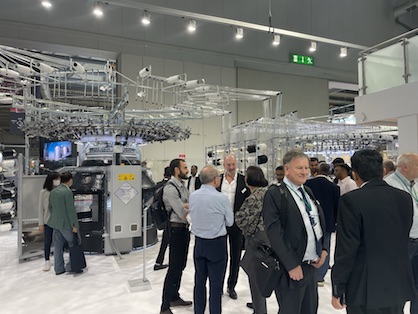
The OVJA 2.4 EM is one of five machines in the Mayer & Cie. portfolio that are specially designed for knitting mattress cover fabric. In this segment the most productive model in the market is the Mayer & Cie. OVJA 2.4 EM. In a 38-inch diameter it knits up to 30 kilograms of sought-after 300 grams per square metre fabric per hour.
This double-layer machine’s portfolio has been extended. In a few simple steps the OVJA 2.4 EM can be converted to knit spacer fabric in gauges of E18 to E20. Visitors were able to watch the machine on show at ITMA knitting spacer fabric with a hole structure.
Further improvements to the OVJA 2.4 EM
A feature that delivers even greater reliability is the thread fluctuation system, which is installed in every other system. It ensures a constant thread tension and prevents the formation of thread loops or dropped stitches. The cross-flow nozzle can be switched off manually.
The new horizontal yarn guide serves the same purpose: to improve the OVJA 2.4 EM’s reliability and user friendliness. The horizontal yarn guide has a larger bore, which is especially beneficial when using a thicker weft yarn. Adjustments for a change in height of the rib dial are not necessary. The improved hold-down function is particularly useful when long floats are involved.
MJ 3.2 E and OVJA 1.6 EE in the Savio Macchine showroom
The MJ 3.2 E is an electronic single jersey jacquard machine. Interested Mayer & Cie. visitors were able to see it in action at Savio Macchine. The MJ 3.2 E is a specialist in mesh and body mapping. It knits electronic jacquard using the two- or three-way technique as required.
The OVJA 1.6 EE was the second off-site exhibit on show at Savio. A double jersey jacquard machine, it has gained a reputation for being the most reliable choice in its sector. It knits both double-face fabric with a lay-in yarn and spacer fabrics.
SF4-3.2 III for lightweight 3-thread fleece fabrics
Mayer & Cie.’s third machine, the SF4-3.2 III, addresses a major trend in the clothing industry. Lightweight elastic three-thread fleece fabrics in both pure cotton and cotton blends are very much in demand. “In this new machine,” Axel Brünner, senior product manager at Mayer & Cie., explains, “we combine our tried and trusted S4 3.2 II and components from our MBF 3.2 such as the stitch formation”.
One of its most impressive features is its plating performance. The exhibitors demonstrated it most impressively by means of the black ground yarn that could not be seen on the front of the fabric. That testified to the quality of the plating – with the result that single dying is sufficient. The plating is so good that double dying is not necessary unless polyester yarn shows through, and if the polyester is processed invisibly in the way the SF4-3.2 III does the job, single dying is sufficient, cutting costs and saving resources.
Conversion kit for even greater flexibility
To make the SF4-3.2 III even more flexible Mayer & Cie. offers a conversion kit that transforms it into an S4-3.2 II in a few simple steps. It then knits single jersey structures with up to four needle tracks, such as piqué and double piqué, all in fine gauges of up to E44. There is also a kit to convert an S4-3.2 II into an SF4-3.2 III.