[pageLogInLogOut]

#ITMA 2019

DiloGroup at ITMA again with a complete operating production line
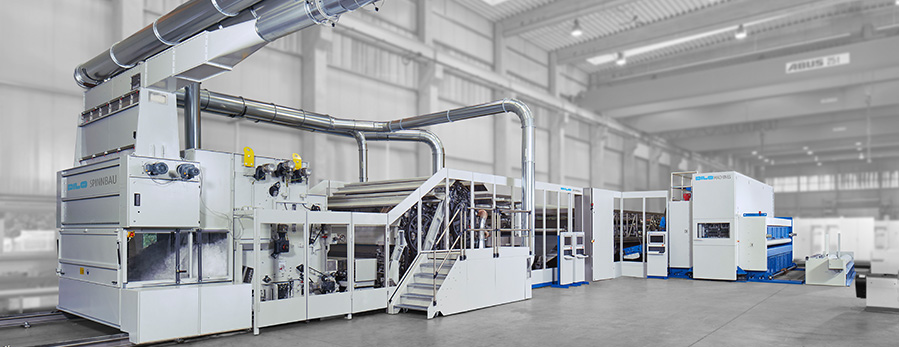
Dilo needlefelt production line, working width 7 m (c) 2019 Dilo
At ITMA 2019 DiloGroup (Hall 5, booth No. B201) will once again exhibit a complete operating production line on a booth space of ca. 1.100 m2. This line will illustrate improvements and modifications as well as innovations in numerous machine design-engineering aspects. The complete technological process starting with fibre preparation via card feeding, to precise web forming and the new Hyperpunch H? needling will be shown. Elements of “industry 4.0” have been incorparated to design the assisting operating system “diloline 4.0”.


In the fibre preparation phase with DiloTemafa components, the “Baltromix Pro” will show a faster blend changeover which is a prerequisite for even higher throughput. An exact control of the filling level avoids idling or over-filling by feeding fibre bales with the aid of a “bale timer”. The sensor module “DI-LoWatt” assures fibre transport with a minimum of air and thus saves energy.

The current universal card feeder VRS-P Vibration Chute is supplemented by a fine opening stage to further improve feeding quality. After the “VectorQuadroCard” the latest version of our high speed crosslapper “HyperLayer” will be included which allows highest throughput at small to medium layering widths and which is especially suited for hydroentanglement lines.

The advantages of the elliptical needle beam kinematics of Hyperpunch technology is even better used in the “Hyperpunch H?” loom as a very economic version of the classical Hyperpunch technique. The needleloom on show – DI-LOOM OD-II SLH?V – is equipped with the new needle pattern 6000X to give a very homogeneous stitching distribution.

An automatic starting-aid “smart-start” for the card with automatic threading to crosslapper and needleloom reduces the number of manual interventions.

 In the field of “textile additive manufacturing” the “3D-Lofter” will offer further chances of fibre savings for needlefelts used in the automotive and other applications because topologically distributed fibre masses can be positioned in the felt where needed by so called “individual webforming spots”.


Needle arrangement “8000X” for a more even needlefelt surface (c) 2019 Dilo

“diloline 4.0” includes a wide variety of “smart manufacturing” actions in collaboration with Siemens which all aim at further simplifying operation, increasing transparency in web forming and consolidation thereby increasing efficiency. Production data are stored, documented and compared. An “alarm monitor” indicates disturbances. A production analysis documents the reasons for standstill times. This data can be used to avoid disturbances. Numerous information modules can be recalled via mobile apps and cloud data (mindSpheres). All these methods to control the machines and to generate production data will be helpful to further secure the complex functions within the production system independently of personnel and shift.

DiloGroup looks forward to meeting numerous visitors from around the world at this most important textile machinery exhibition in Barcelona from June 20 – 26, 2019.

More News from Dilo, Oskar Maschinenfabrik KG

#Nonwoven machines

DiloGroup - Complete nonwoven needling line for hygiene materials in the United States

DiloGroup has received an order for a complete needling line designed for the production of hygiene materials in the United States. This project further strengthens our position in the American hygiene sector and reflects the continued demand for reliable, high-performance nonwoven equipment.

#INDEX 2026

“Needle punching technology is more universal and sustainable than ever!”

Needle punching technology was long regarded as a rather traditional and comparatively slow technology within the nonwovens industry. In this interview, Johann Philipp Dilo explains why needle punching is more relevant than ever today – ranging from energy efficiency and resource conservation to hygiene applications, new machine concepts and design-oriented nonwoven solutions.

#Nonwovens

Temafa Maschinenfabrik GmbH supplies a complete decortication plant for processing hemp straw to Hanffaser Geiseltal eG

Temafa Maschinenfabrik GmbH, a leading supplier of machinery and plants for fibre processing, has successfully secured an order to supply a complete plant for processing hemp straw to Hanffaser Geiseltal eG, based in Mücheln.

#Techtextil 2026

Modernizing Needling – DiloGroup at Techtextil & INDEX 2026

With the theme “Modernizing Needling”, the DiloGroup presents a comprehensively enhanced portfolio for needling technology. The objective is to further increase the performance and application range of needlefelt production lines in terms of productivity, flexibility, and the development of new products, thereby meeting the growing demands of modern technical textiles.

More News on ITMA 2019

Latest News

#Industry 4.0 / Digitalization

Coats Digital launches AI-powered GSD RealMotion for motion analysis

Coats Digital has launched GSD RealMotion, an AI-powered solution designed to provide apparel manufacturers with greater visibility into factory-floor operations. By analysing shop-floor video and applying Coats Digital’s GSD methodology, the solution turns video recordings into structured, motion-by-motion method studies.

#Textile chemistry

Archroma and Lameirinho partner in pioneering deployment of InOneGO single-step dyeing

Archroma, a global leader in specialty chemicals, and Lameirinho, a leading home textiles manufacturer based in Portugal, are collaborating to bring InOneGO by Archroma, a new single-step dyeing process, into commercial production. Lameirinho’s first InOneGo bedlinens collection is now available worldwide.

#Knitting & Hosiery

KARL MAYER launches extra-wide HKS 3-M EL for increased productivity

KARL MAYER has launched a new extra-wide version of its HKS 3-M EL tricot machine, designed to increase productivity particularly in the manufacture of textiles for sports, activewear and athleisure applications.

#Research & Development

Reducing development times for technical textiles by accelerated thermo-oxidative aging in a high-pressure autoclave

Synthetic polymers used in technical textiles can be effectively protected against degradation caused by heat, oxygen, and water through the use of stabilizer systems. This enables service lives of several decades, extending to more than 50 years. As the use of durable technical textiles continues to grow, so does the demand for reliable methods to predict their service life within economically feasible testing periods. For the first time the German Institutes of Textile and Fiber Research Denkendorf (DITF) developed methods for robust service life prediction for textiles in an IGF research project.

TOP