[pageLogInLogOut]

#ITM 2016

Setex will demonstrate the adavantages of OrgaTEX X1 software at ITM
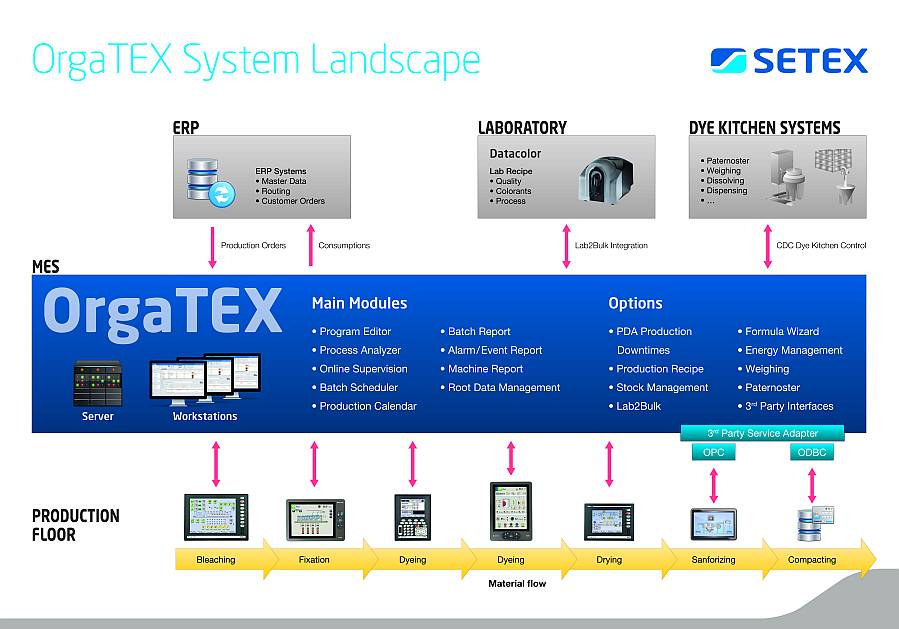
Setex OrgaTEX landscape (c) 2016 Setex
One of the greatest challenges of our time is the growing contrariness between the economic and quality requirements in the textile industry, and taking advantage of all existing technological opportunities. Setex, a global leader in designing, manufacturing and implementation of automation solutions for textile dyeing and finishing machines, will demonstrate the new OrgaTEX X1, which offers an efficient use of latest technologies.
The OrgaTEX X1 production management software guides the intelligent communication to the machines for an efficient production and energy management.

The process and recipe handling - constantly used parts of the software - is new designed. The modules provide impressive new features to simplify complex production steps, to save expert know-how systematically and to optimize resource efficiency.

OrgaTEX X1 is also highly customizable. Although dyeing machines significantly  lowering liquor ratio and requiring less chemical quantities, this software suite still can reduce dyeing time and production cost, optimize the throughput and expose weak  spots and bottlenecks. OrgaTEX X1 has enhanced adapters to communicate with dyeing, continue and finishing machines for ecological and cost improvement: Each machine can be considered within the overall energy management concept.

Intelligent integration of dosing systems saves chemicals and water. The operation is independent of operator skill.

The philosophy of the new software is to bring the best-in-class recipe tools but still providing the flexibility of using simple flat recipe methods. As such, converted information and experience is usable as formulas, wizards assist the creation of formulas and there are predefined formulas shipped with the system.

This is essential for a fast and smooth implementation in a production running at full capacity. Existing machines can easily be refitted to benefit from SETEX´s knowledge of specific solutions. To learn more ask for demonstrations at ITM 2016 in Hall 12, Booth Number 1209B.

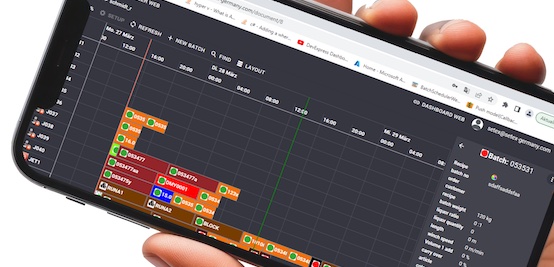
Pic: OrgaTEX X1 recipe tool

More News from SETEX Schermuly textile computer GmbH

More News on ITM 2016

Latest News

#Techtextil 2026

AI, Start-ups, Research: Techtextil and Texprocess bring together players in the textile industry

From start-ups to universities and research institutes: at Techtextil and Texprocess, the world’s leading innovation trade fairs in Frankfurt am Main, exhibitors present future-oriented concepts for the global textile industry. With the international Campus & Research area, a strong participation from start-ups and the latest AI applications for textile processing, both trade fairs showcase current developments in the textile industry. By bringing together innovation, research and application, they enable new partnerships across the textile value chain.

#Techtextil 2026

IVGT joint stand brings innovation and networking to Techtextil 2026

At Techtextil 2026 and the parallel Texprocess 2026, key transformation topics such as artificial intelligence, digitalisation, sustainability, recycling and the circular economy will be reflected across the show. Against this backdrop, the IVGT, together with 16 member companies, will present its joint stand in Hall 12.1 (Stand D62) as a platform for exchange and networking.

#Man-Made Fibers

Indorama Ventures supports Southeast Asia’s textile customers with reliable regional supply and global innovative portfolio

Indorama Ventures, one of the leading global polyester fiber and filament yarn suppliers globally, will participate in Indo Intertex 2026 in Jakarta this April, making its diverse global portfolio available to apparel, home textile, and hygiene customers across Southeast Asia.

#Raw Materials

New study shows low environmental impact by Cotton made in Africa Organic Cotton from Tanzania

Today, the Aid by Trade Foundation (AbTF) is announcing the results of a comprehensive life-cycle analysis (LCA) for cotton produced in Tanzania under the Cotton made in Africa Organic (CmiA Organic) standard. The study emphasises the small ecological footprint of CmiA Organic verified cotton. This can largely be traced back to the absence of synthetic pesticides, artificial fertilisers, and artificial irrigation. Consequently, CmiA Organic cotton can help the textile industry meet regulatory requirements as well as science-based targets. The results also show that the consequences of climate change threaten the livelihoods of these cotton farmers, even though the type of agriculture they practise barely contributes to climate change.

TOP