[pageLogInLogOut]

#INDIA ITME 2022

First ITME since 2018 ends “satisfactorily” for Mayer & Cie.

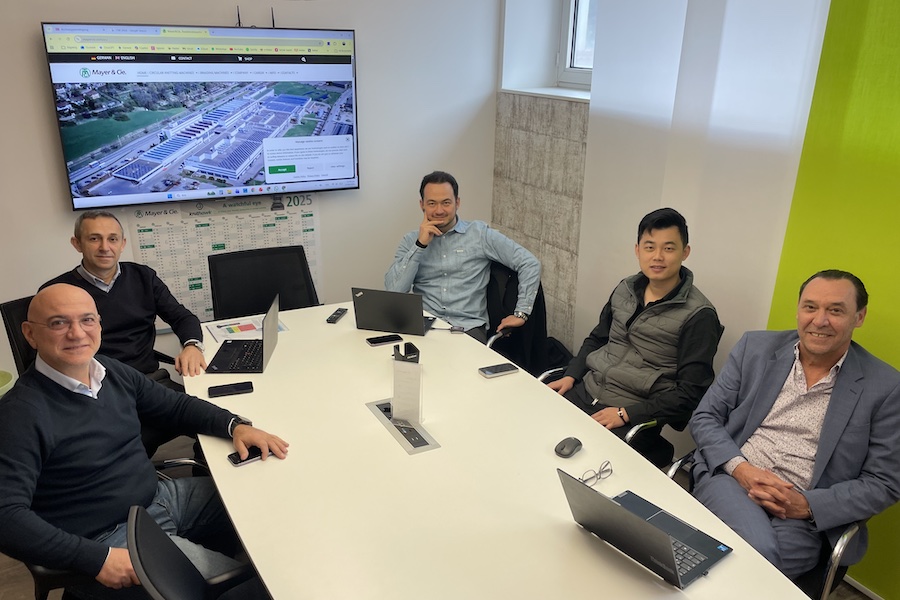
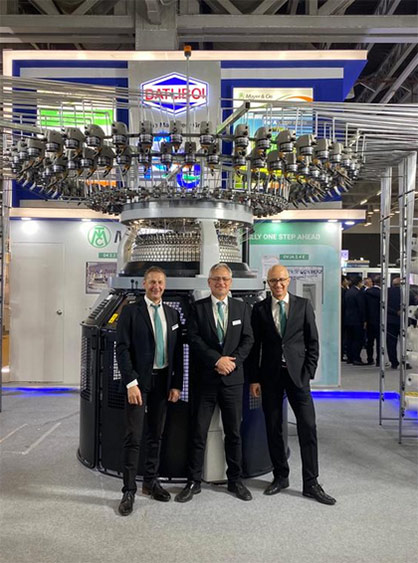
The Batliboi and Mayer & Cie. team at ITME 2022. © 2022 Mayer&Cie
“We are satisfied with how the trade fair went,” says Timo Schramm, area sales manager at Mayer & Cie. and responsible for India. “Of course, the uncertainties of the world situation are reflected in Indian demand for textile machinery in general, including circular knitting machines.” Export demand has declined and domestic demand has also stagnated. However, local companies assume that demand will return to normal in the medium term, according to Schramm. The number of sales on the ITME also indicates this.

The ITME exhibition machine, an OVJA 2.4 E, met with interest among the visitors. Mayer & Cie. presented the machine at the stand of the Indian representative Batliboi, with whom the circular knitting machine manufacturer has been working for a long time. The machine, with a diameter of 38 inches, is aimed at manufacturers of mattress cover fabrics. Mayer & Cie. enjoys a good reputation in this segment.

In addition to this application, Mayer & Cie. is experiencing constant demand for its single jersey machines. “Single jersey with elastane and in open width are the common requirements”; Timo Schramm knows. These are fulfilled, for example, by the Relanit 3.2 HS and the circular knitting machines from the S4 series. In the double jersey segment, it is mainly the D 4 2.2 II in E 18 for rib and rib structures that are favoured. The D4 2.2 HPI high-performance machine for interlock fabrics is also popular in India.


Their efficiency speaks for all Mayer & Cie. machines. “The desire for sustainable solutions once again brings this feature of our machines, coupled with their long service life, into focus,” says Timo Schramm confidently.
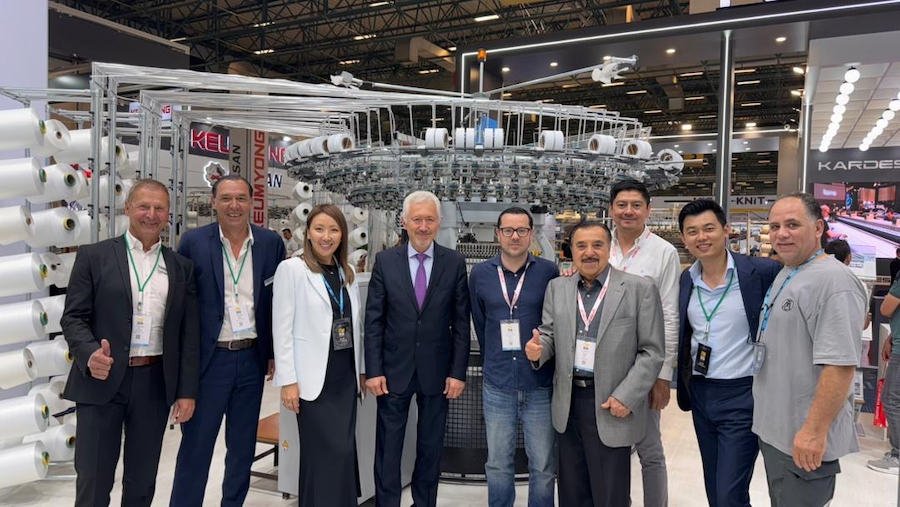
The Mayer & Cie. team in front of the OVJA 2.4 E at ITME 2022. © 2022 Mayer&Cie


More News from Mayer & Cie. GmbH & Co.

#Knitting & Hosiery

Huixing acquires insolvent Mayer & Cie.

Insolvency proceedings for the circular knitting and braiding machine manufacturer Mayer & Cie. were opened on December 1, 2025. Immediately following the opening of proceedings, the complete cessation of business operations was initiated. Most employees were subsequently given notice effective the end of February 2026. The production of the remaining orders in the circular knitting segment is expected to be completed by the end of the month. As early as December 2025, Mayer & Cie.’s braiding machine division was sold to an Italian investor.

#Knitting & Hosiery

Mayer & Cie. to shut down after failed search for investor – 270 jobs affected

Mayer & Cie., the long-established German manufacturer of circular knitting and braiding machines, will cease operations after its international search for an investor ended without success. The company, based in Albstadt-Tailfingen, had been undergoing insolvency proceedings in self-administration since its filing on 23 September 2025. As Schwarzwälder Bote reports, the insolvency court has now formally opened the proceedings, triggering the decision to wind down the business in an orderly process.

#Knitting & Hosiery

Mayer & Cie. files for insolvency under self-administration

On 23 September 2025, Mayer & Cie., a manufacturer of circular knitting and braiding machines in Albstadt, filed an application for the opening of insolvency proceedings in self-administration at the Hechingen District Court.

#ITMA Asia + CITME Singapore 2025

Mayer & Cie. at ITMA Asia

Mayer & Cie. will participate in ITMA Asia from October 28 to 31, 2025, which takes place in Singapore. Visitors will find the manufacturer of circular knitting machines and braiding machines in Hall 5, Stand D 301. At its booth, the company will be showing a new circular knitting for jacquard fabrics - the OVJA 2.4 EC II - and will provide an overview of its digital and smart solutions. Another focus is on the machines of Mayer & Cie's "Performance Line": circular knitting machines, which are the most efficient solution in their respective classes.

More News on INDIA ITME 2022

Latest News

#Techtextil 2026

AI, Start-ups, Research: Techtextil and Texprocess bring together players in the textile industry

From start-ups to universities and research institutes: at Techtextil and Texprocess, the world’s leading innovation trade fairs in Frankfurt am Main, exhibitors present future-oriented concepts for the global textile industry. With the international Campus & Research area, a strong participation from start-ups and the latest AI applications for textile processing, both trade fairs showcase current developments in the textile industry. By bringing together innovation, research and application, they enable new partnerships across the textile value chain.

#Techtextil 2026

IVGT joint stand brings innovation and networking to Techtextil 2026

At Techtextil 2026 and the parallel Texprocess 2026, key transformation topics such as artificial intelligence, digitalisation, sustainability, recycling and the circular economy will be reflected across the show. Against this backdrop, the IVGT, together with 16 member companies, will present its joint stand in Hall 12.1 (Stand D62) as a platform for exchange and networking.

#Man-Made Fibers

Indorama Ventures supports Southeast Asia’s textile customers with reliable regional supply and global innovative portfolio

Indorama Ventures, one of the leading global polyester fiber and filament yarn suppliers globally, will participate in Indo Intertex 2026 in Jakarta this April, making its diverse global portfolio available to apparel, home textile, and hygiene customers across Southeast Asia.

#Raw Materials

New study shows low environmental impact by Cotton made in Africa Organic Cotton from Tanzania

Today, the Aid by Trade Foundation (AbTF) is announcing the results of a comprehensive life-cycle analysis (LCA) for cotton produced in Tanzania under the Cotton made in Africa Organic (CmiA Organic) standard. The study emphasises the small ecological footprint of CmiA Organic verified cotton. This can largely be traced back to the absence of synthetic pesticides, artificial fertilisers, and artificial irrigation. Consequently, CmiA Organic cotton can help the textile industry meet regulatory requirements as well as science-based targets. The results also show that the consequences of climate change threaten the livelihoods of these cotton farmers, even though the type of agriculture they practise barely contributes to climate change.

TOP