[pageLogInLogOut]

#INDEX 20

ANDRITZ to supply a neXline wetlace hybrid line to Albaad, Israel
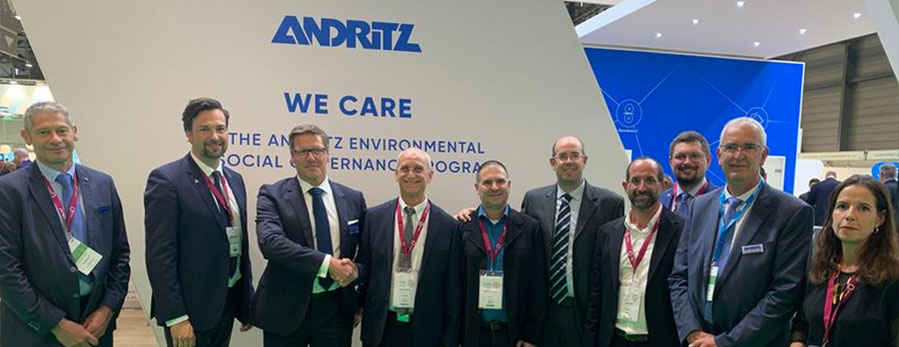
Albaad orders neXline wetlace hydrid - handshake at INDEX show © ANDRITZ
International technology group ANDRITZ has received an order from Albaad Massuot Yitzhak Ltd. to supply a neXline wetlace hybrid line for their Dimona facilities, Israel.

The line will produce a wide variety of pulp-based wet wipes and is scheduled for start-up during the third quarter 2023.

The state-of-the-art neXline wetlace hybrid is the perfect combination of inline drylaid and wetlaid web forming with hydroentanglement and drying, including quality control equipment and a Metris Industry 4.0 package. All components will be delivered by ANDRITZ and are designed to produce first-class fabrics, including biodegradable, carded-pulp and flushable/dispersible nonwovens for end uses as wipes.

Tobias Schäfer, Vice President Sales at ANDRITZ Nonwoven, comments: “Our innovative production line gives Albaad enormous flexibility in the production of wipes. In addition, the Metris digitalization package by ANDRITZ will provide Albaad with highly efficient and smart operation.”

Dan Mesika, CEO and President of Albaad, says: “We are dedicated to developing new products – such as eco-friendly, biodegradable wipes. As pioneering manufacturers of our Hydrofine® flushable wipes, we are committed to environmental sustainability. Thanks to the new ANDRITZ line, we will enlarge the product portfolio at our Dimona production site with innovative fabrics and high efficiency.


Gadi Choresh, President of the Nonwovens Division at Albaad, says: “Our knowledge and experience in drylaid and wetlaid technology, together with the state-of-the-art equipment supplied by ANDRITZ, will enable us to provide the market with natural-source nonwovens and the best answer to the market demand.”

Albaad is one of the world’s three largest wet wipe manufacturers and is committed to delivering excellent wipes for every need. The company runs world-leading production facilities on three continents, each equipped with the latest technologies. Albaad produces spunlace and flushable fabrics in its facilities as well as purchasing from other roll goods suppliers in order to support production of a wide variety of wipes.




More News from Andritz Küsters GmbH

More News on INDEX 20

Latest News

#Techtextil 2026

AI, Start-ups, Research: Techtextil and Texprocess bring together players in the textile industry

From start-ups to universities and research institutes: at Techtextil and Texprocess, the world’s leading innovation trade fairs in Frankfurt am Main, exhibitors present future-oriented concepts for the global textile industry. With the international Campus & Research area, a strong participation from start-ups and the latest AI applications for textile processing, both trade fairs showcase current developments in the textile industry. By bringing together innovation, research and application, they enable new partnerships across the textile value chain.

#Techtextil 2026

IVGT joint stand brings innovation and networking to Techtextil 2026

At Techtextil 2026 and the parallel Texprocess 2026, key transformation topics such as artificial intelligence, digitalisation, sustainability, recycling and the circular economy will be reflected across the show. Against this backdrop, the IVGT, together with 16 member companies, will present its joint stand in Hall 12.1 (Stand D62) as a platform for exchange and networking.

#Man-Made Fibers

Indorama Ventures supports Southeast Asia’s textile customers with reliable regional supply and global innovative portfolio

Indorama Ventures, one of the leading global polyester fiber and filament yarn suppliers globally, will participate in Indo Intertex 2026 in Jakarta this April, making its diverse global portfolio available to apparel, home textile, and hygiene customers across Southeast Asia.

#Raw Materials

New study shows low environmental impact by Cotton made in Africa Organic Cotton from Tanzania

Today, the Aid by Trade Foundation (AbTF) is announcing the results of a comprehensive life-cycle analysis (LCA) for cotton produced in Tanzania under the Cotton made in Africa Organic (CmiA Organic) standard. The study emphasises the small ecological footprint of CmiA Organic verified cotton. This can largely be traced back to the absence of synthetic pesticides, artificial fertilisers, and artificial irrigation. Consequently, CmiA Organic cotton can help the textile industry meet regulatory requirements as well as science-based targets. The results also show that the consequences of climate change threaten the livelihoods of these cotton farmers, even though the type of agriculture they practise barely contributes to climate change.

TOP