[pageLogInLogOut]

#Home Textiles

Heimtextil launches digital materials library
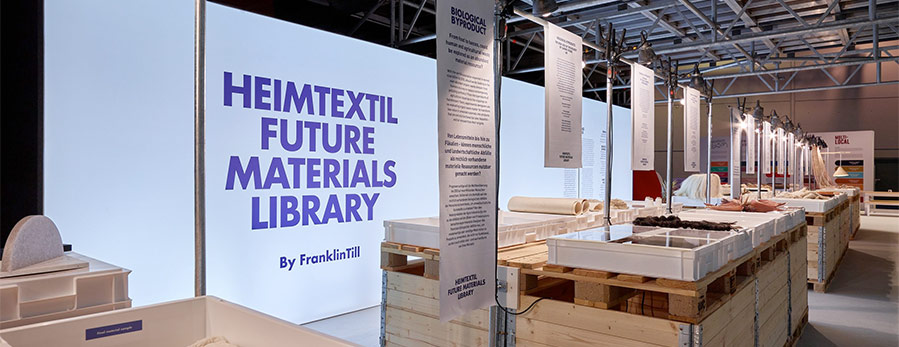
© 2021 Messe Frankfurt
Progressive material innovations presented digitally: following the cancellation of this year’s fair due to the corona pandemic, Heimtextil is extending its range of digital services and launching a new online materials library entitled ‘Future Materials Library’. 24 future-oriented materials for interior applications can now be found at www.heimtextil.messefrankfurt.com/future.

Heimtextil is now showing a selection of innovative materials from all over the world in the digital ‘Future Materials Library’. At the last physical Heimtextil in 2020, visitors had the opportunity to explore the ‘Future Materials Library’ with all their senses. Now, in the online version of the library, visitors can discover the potential of previously unknown textiles at any time. The ‘Future Materials Library’ invites visitors to open their minds to experimental approaches and revolutionary ideas.

The curators of the new materials library are London-based futures-research agency, FranklinTill. “We are transitioning to a materials revolution that will help restore the balance in our relationship to our planet. As part of the Heimtextil Trends 21/22, we present a new selection of materials for interior applications with exciting innovations from all over the world”, says Caroline Till of FranklinTill.

A mix of commercially viable products and developments in an early stage

Imaginative designers and environmentally-aware manufacturers: the Future Materials Library 2021 offers materials pioneers a platform and presents a first-class mix of economically proven and revolutionary developments. FranklinTill has organised the materials in four themes: REGENERATIVE CROPS, REMADE FIBRES, HARVESTING WASTE STREAMS and SUSTAINABLE COLOUR.

An example of a supplier of regenerative crops is the British company Tengri, which obtains rare yak fibres directly from a cooperative of nomadic yak shepherds in the Khangai region of Mongolia. In this way, Tengri enriches the pool of sustainable natural materials that, in addition to yak fibres, includes hemp, nettle and flax.

When it comes to remade fibres, the Finnish pioneers from Ioncell supply a pioneering material: they use an ionic liquid to turn used textiles, pulp, old newspapers and cardboard into strong textile fibres, which are then used to make long-lasting, high-quality fabrics.?The French-Dutch company Tarkett also exploits waste products and gives fitted and used floor coverings a second life. With the aid of ground-breaking technologies, the two main components of carpet tiles – yarn and backing – are separated and a yarn purity of 95 percent guaranteed.

Against the background of 28 million tonnes of food being thrown away every year in Japan, the country’s Food Textile company is dedicated to the reduction of food waste, which it uses to make sustainable dyes. In a patented process, blueberries, red cabbage, coffee and matcha are turned into natural, brilliant textile dyes.


With their different approaches, these textile pioneers provide an exciting contribution to the transformation of the current linear system of production and consumption into a circular model. This is in line with the objectives of the ‘Future Materials Library’, which aims to convince both producers and consumers of the benefits of the circular-flow economic principle.

Resources are running low

Thus, the new Heimtextil materials library tackles one of the main problems of the modern age: the shortage of resources on earth. In particular, textile production creates huge and continuously growing quantities of waste. And, over past decades, the design business has developed a ‘take, make and discard’ model of consumption that is incredibly harmful for our planet. In the climate-emergency era, however, future-oriented designers are learning from nature and working together with it. They endeavour to make use of the power of highly efficient natural circular systems to create textiles and materials that are better for both humans and the planet.

Heimtextil Trends: a guide for the international sector

The ‘Future Materials Library’ is part of the Heimtextil Trends that, for almost three decades, have been offering orientation for the sector by revealing design tendencies for the coming season. Even in the crisis, the Heimtextil Trends remain a vital part of the overall concept of the fair and provide important content for all target groups involved within the worldwide sector. Accordingly, Heimtextil aims to spotlight style-defining design developments taking place within the larger context of lifestyle trends. At the same time, the Heimtextil trend experts scan the exhibitors’ product world and identify unequivocal trends in the sector. In this connection, particular attention is paid to sustainable aspects along the entire value chain – in both the new digital library and live during the fair next January.
More News from Messe Frankfurt GmbH

#Technical Textiles

Techtextil India 2025 concludes on a stellar note: Sports textile, circular supply chains, bio-based materials and resource-efficient manufacturing under spotlight

The 10th edition of Techtextil India 2025 concluded recently at the Bombay Exhibition Centre, Mumbai, with strong buyer turnout, primarily from Western India, reaching 9144 visitors across 235 Indian cities and 45 countries. Over three days, the trade fair brought together leading domestic and international brands, technology providers, institutional buyers and policymakers, reinforcing India’s ambition to emerge as a global hub for value-added technical textiles. The show hosted 216 exhibitors, featuring over 300 brands and showcased cutting-edge solutions across 12 application areas, keeping the show floor busy throughout the three days.

#Heimtextil 2026

Global textile expertise meets high-end contract design: Heimtextil and Hospitality Interiors Europe announce partnership starting 2027

Heimtextil further expands its role as the global leading trade fair for home and contract textiles and textile design – and starts a new partnership with the format Hospitality Interiors Europe (HINT). With the launch, a complementary event will take place alongside Heimtextil 2027, targeting decision-makers from the hotel and high-end hospitality design sector. Both platforms combine their strengths, create tangible synergies for exhibitors and visitors – and expand the holistic interior design offering for architecture, interior design, hospitality and the contract sector. Hospitality Interiors Europe already presents itself at Heimtextil 2026 with its own dedicated lounge area.

#Heimtextil 2026

Artificial Intelligence in focus: Heimtextil 2026 prepares global textile industry for the future with strong content programme

Artificial intelligence (AI) rapidly transforms the textile industry - from creation and production to pricing, distribution and communication. But how can AI be applied successfully, and where does it truly add value? Heimtextil addresses these questions from 13 to 16 January 2026: The comprehensive programme dedicated to the key future field AI strengthens the global industry and opens up new business opportunities as well as practical applications for design, retail, industry, architecture, interior design and contract furnishing.

#Heimtextil 2026

Texpertise Focus AI: Messe Frankfurt puts Artificial Intelligence centre stage at its international textile and apparel trade fairs

Under the banner 'Texpertise Focus AI, Messe Frankfurt will place a strong emphasis on Artificial Intelligence (AI) across its international textile and apparel trade fairs from 2026 onwards, setting a future-shaping signal for the industry. The initiative highlights the responsible use of AI along the entire textile value chain, from fibre production to the point of sale. The programme will launch at Heimtextil in Frankfurt in January 2026.

More News on Home Textiles

#Knitting & Hosiery

Live more beautifully and comfortably with Warp Knits

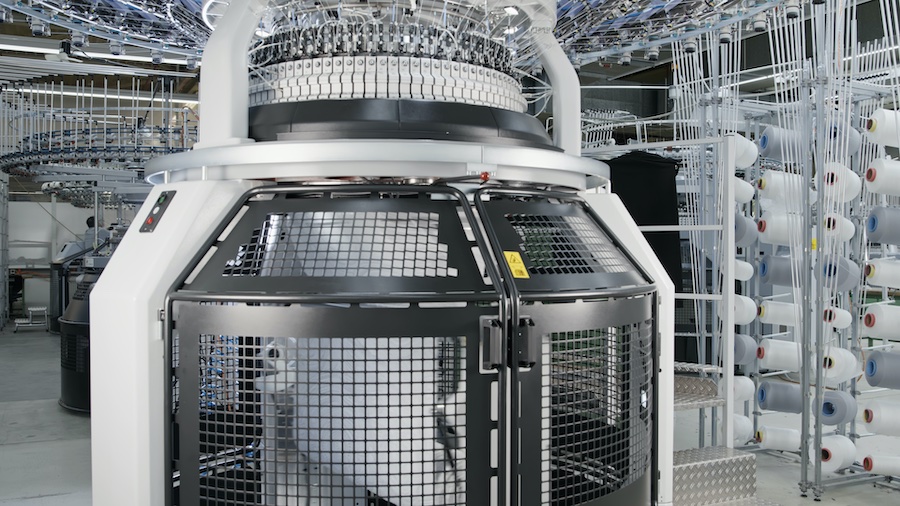
Knitted fabrics are the all-rounders among home textiles. They can be designed in many different ways and are used in mattresses, blankets and pillows as well as in terry towelling, curtains and upholstery fabrics to create trendy designs, constantly new products and good business.

#Home Textiles

Intertextile Shanghai Home Textiles – Spring Edition 2026 returns to meet market demand with innovative bedding solutions

Returning in 2026, Intertextile Shanghai Home Textiles – Spring Edition will take place from 11 to 13 March at the National Exhibition and Convention Center in Shanghai. With rising daily pressures and increasing sleep disorders, demand for high-quality, functional, and sustainable bedding solutions is surging. The fair will spotlight innovative bedding products and technologies designed to meet these evolving consumer needs within this expanding market. Last year’s edition welcomed over 25,000 visitors from 85 countries and regions, reflecting a 7.5% increase in attendance and broader global participation.

#Heimtextil 2026

Mimaki demonstrates versatile, simple TRAPIS textile printing at Heimtextil 2026

Mimaki’s textile pigment transfer printing system, TRAPIS, is able to print on a diverse range of fabrics - unlike traditional processes - including natural fibres and synthetic fabrics. The full solution will be shown on Mimaki’s booth (Hall 3.0 Stand A97), as the company returns to Heimtextil to showcase its advancements in sustainable, high quality and efficient textile printing.

#Home Textiles

Culp reports improved operating results in Q2 as restructuring gains traction

Culp, Inc., a major supplier of mattress and upholstery fabrics, reported its fiscal Q2 2026 results with signs of operational improvement despite continued weakness in the global home furnishings market. Consolidated sales reached USD 53.2 million, slightly above the previous quarter, with the bedding segment growing both sequentially and year-over-year.

Latest News

#Research & Development

Innovation center for textile circular economy inaugurated

Just over eight months after the foundation stone was laid, the new Innovation Center for Textile Circular Economy was officially inaugurated today at TITK Rudolstadt. Thuringia's Minister President Mario Voigt, TITK Director Benjamin Redlingshöfer, and other guests of honor cut the ribbon to the modern building complex and viewed the premises, which are now ready for occupancy. The “DICE – Demonstration and Innovation Center for Textile Circular Economy” is TITK's largest single investment to date. The Free State of Thuringia supported the total cost of €11.5 million with €8 million in GRW and FTI funding.

#Research & Development

Sustainable design of Geosynthetics and roof underlayments made from recyclates

Is it possible to recover plastic recyclates from previously unused waste streams in order to produce high-quality fibers and films? How can bio-based polymer fibers be manufactured so as to allow adjustable biodegradability? These are the questions being addressed by researchers from the Fraunhofer Cluster of Excellence Circular Plastics Economy CCPE in the Zirk-Tex project.

#Associations

Waste2Fashion: FTTH Committed to advancing Circular Fashion in the Mediterranean

As an official partner of the Waste2Fashion project, the Tunisian Federation of Textile and Apparel (FTTH) participated in the Kick-off Meeting held on 10–11 December in Spain. The event brought together project partners from across the Mediterranean, including Spain, Italy, Egypt, Lebanon, and Tunisia, to align on a shared vision and initiate the first implementation steps.

#Associations

AATCC announces 2025 Herman & Myrtle Goldstein Graduate Student Paper Competition winners

The American Association of Textile Chemists and Colorists (AATCC) recognized the winners of the 2025 Herman & Myrtle Goldstein Graduate Student Paper Competition. Founded in 1982 to give student members the chance to conduct and present original research, the competition was renamed in 1994 in honor of Herman and Myrtle Goldstein, following their US$60,000 endowment. Their gift is a lasting remembrance of their dedication to young people in the textile industry.

TOP