[pageLogInLogOut]

#Europe

Commission presents new initiatives boosting European industrial leadership in advanced materials

(c) 2024 EU Commission - Wind turbines in Wallonia
Today, the Commission has proposed an encompassing strategy to move towards EU industrial leadership in advanced materials, a key enabling technology highly relevant for the twin green and digital transition. The Communication on Advanced Materials for Industrial Leadership puts forward concrete steps enabling to align research and innovation priorities and investments in the EU, ensuring European leadership in this key technology. This initiative, eagerly anticipated by the Member States and industry, is the first step towards a common European approach for advanced materials, laying the groundwork for further action.

Advanced materials are intentionally designed and engineered materials to display superior performance or special functions, which can be developed with unprecedented speed thanks to today's scientific understanding and computing power. They are fundamental for example for innovation in energy, electronics, construction and mobility, and therefore crucial for the green and digital transition. The first list of research areas is expected to be expanded overtime in dialogue with the Technology Council to be set-up.

The demand for advanced materials is expected to increase significantly in the coming years, for instance for the production of renewable energy, batteries, zero-emission buildings, semiconductors, medicines and medical devices, satellites, space launchers, planes or for other dual-use applications as well as defence equipment.

The strategy aims to enhance the EU's long-term competitiveness by ensuring the Union remains at the forefront of new material technologies, supporting development, testing and deployment capacities. The actions will also strengthen the EU's open strategic autonomy and economic security by reducing dependencies on critical materials by replacing them or supporting their recycling and reuse.


The Communication proposes actions along five main pillars to be implemented together with EU Member states, industry players and other key stakeholders:

  • Strengthening the European research & innovation ecosystem on advanced materials.
  • Fast-tracking innovative materials to the market. This includes developing a “materials commons”, a European digital infrastructure for advanced materials research and innovation. It will significantly accelerate the design, development and testing of new advanced materials in a controlled environment, also using AI.
  • Increasing capital investment and access to financing. As part of this package of actions, the EU will set up a new partnership with the industry under Horizon Europe, aiming at €500 million of investments for 2025-2027, with at least €250 million coming from private sources.
  • Fostering the production and use of advanced materials. This includes procurement for innovation, standard setting and the launch of an Advanced Materials Academy with the European Institute of Innovation and Technology to make sure European workforce has the necessary skills.
  • Creating a Technology Council for advanced materials to advise on the steering of this initiative with Member States, countries associated to Horizon Europe and industry.
More News from TEXDATA International

#ITM 2026

ITM 2026: The new geography of textile production

New production hubs are emerging across North Africa and Central Asia, while Türkiye is accelerating its transformation toward higher-value, technology-driven and more sustainable textile manufacturing.

#Research & Development

“Production is a product”

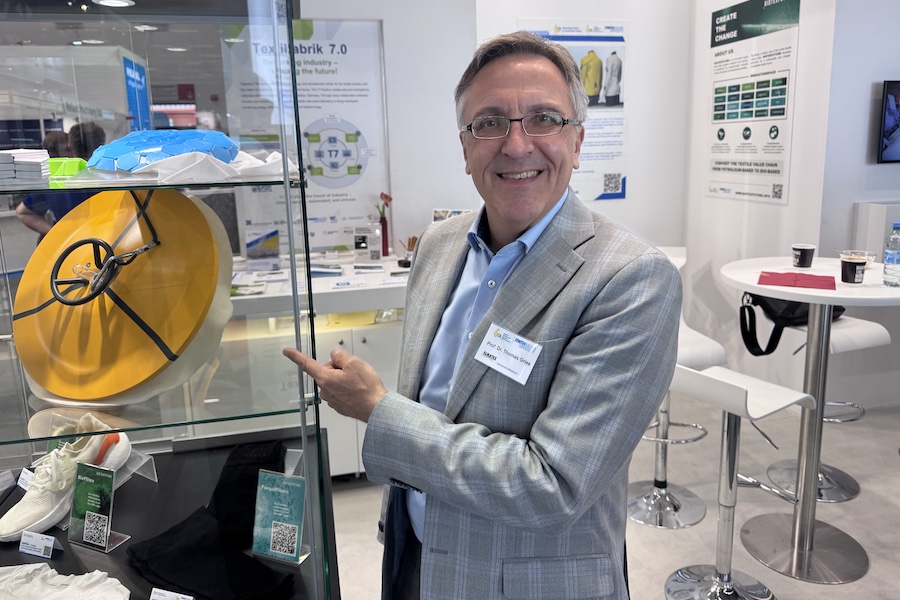
From technical textiles and AI-driven robotics to the limitations of textile circularity: Professor Dr Thomas Gries looks back on more than two decades of development at ITA Aachen. In the interview, he explains why production technology remains a decisive success factor, discusses international collaborations and innovation ecosystems, and shares his views on the transformation of production landscapes and the challenges facing an increasingly regulated industry.

#Knitting & Hosiery

“We need to move away from the price trap and return to a value-driven mindset.”

With its new Textile Innovation Center, KARL MAYER is sending a strong signal for innovation, collaboration, and the future of textile applications. In this interview, Karl Josef Mayer discusses new opportunities in warp knitting, the processing of staple fibres, recycling, the changing role of machinery manufacturers, and why the textile industry must once again focus more strongly on the value of textiles. by Oliver Schmidt

#Associations

“Innovation, resilience and international experience remain the great strengths of the Swiss textile machinery industry”

Geopolitical uncertainty, growing competitive pressure from China, new free trade agreements and the shift towards a circular economy are currently reshaping the global textile industry. In this interview, Cornelia Buchwalder discusses the current mood within the Swiss textile machinery sector, the industry’s distinctive innovative strength, new market opportunities in India and Asia, and the technological trends that could shape the upcoming trade fair cycle leading up to ITMA 2027.

More News on Europe

#Europe

European textile industry calls for €10 handling fee on ultra-fast-fashion imports

The introduction of the €3 customs duty on low-value imports marks an important milestone in Europe’s efforts to address the challenges created by the rapid growth of ultra-fast-fashion imports. Together with the abolition of the €150 customs duty exemption, it demonstrates that policymakers are willing to act when market distortions become impossible to ignore. However, the European textile and clothing industry considers this a first step rather than the final destination.

#Europe

The Digital Product Passport registry is now live

On 20 July, the European Commission launched the Digital Product Passport Registry together with a testing environment, marking an important milestone in making the Digital Product Passport (DPP) a practical reality for businesses placing products on the EU market.

#Europe

EU ban on destroying unsold clothing and footwear now in force

The European Union's ban on the destruction of unsold clothing, clothing accessories and footwear has entered into force. Since July 19, 2026, large companies across the EU have been prohibited from destroying unsold textile products, while medium-sized companies will be required to comply with the same rules from 2030.

#Recycling / Circular Economy

Commission clarifies rules on plastic bottles recycling

The European Commission today adopted new rules on recycling of single-use plastic beverage bottles made primarily of polyethylene terephthalate (PET bottles). These rules establish, for the first time, a methodology to calculate, verify and report chemically recycled content. This is part of the Commission’s December 2025 plastics package.

Latest News

#Weaving

Lindauer DORNIER GmbH welcomes new apprentices and dual-study students

For 22 new “DORNIER Talents”, these days mark the beginning of a new chapter at Lindauer DORNIER. For the family-owned company, in-house training is a key pillar in developing skilled professionals and retaining them within the company for the long term.

#Raw Materials

Cotton Brazil Dialogues 2026 concludes with 50 international participants immersed in Brazilian cotton production

The Cotton Brazil Dialogues concludes its 2026 edition after a series of technical visits to farms, cotton gins and reference centers, as well as workshops focused on Brazilian cotton production. A total of 50 participants from 14 countries took part in the field trips. The initiative is led by the Brazilian Association of Cotton Growers (Abrapa) and the National Association of Cotton Exporters (Anea), with support from the Brazilian Trade and Investment Promotion Agency (ApexBrasil).

#Research & Development

Novel flame-retardant and recyclable fiber-reinforced composite

Airplanes and passenger trains must meet strict safety requirements, including fire safety standards. This calls for materials that are flame-retardant, lightweight, robust, and scalable. Empa researchers, in collaboration with their industry partner Elantas, have now succeeded for the first time in making such a material – a composite – fully recyclable.

#Composites

WHILL selects Teijin’s tough, lightweight Carbon Fiber Composite for new last-mile mobility

Teijin Limited announced today that WHILL Inc., a global leader in inclusive mobility technology, has selected Sereebo® P CFP series, a carbon fiber-reinforced thermoplastic (CFRTP) material, for key structural components of the upcoming WHILL Model C Lite. Sereebo® P CFP series provides high strength, light weight, design flexibility and system cost advantages to the Model C Lite, which is a battery powered, single-seat, last-mile device. This new model combines maneuverability with light weight and one-handed folding to ensure ease of handling and operation.

TOP