#Dyeing, Drying, Finishing
ETV is looking to the future with Monforts
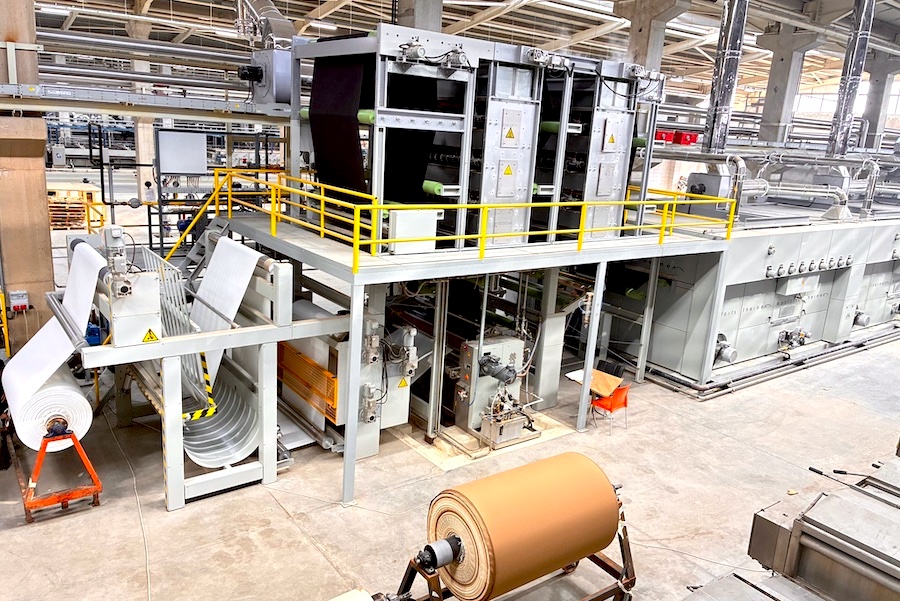
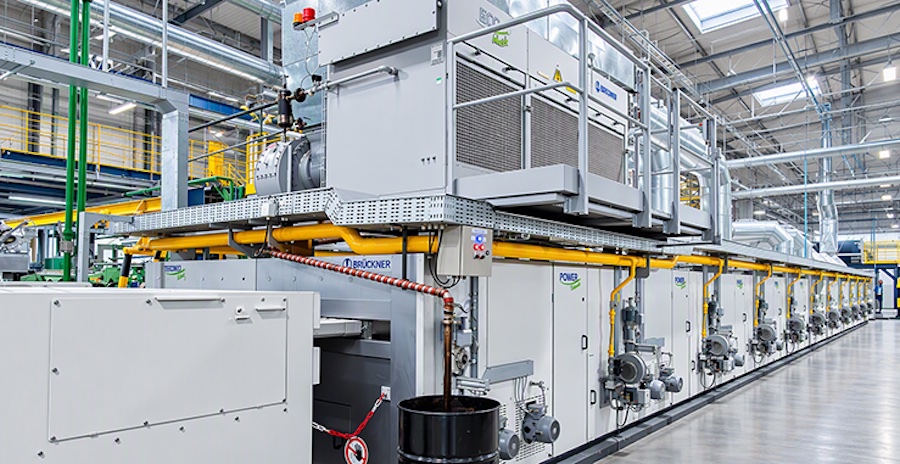
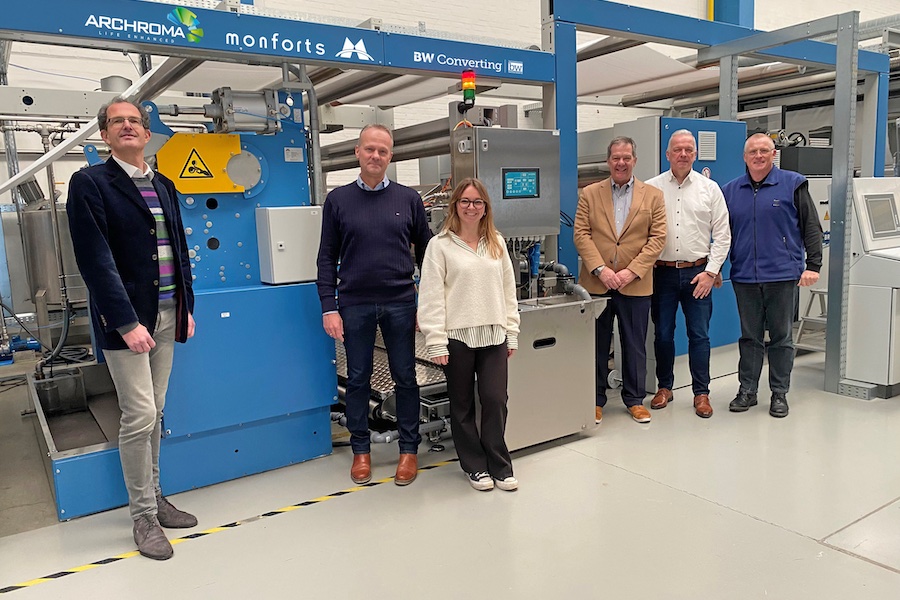
Founded in 1950, the privately held company is currently installing a third Monforts Montex 8500 finishing range with a working width of 3.2 metres, fully equipped with a Montex®Coat coating unit, an EcoBooster heat recovery unit, crash calender and computer-controlled winders and unwinders.
Longevity
For ETV managing director Dirk Tunney, the company’s longevity is in part due to a timely move away from traditional textile applications such as clothing and home textiles 25 years ago, to focus on adding value and functionality to technical textiles, films and membranes.
“The large discounters now dominate the procurement markets, particularly in the home textiles sector,” he says. “Stationary retail hardly exists anymore and the market is characterised by the price structure of cheap imports from non-European countries.”
Since repositioning itself in 1999, ETV has grown into a powerhouse in its selected fields, dyeing and finishing around 1,500 tons of yarn and 1.6 million linear metres of fabric each year. In addition, the company annually prints around 4 million linear metres of fabrics, foils and membranes, along with coating up to 40 million linear metres of fabrics and nonwovens.
ETV was also early in addressing the need for sustainable processes with a thermal exhaust air aftertreatment unit, a printing paste recycling station and the use of 100% recycled industrial water as a result of its own in-house water and sewage treatment plant.
Energy costs
Escalating energy costs in Germany, however, have understandably been a cause for concern for the company.
“Up to and including 2020, our energy expenditure was less than 10% of our total overheads which ensured we were competitive on the market, but at their peak in 2022, gas prices in Germany had increased tenfold and electricity prices increased fivefold,” Tunney says. “Our industry today has to live with electricity prices that are approximately twice as high and gas prices that are approximately three-and-a-half times higher than before 2021. In the future, we are assuming a level of 12-13% so we are talking about additional expenditure of up to €400,000 depending on our future product production programme, which as a contract processor we have only a limited influence on.
“Energy is certainly no longer cheap in Germany and we have moved from being an exporter of electricity to an importer and will no longer be able to supply ourselves in the future if we don`t change anything. It’s worrying that without our European neighbours our lights would sometimes go out.”
Industry standard
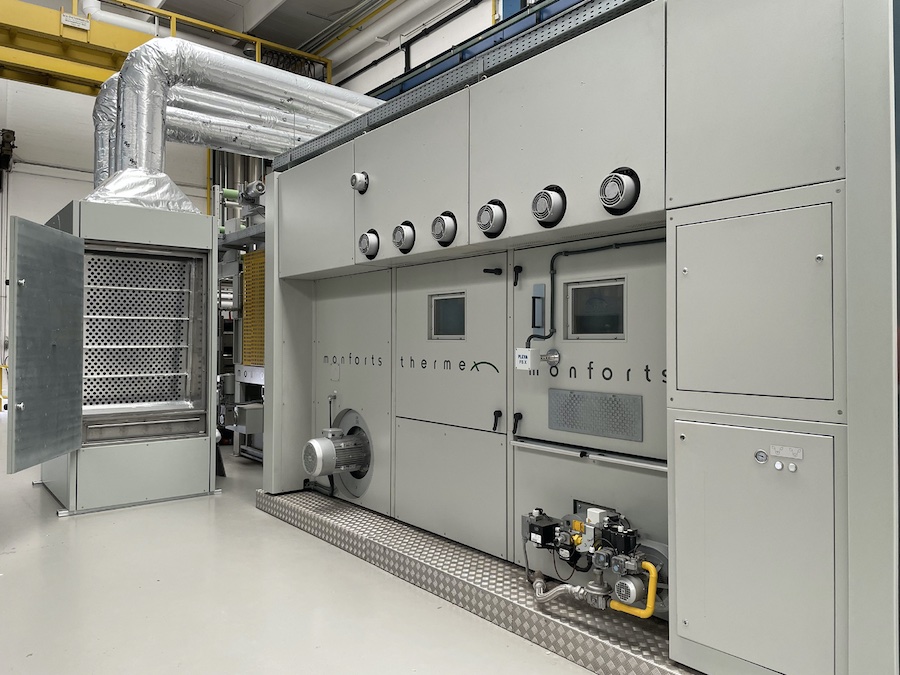
Monforts Montex stenters are now industry standard for the fabric finishing industry, providing many advantages in terms of production throughput and especially in energy efficiency and savings.
The Monforts Eco Booster, integrated into the chamber design of ETV’s Montex stenter, is a single heat recovery system with automatic cleaning that can further save up to 35% in energy costs. The Eco Booster consumes only minimal amounts of water during the cleaning cycle and the entire process is controlled and monitored automatically.
The Montex®Coat serves a very diverse number of markets and enables full coatings, pigment dyeing or minimal application surface and low penetration treatments to be carried out. Knife coating, roller coating or screen printing can also all be accommodated with this system. In addition, the Montex®Coat provides the ultimate in flexibility and the ability to switch quickly from one fabric run to the next, without compromising on the economical use of energy or raw materials.
“We certainly anticipate energy savings in addition to increased productivity and process reliability with this latest line and in addition, we will be working with Monforts on alternative energy options,” Tunney says.
Green hydrogen
Monforts is currently leading a consortium of industrial partners and universities in the three-year WasserSTOFF project, launched in November 2022, to explore all aspects of this fast-rising new industrial energy option.
The target of the government-funded project is to establish to what extent hydrogen can be used in the future as an alternative heating source for textile finishing processes. This will first involve tests on laboratory equipment together with associated partners and the results will then be transferred to a stenter frame at the Monforts Advanced Technology Center (ATC) in Germany.
“Green hydrogen’s potential as a clean fuel source is tremendous, but there is much we need to explore when considering its use in the textile finishing processes carried out globally on our stenter dryers and other machines,” says Monforts Managing Director Gunnar Meyer. “Everybody knows that textile finishing is a high energy consuming process and to make the processes more efficient, we already offer several solutions, but as a technology leader we are also rising to the challenge of exploring alternative heating options to be ready for the future.”
ETV’s relative proximity to the Monforts headquarters in Mönchengladbach makes it an ideal site for the WasserSTOFF project.
“The project for a hydrogen-powered coating stenter frame is very suitable for our region,” says Tunney. “Germany’s textile industry has a long tradition and with more than 1,400 companies, is not unimportant to the country, but without support from politics, both ideologically and financially, something like this cannot be done.
“If we want decarbonization, paths must be identified and funds made available. We absolutely have to remain open to technology in order to position ourselves in the best possible way. Otherwise it will result in deindustrialization, which none of us want. We look forward to a closer collaboration with Monforts and its project partners going forward.”
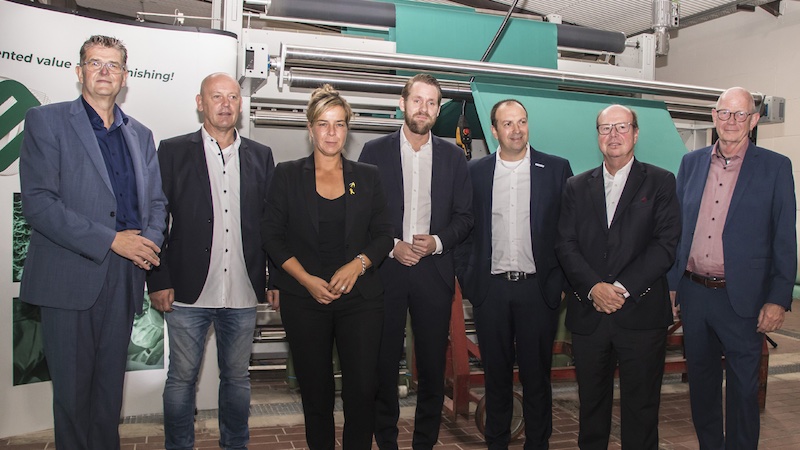
On September 6 this year, the Minister for Economic Affairs and Climate Protection of North Rhine-Westphalia (State of Germany), Mona Neubaur, visited ETV to see first hand how the textile industry is rapidly adapting to a changing landscape.
“The future of German industry will be decided in North Rhine-Westphalia,” she said. “This requires courageous companies to move forward. Innovative ideas strengthen our competitiveness and make a significant contribution to becoming the first climate-neutral industrial region in Europe. Green hydrogen will play an important role in this and I am very pleased that through companies like ETV and Monforts and their partners, we are now moving quickly from preparation to action.”