[pageLogInLogOut]

#Dyeing, Drying, Finishing

First in finishing in Guatemala
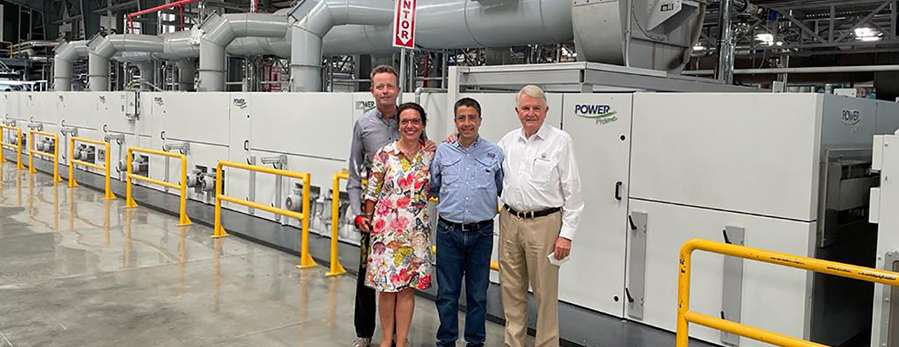
From left to right: Axel Pieper and Regina Brückner (CEO Brückner), Francisco Solares (GM and Vice President of Texpasa), Juan Niemann (Brückner representative in Guatemala) © 2023 Brückner
Texpasa is a family business whose roots go back to 1978. Through various historical stages such as yarn spinning, circular, and flat-bed knitting, Texpasa has evolved into a state-of-the-art company that knits, dyes, and finishes a variety of textiles for the apparel market. In addition to its first plant in Guatemala City, Texpasa completed its second plant in 2020 at the Michatoya Industrial Park in Palin incorporating knitting, dyeing, and finishing facilities.

The original factory is being consolidated into the new facility and the Brückner stenters, the first of which has been in operation since 2007, are currently being moved to Palin with the support of Brückner technicians.

David Franco, Maintenance Manager of Texpasa, is highly satisfied with the support of the service team: "Brückner builds high-quality machines and offers excellent service. We have known this since the purchase of our first stenter. The support during the relocation of the machines from Guatemala City to Palin also shows us that Brückner is a service partner we can rely on even in the case of big challenges. The machines were carefully dismantled and packed with Brückner's support. They arrived in good condition and are being reassembled and put into operation without any problems."

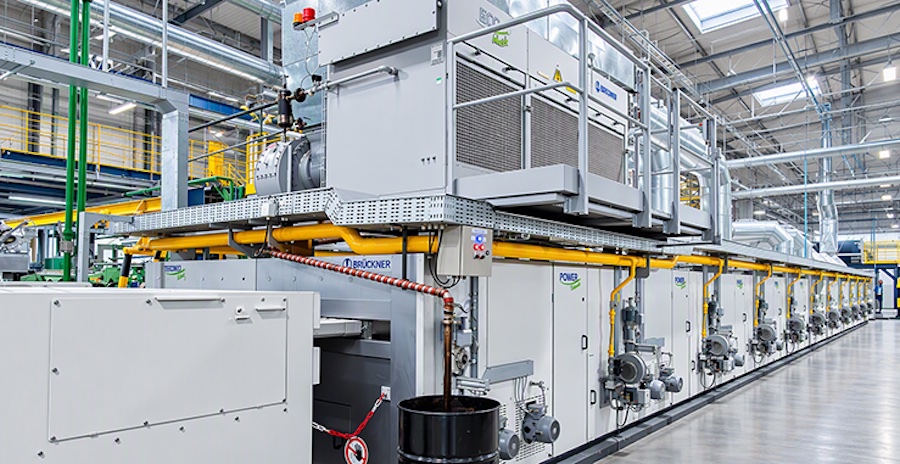
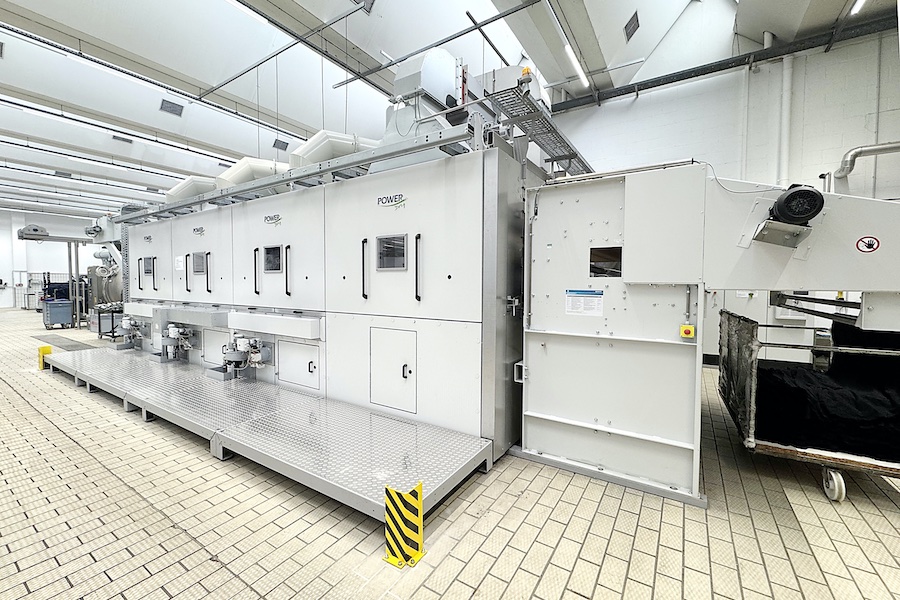
A total of seven Brückner stenter frames with vertical chains will be operating in the Michatoya plant from the start of 2024. The latest POWER-FRAME stenter with 10 bays was put into operation in 2022. All Brückner stenters in the Michatoya Industrial Park are counter-construction. Thus, the heating and ventilation elements change the dryer side every 1.5 meters, which leads to an absolutely uniform air admission, i.e. a very homogeneous air quantity and temperature distribution over the entire fabric web width. They offer the highest possible drying performance and process control matched to the fabric quality thanks to the technically mature and proven split-flow ventilation system. This is extremely important for the major sports and leisure brands in which Texpasa supports. Robust and low-maintenance chains, chain bars, and pin bar carriers stand for long service life and low wear. The finishing results are exactly reproducible and overdrying of the fabric during machine standstill is excluded by the air bypass system. Minimal air pressure losses and high-quality insulation result in the lowest possible electrical and thermal energy consumption and thus in low production costs.


Sustainability is important to Texpasa in numerous aspects: The company has allocated capex into sustainable and reusable green energy, e.g. photovoltaics, and biomass, and has planted together with partners 60,000 trees in a biomass forest for the future, thus reducing the CO2 footprint. Another sustainability building block is the wastewater treatment center, with a capacity of up to 100 cubic meters of water per hour. After treatment, the water meets or exceeds all purity regulations.
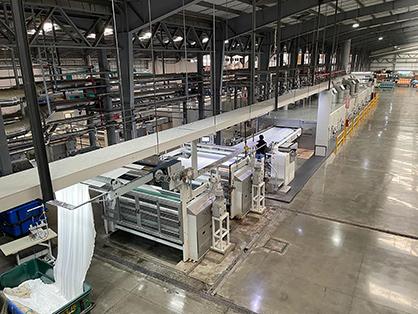
Brückner stenter at Texpasa © 2023 Brückner


Francisco Solares, GM and Vice President of Texpasa puts it in a nutshell: "The Brückner machines perfectly fit our demanding sustainability concept. The quality of the finished fabric is excellent and the stenters impress with energy efficiency and low production costs. We appreciate very much that Brückner accompanies us as an innovative supplier of high-quality textile finishing lines and reliable service partner". Brückner appreciates this long-standing customer, too: Regina Brückner, CEO says: "As a traditional and highly innovative family-owned company, we attach great importance to sustainability both in our production facilities and in our products. Texpasa is a very good example of how investing in the future, sustainability, and environmental protection can go hand in hand. We are very pleased about this long-standing cooperation and wish Texpasa continued success."
More News from BRÜCKNER Textile Technologies GmbH & Co. KG

#ITMA Asia + CITME Singapore 2025

BRÜCKNER will be demonstrating what modern textile finishing looks like today at ITMA ASIA

Brückner Textile Technologies is presenting German engineering expertise and energy-efficient line concepts at this year's ITMA ASIA in Singapore. The family-run company has been a leader in customized technologies and solutions for textile equipment for over 75 years. The focus is on energy efficiency, automation, and maximum productivity.

#Dyeing, Drying, Finishing

Inauguration of the branch office in Coimbatore, India

With the establishment of Brückner Textile India Pvt. Ltd., the Brückner Group, based in Leonberg, Germany, marks another important milestone in its long and successful company history. The new subsidiary in Coimbatore, India, brings Brückner significantly closer to its Indian customers – both geographically and strategically.

#Dyeing, Drying, Finishing

Growing with a vision: BRÜCKNER opens branch office in India

The worldwide leading textile machinery manufacturer BRÜCKNER is opening its own subsidiary in India on June 1st, 2025. With this strategic step, the German family-owned company further strengthens its global presence and expands into the Indian market, which is so important for the textile industry.

#Dyeing, Drying, Finishing

William Clark & Sons – the oldest linen producer in North-ern Ireland commissioned new finishing plant with BRÜCKNER

William Clark & Sons have been providing world class linen direct from Northern Ireland to customers around the world for nearly 300 years. The Company is the only supplier in the world that can produce Beetled linen fabric with that unmistakable sheen. Using the Beetling process the fabric gets pounded for 20 days by wooden hammers on the original beetling engines. This equipment is as reliable today as when they were commissioned over 100 years ago, and the process remains unchanged.

More News on Dyeing, Drying, Finishing

#Techtextil 2026

Smart sensors, smart savings - Reducing energy and cost in textile finishing

As energy prices, sustainability requirements and quality expectations continue to rise, manufacturers of technical textiles face increasing pressure to optimize efficiency while ensuring process reliability. At the same time, skilled labor shortages require production systems that are intuitive, automated and easy to manage. PLEVA addresses these challenges with robust, maintenance-friendly sensor technologies combined with intelligent process control.

#Dyeing, Drying, Finishing

Navis TubeTex and Fibroline announce upcoming Innovation Days

Navis TubeTex and Fibroline LLC announced their upcoming Innovation Days, a collaborative 3-day event designed to showcase advancements in product development technologies, and next-generation sustainable manufacturing solutions.

#Dyeing, Drying, Finishing

BW Converting expands Southeast Asian presence with new agency partnerships in Vietnam and Indonesia

BW Converting is strengthening its presence in Southeast Asia through new agency partnerships in Vietnam and Indonesia, reinforcing the company’s commitment to supporting textile manufacturers across the region. The expansion comes as BW Converting prepares to exhibit at SaigonTex 2026 (April 8–11, Saigon Exhibition and Convention Center, Ho Chi Minh City, Vietnam) and INDO INTERTEX 2026 (April 15–18, Jakarta International Expo, Indonesia).

#Dyeing, Drying, Finishing

Monforts unveils interactive digital platform for textile finishers

Monforts has launched a new digital platform designed to give textile manufacturers faster, more intuitive access to the company’s finishing technologies, technical expertise and aftersales support worldwide.

Latest News

#Techtextil 2026

Performance Apparels: Functional textiles drive innovation at Techtextil 2026

From high-performance fibres and advanced membranes to smart textiles and sustainable material concepts – functional apparel is becoming one of the most dynamic innovation fields in technical textiles. At Techtextil 2026, exhibitors demonstrate how new materials, finishing technologies and digital functions are shaping the next generation of protective, workwear and outdoor systems.

#Textile chemistry

A flagship for chemical production: BASF inaugurates world-scale Verbund site in China

BASF today (March 26, 2026) celebrated the official inauguration of its newly built, world-scale Verbund site in Zhanjiang, Guangdong Province in southern China. Covering an area of around four square kilometers, it is more than a major BASF project in the chemical growth market of China. “Zhanjiang shows what the future of chemistry looks like: efficient, digital and sustainable by design. The site showcases a smart integrated Verbund structure on an industrial scale,” said Dr. Markus Kamieth, CEO of BASF, at the ceremony attended by representatives from government, customers, business partners and employees.

#Nonwovens

VEOCEL™ Lyocell production expands to Asia – Launching a new chapter for nonwovens in the region

VEOCEL™, Lenzing's flagship specialty nonwovens brand, expands production at its Thai plant in Prachinburi. This is the first-ever production of its nonwoven-grade lyocell fibers in Asia. Built in 2022 with a 100,000-ton annual production capacity, the facility - previously focused on fibers for textile applications - now can directly meet the demand for VEOCEL™’s biodegradable¹, wood-based lyocell fibers for nonwovens products. These fibers are an essential ingredient for high-quality nonwovens products, ranging from baby wipes to facial sheet masks and everyday personal hygiene items.

#Research & Development

Hof University develops sustainable textile coating for the fashion of tomorrow from mushrooms

Clothing is often treated as disposable: T-shirts for events, general merchandise, or short-term campaigns frequently end up in the trash after only a few uses. This is particularly problematic given that their production still largely relies on fossil-based materials. This is precisely where a new research project at Hof University of Applied Sciences comes in.

TOP