[pageLogInLogOut]

#Dyeing, Drying, Finishing

Rudolf commissions Baldwin’s TexCoat™ G4 lab-scale precision spray unit

Rudolf GmbH, a leading provider of chemicals to the textile industry, can now offer side-by-side performance tests of the age-old “dip and squeeze” pad versus precision spray finishing with the delivery of Baldwin Technology Inc.’s TexCoat ™ G4 lab-scale unit

Textile manufacturers can now conduct side-by-side pad vs. precision spray finishing trials at customer service center in Germany

Rudolf, founded more than 100 years ago and based in Geretsried, Bavaria, offers a wide portfolio of chemical solutions and services that increase innovation and sustainability along the entire textile value chain, from fiber to finish.

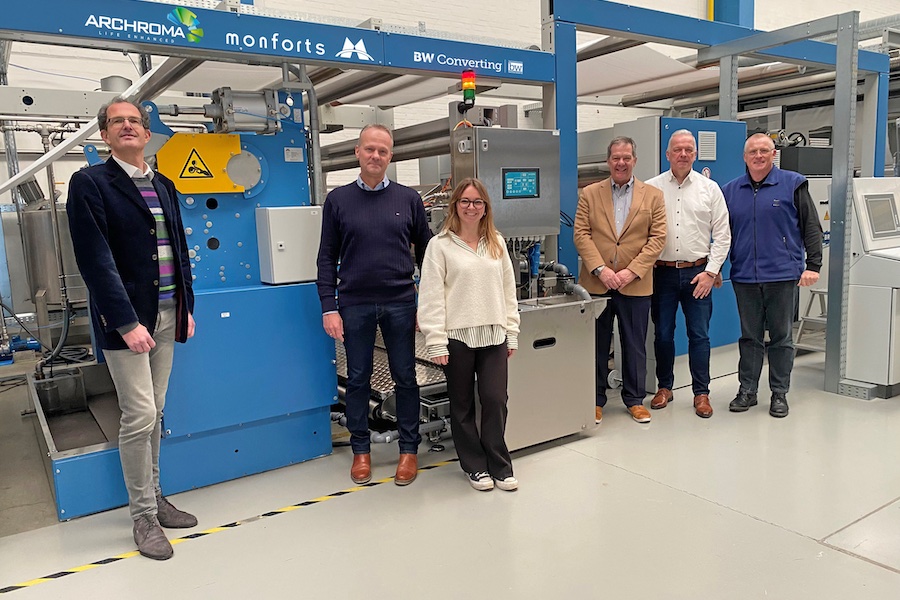
“The commissioning of Baldwin’s lab scale TexCoat in Rudolf’s Customer Solution Center further strengthens the partnership of our two companies and provides the technical expertise to the textile industry in transitioning from pad to TexCoat G4 precision spray finishing,” said Rick Stanford, Baldwin’s VP of Global Business Development, Textiles.

© 2023 Baldwin
© 2023 Baldwin


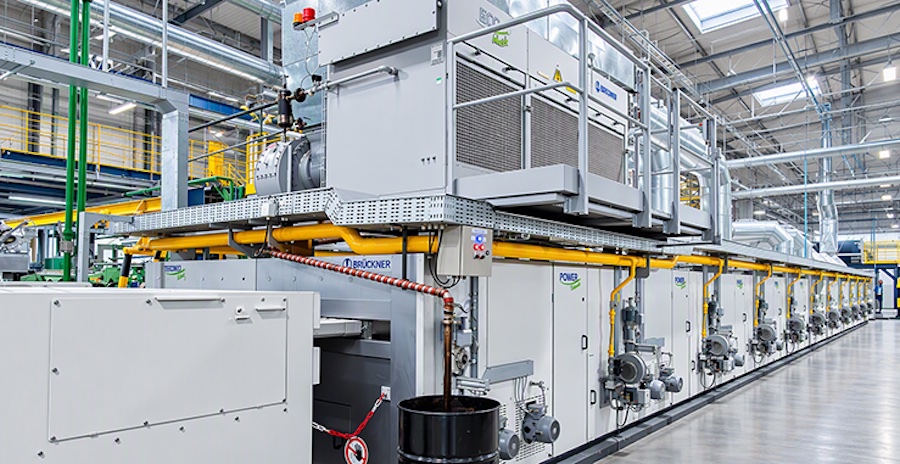
The new TexCoat lab-scale unit at Rudolf’s Geretsried, Germany-based Customer Solution Center, tests the sprayability of chemicals on fabrics as an additional tool to help the market transition to precision spray with confidence in the performance and sustainability of the end result.

With Baldwin’s innovative system, the chemistry is precisely distributed across the textile surface and is applied only where it is required, on one or both sides of the fabric. The non-contact technology eliminates chemistry dilution in wet-on-wet processes, allowing full control of maintaining consistent chemistry coverage rates.


Plus, pad bath contamination is eliminated, and changeovers are only required when there is a change of finish chemistry.  On wet-on-dry processes, the finish is applied with 50% of the amount of water required for pad finishing.  Dryer fabric entering the stenter means less water to evaporate resulting in less energy and higher production speeds.

More specifically, with Baldwin’s TexCoat G4, textile finishers can expect unprecedented tracking and control of the finishing process for consistent quality. Changeovers are easily and quickly performed thanks to recipe management, including automated chemistry and coverage selection. Furthermore, the system takes speed information from the drying process to insure exact coverage regardless of any change in speed.  TexCoat G4 measures every drop of chemical usage ensuring that the amount of chemical add-on is precise.

In addition, the TexCoat G4 system can process a wide range of low-viscosity water-based chemicals, such as durable water-repellants including PFAS-free, softeners, anti-microbials, easy care resins, flame retardants and more. Baldwin’s innovative technology utilizes the same chemicals used in the traditional pad bath, with no special auxiliaries required.

For a list of Rudolf-approved chemicals, click here:

https://www.flipsnack.com/BB6FA8DEFB5/baldwin-textile-solutions/full-view.html 


“We are excited to introduce the TexCoat™ G4 lab-scale unit to the textile industry in collaboration with Baldwin Technology Inc.,” said Norbert Haberer, Rudolf Director of Finishing Chemicals. “This innovative precision spray technology revolutionizes finishing processes, delivering consistent quality while minimizing waste and resource consumption. At Rudolf GmbH, we remain committed to driving sustainability and innovation across the textile value chain and offer a new service in our in-house application labs”




More News from RUDOLF

#Textile chemistry

RUDOLF gets the exclusive global distribution rights for Sanitized® textile technologies

With effect from today, RUDOLF officially assumes exclusive global distribution rights for Sanitized® textile technologies from SANITIZED AG. This is the next milestone in the strategic collaboration announced in 2025, with the partnership between the two companies now fully implemented and expanded worldwide.

#Textile chemistry

RUDOLF appoints Marcos Furrer as CEO, Dr Gunther Duschek as CTOO and Dr Oliver Kusterle as CSO – Dr Wolfgang A. Schumann becomes Chairman of the Board of Directors

RUDOLF, a leading global medium-sized specialty chemical company, is adopting a new management structure at the beginning of 2025 to accelerate the implementation of its strategic goals. The aim remains to further strengthen RUDOLF‘s international market position and to sustainably, expand the company‘s innovative strength in an increasingly dynamic competitive environment.

#Textile chemistry

Strategic growth: RUDOLF signs MOU to acquire Proeza in Mexico

RUDOLF has announced the formal signing of a Memorandum of Understanding (MOU) to acquire Proeza in Mexico. This strategic acquisition marks a significant milestone for RUDOLF, enabling the company to leverage Proeza’s established strengths and extensive market presence.

#Digital Printing

RUDOLF introduces innovative digital pigment printing toolbox

RUDOLF, a world leader in speciality chemicals, announces a development in digital textile printing with the introduction of its new Digital Pigment Printing Toolbox. Continuous research and development enables RUDOLF to offer products with maximum performance and minimum environmental impact. Interest in digital pigment printing is growing because it has the advantage over other printing technologies of eliminating one process step. With pigment printing, there is no need for posttreatment, which means that the water required for post-treatment can be saved.

More News on Dyeing, Drying, Finishing

#Advertorial

New Gravimax MMX-R X-ray sensor platform opens up new application fields

The demands placed on quality control in web-based production processes are increasing: materials are becoming more complex, basis weights are varying more widely, and at the same time, pressure is growing to make processes more efficient and transparent. Precise measurement data across the entire web width has therefore become a key factor in ensuring stable production processes. With its new Gravimax MMX-R sensor platform, Mahlo introduces a radiometric measurement solution designed to set new standards in determining basis weight and material composition. The platform combines advanced X-ray technology with newly developed signal processing, enabling measurement tasks that previously often required multiple sensor technologies.

#Techtextil 2026

BW Converting to present its Baldwin TexCoat® G4 at Techtextil 2026

BW Converting will present its Baldwin TexCoat® G4 precision spray finishing system at Techtextil Frankfurt 2026, taking place April 21-24 at Messe Frankfurt. Visitors to Hall 12, Booth C56B, will have the opportunity to explore how this advanced spray technology helps textile manufacturers improve finishing quality, increase efficiency and reduce resource consumption across a wide range of applications.

#Techtextil 2026

Smart sensors, smart savings - Reducing energy and cost in textile finishing

As energy prices, sustainability requirements and quality expectations continue to rise, manufacturers of technical textiles face increasing pressure to optimize efficiency while ensuring process reliability. At the same time, skilled labor shortages require production systems that are intuitive, automated and easy to manage. PLEVA addresses these challenges with robust, maintenance-friendly sensor technologies combined with intelligent process control.

#Dyeing, Drying, Finishing

Navis TubeTex and Fibroline announce upcoming Innovation Days

Navis TubeTex and Fibroline LLC announced their upcoming Innovation Days, a collaborative 3-day event designed to showcase advancements in product development technologies, and next-generation sustainable manufacturing solutions.

Latest News

#Techtextil 2026

AI, Start-ups, Research: Techtextil and Texprocess bring together players in the textile industry

From start-ups to universities and research institutes: at Techtextil and Texprocess, the world’s leading innovation trade fairs in Frankfurt am Main, exhibitors present future-oriented concepts for the global textile industry. With the international Campus & Research area, a strong participation from start-ups and the latest AI applications for textile processing, both trade fairs showcase current developments in the textile industry. By bringing together innovation, research and application, they enable new partnerships across the textile value chain.

#Techtextil 2026

IVGT joint stand brings innovation and networking to Techtextil 2026

At Techtextil 2026 and the parallel Texprocess 2026, key transformation topics such as artificial intelligence, digitalisation, sustainability, recycling and the circular economy will be reflected across the show. Against this backdrop, the IVGT, together with 16 member companies, will present its joint stand in Hall 12.1 (Stand D62) as a platform for exchange and networking.

#Man-Made Fibers

Indorama Ventures supports Southeast Asia’s textile customers with reliable regional supply and global innovative portfolio

Indorama Ventures, one of the leading global polyester fiber and filament yarn suppliers globally, will participate in Indo Intertex 2026 in Jakarta this April, making its diverse global portfolio available to apparel, home textile, and hygiene customers across Southeast Asia.

#Raw Materials

New study shows low environmental impact by Cotton made in Africa Organic Cotton from Tanzania

Today, the Aid by Trade Foundation (AbTF) is announcing the results of a comprehensive life-cycle analysis (LCA) for cotton produced in Tanzania under the Cotton made in Africa Organic (CmiA Organic) standard. The study emphasises the small ecological footprint of CmiA Organic verified cotton. This can largely be traced back to the absence of synthetic pesticides, artificial fertilisers, and artificial irrigation. Consequently, CmiA Organic cotton can help the textile industry meet regulatory requirements as well as science-based targets. The results also show that the consequences of climate change threaten the livelihoods of these cotton farmers, even though the type of agriculture they practise barely contributes to climate change.

TOP