#Dyeing, Drying, Finishing
Unique waxed cotton finishing with new Monforts line

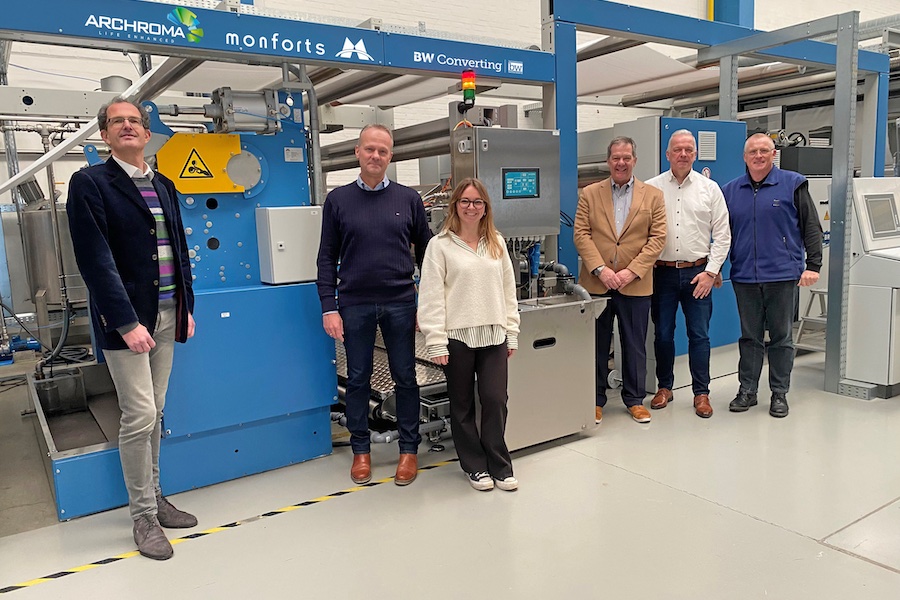
The range, with a working width of two metres, was built at the Montex assembly plant in Austria and consists of a Montex®Coat coating unit in knife execution for paste and foam coating and a Montex 8500 6F stenter.
Unique know-how
Founded in 1864, Halley Stevensons has amassed unique technical know-how and manufacturing experience in the art of waxed cotton for weatherproofed fabrics and is able to provide international orders in custom colours and finishes to very low minimum quantities where required. The company exports worldwide and its premium brand customers include Belstaff, Barbours, Filson and J.Crew.
“Our team of skilled technicians is constantly striving to develop and refine new and existing products in terms of colour, handle and performance and we regularly design and build our own bespoke machinery to give us optimum manufacturing capabilities,” says Managing Director James Campbell.
The new range draws on all of the latest advances and technical expertise of Monforts gained from countless installations around the world, allowing Halley Stevensons to pigment dye, direct coat and pad apply finishes and offering more scope for R&D.
Lifeblood
“R&D is the lifeblood of our business,” says Campbell. “The precise process control functions of the line give our technicians confidence to make new products as well as finely tuning the energy requirements of existing products. We love the fact that we can record the energy used on each production batch and use this for continual improvements and efficiency savings. The touchscreen software is visual and easy to use, moving from one screen to another to check the various parameters of processing.”
The range has replaced one of the company’s older stenter/coating lines and has already enabled Halley Stevensons to recreate various products with lower coating applications at higher speeds than was previously possible.
“Many refinements have been made to the Montex®Coat in the past few years, resulting in higher coating accuracy and the resulting quality of the treated fabrics,” says Monforts engineer for textile technologies Alexander Fitz, who has been working with Halley Stevensons on commissioning of the range and new product trials. “Monforts is the only manufacturer to offer completely integrated coating lines from a single source and the coating machine is tailored to the subsequent Montex drying technology – with all the benefits resulting from fully integrated plc control.”
“Since we last purchased a stenter, the advancement of the technology on the Montex has been vast, especially in burner and air extraction,” adds Campbell. “The machine is also very robust – especially the chains, which need very little lubrication and will last us a long time. We have been pleasantly surprised how quickly we can move from say, a 100gsm fabric to a 600gsm fabric, with no requirement to adjust tensions.”
Sailcloth heritage
Waxed cotton was originally developed by sailors in the early 15th century when Scottish North Sea herring fleets began treating flax sailcloth with fish oils and grease in an attempt to waterproof their sails. Remnants of these sails were used by the sailors as capes to withstand the high winds and sea spray.
By the mid 1850s, sailcloth was being treated with linseed oil, but while initially highly effective, it would yellow and stiffen through weathering over time and eventually lose its waterproofing qualities.
In the years that followed, various treatments were applied to cottons in an attempt to find the most effective weatherproofing solution, and the combination of densely-woven cotton impregnated with a paraffin waxed coating proved most successful. For over 150 years, Halley Stevensons created many different variations of both woven constructions and finishing treatments and now supplies thousands of metres of waxed cotton every year, with each roll produced to custom specifications.
Durability
“The beauty of waxed cotton is its durability and longevity,” says Campbell. “The fabrics are breathable, with the wax adjusting to ambient temperatures to be softer and more breathable in warm weather and stiffer and more wind proof in cold conditions.”
While traditional waxes are petroleum or paraffin based, Halley Stevensons has always been comfortable about using a waste product from industry and reusing it to make products that last a lifetime.
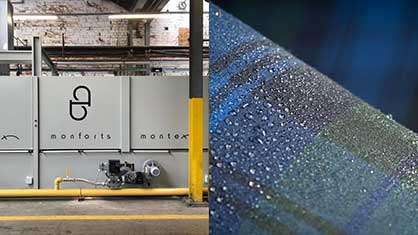
“We are always exploring different finishing techniques and one of our most popular finishes is our hybrid aero – an emulsified blend of waxes,” Campbell says. “This fabric is water repellent but has little wax in the mixture so the handle is much drier to touch than the traditional wet waxes.”
The company has also recently launched a new 100% plant-based wax – Ever Wax Olive – consisting of a blend of olive oil, rape seed and castor bean with comparable water repellence to petroleum and a far better rating than other natural waxes which have come before it.
Benchmark
“The high tradition of skills and fabric innovation imposed by our original guildsmen is still our benchmark standard of honest workmanship today,” Campbell concludes “We use responsibly sourced cotton fabrics and processes that are gentle to the product and low impact to the environment. Our dyeing methods use very low levels of water and our waxes are simply heated up for application and cooled down to store when not in use, meaning no waste discharges. Now, with this new Monforts line, we are also achieving running speeds two-to-three times faster than with the older stenter, combined with less gas usage. It’s proved a great partnership.”