[pageLogInLogOut]

#Dyeing, Drying, Finishing

Long partnership for high quality
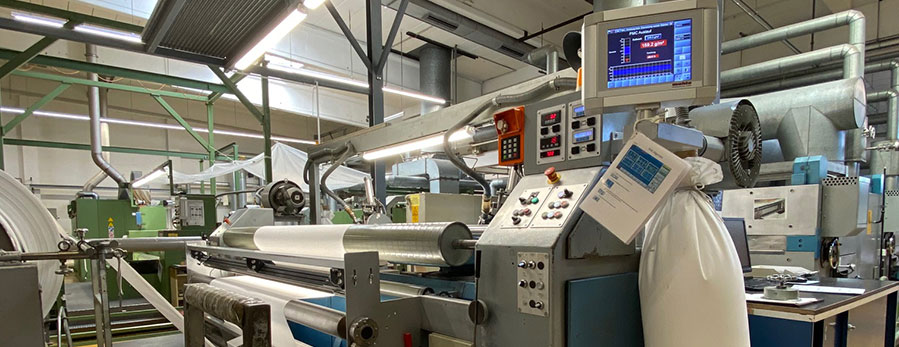
The Famacont PMC integrated in the production line © 2021 Mahlo
When you think of a textile production hotspot, Paderborn may not be the first place that comes to mind. It should though! Because this is where Penn Textile Solutions GmbH has been based since 1959. The company is one of the world's leading manufacturers of elastic fabrics for under-wear, corsetry, sportswear and swimwear, as well as highly functional textiles for technical applications. The fully integrated company with its own warping, circular knitting, warp knitting, dyeing and finishing facilities currently employs around 150 people.

Penn Textile Solutions relies on process control from Bavaria

"Over the past several years, one of the areas Penn has specialized in is the production of custom-fit, close-contour compression knits. These are increasingly being used in the sporting goods sector," describes operations mana-ger Franz Schütte. "Customers can expect a unique design with highly functional wearing comfort from our articles at the same time." The production of these textiles requires the corresponding know-how as well as the appropriate production and process technology for the production of the surfaces as well as for the finishing and quality assurance. In order to continue to meet these high demands, Penn wanted to further optimize its stenter frame processes. 

Tugsan Vural, deputy head of the equipment department (left) and plant manager Franz Schütte trust in Mahlo quality. © 2021 Mahlo


Many of the products are made from so-called compression knits, in which different constructions are integrated within one quality. Penn produces the compression knitted fabrics on special raschel looms. "The compression zones place accurately in the finished element. The balance of the agents plays an important role here." In the subsequent finishing process, a textile surface with the required stretch behaviour, the appropriate repeat lengths and basis weights should be created, particularly in the drying and fixing process. The measuring and control system in the stenter frame process must realize and guarantee these requirements over the entire length of the section. Not an easy task!

Penn has long relied on Mahlo

To achieve its own high quality targets day after day, Penn has relied on the cooperation with Mahlo, based in Saal an der Donau in Bavaria, for years. The manufacturer of measuring, control and automation systems for web-shaped goods has decades of experience in the field of process control. "We have been using Mahlo systems for more than 30 years and have always been able to rely on excellent results," says Schütte. Until the summer of 2020, the textile manufacturer had been using a basis weight measurement system in the stenter frame outlet with beta radiation and manual control. "When the krypton preparations had passed their half-life, we had to make a decision: Exchange or replace the system right away." They sat down with Mahlo representatives and looked for the best solution. Since the systems had already reached a high operating age and the measurement was limited to the basis weight, a new concept was decided upon. "Mahlo made us the best price-performance offer." The new system should be even more efficient and easier to operate for the special makes.

Penn Textile Solutions GmbH in Paderborn<br />
 © 2021 Mahlo
Penn Textile Solutions GmbH in Paderborn © 2021 Mahlo


The compression zones of the functional fabric create corresponding distortions within the textile surface in its raw state, which have to be smoothed out in the fixing process. This work is now taken over by a process control system. The Mahlo Famacont PMC-15 with two measuring points automatically controls the leading of the stenter frame by continuously and contactlessly determining the mesh density. In addition, the Patcontrol PCS-20 process control system ensures that the dimensions of the different zones are recorded and also automatically controlled. "The previous beta-radiation facility was not able to collect this kind of data," explains the Penn operations manager. Another important aspect for the textile manufacturer: the complete and costly radiation protection is no longer necessary with the new systems.

Thanks to the Patcontrol PCS process control system, the zone fabric is detected and also automatically controlled. © 2021 Mahlo


Despite very good experience with Mahlo in the past, every change naturally involves a risk. Penn did not have to rely on theoretical considerations, however, but carried out tests in advance with appropriate sample material in the Mahlo test laboratory. The results convinced the decision-makers. "In addition, appropriate internal considerations and external consultations provided us with the necessary certainty for the investment decision. The risk was therefore manageable," says Schütte. The investment has already paid off. "The new measurement and control technology enables consistent compliance with our desired parameters." Scrap in the form of manufacturing waste due to mismatched quality parameters has decreased by 5%. Due to the success of the production process, a further measuring station for thread density and basis weight was put into operation this summer.


More News from Mahlo GmbH + Co. KG

#Advertorial

New Gravimax MMX-R X-ray sensor platform opens up new application fields

The demands placed on quality control in web-based production processes are increasing: materials are becoming more complex, basis weights are varying more widely, and at the same time, pressure is growing to make processes more efficient and transparent. Precise measurement data across the entire web width has therefore become a key factor in ensuring stable production processes. With its new Gravimax MMX-R sensor platform, Mahlo introduces a radiometric measurement solution designed to set new standards in determining basis weight and material composition. The platform combines advanced X-ray technology with newly developed signal processing, enabling measurement tasks that previously often required multiple sensor technologies.

#Dyeing, Drying, Finishing

Orthopac RVMC-20 plus: German Engineering for Smarter Weft Straightening

In times of rising cost pressure and growing quality demands, textile producers worldwide are searching for solutions that combine precision, efficiency, and sustainability. With its latest innovation, the Orthopac RVMC-20 plus, Mahlo once again demonstrates the strength of German engineering: improving proven technology to meet today’s challenges.

#Dyeing, Drying, Finishing

Stefan Moll becomes new CEO of the machinery manufacturer

Starting January 1, 2026, Stefan Moll will take over the management of Mahlo GmbH + Co. KG, the world’s leading provider of measurement and control technology for web-shaped materials. With this move, Mahlo is focusing on the long-term safeguarding of its market position and technological leadership. The current CEO, Rainer Mestermann, will leave the company after 14 years as part of a planned succession arrangement.

#Dyeing, Drying, Finishing

Knitex Industries Ltd. (Mondol Group) invests in advanced Mahlo technology

Bangladesh’s Knittex Industries Ltd. is known for its commitment to top-quality knitwear and responsible produc-tion. To further enhance fabric quality, the company has invested in a Mahlo Orthopac RVMC-15 weft straightener. Installed by Tootal Quality Resources, the system ensures perfect fabric alignment and supports Knittex’s goal of continuous improvement.

More News on Dyeing, Drying, Finishing

#Techtextil 2026

BW Converting to present its Baldwin TexCoat® G4 at Techtextil 2026

BW Converting will present its Baldwin TexCoat® G4 precision spray finishing system at Techtextil Frankfurt 2026, taking place April 21-24 at Messe Frankfurt. Visitors to Hall 12, Booth C56B, will have the opportunity to explore how this advanced spray technology helps textile manufacturers improve finishing quality, increase efficiency and reduce resource consumption across a wide range of applications.

#Techtextil 2026

Smart sensors, smart savings - Reducing energy and cost in textile finishing

As energy prices, sustainability requirements and quality expectations continue to rise, manufacturers of technical textiles face increasing pressure to optimize efficiency while ensuring process reliability. At the same time, skilled labor shortages require production systems that are intuitive, automated and easy to manage. PLEVA addresses these challenges with robust, maintenance-friendly sensor technologies combined with intelligent process control.

#Dyeing, Drying, Finishing

Navis TubeTex and Fibroline announce upcoming Innovation Days

Navis TubeTex and Fibroline LLC announced their upcoming Innovation Days, a collaborative 3-day event designed to showcase advancements in product development technologies, and next-generation sustainable manufacturing solutions.

#Dyeing, Drying, Finishing

BW Converting expands Southeast Asian presence with new agency partnerships in Vietnam and Indonesia

BW Converting is strengthening its presence in Southeast Asia through new agency partnerships in Vietnam and Indonesia, reinforcing the company’s commitment to supporting textile manufacturers across the region. The expansion comes as BW Converting prepares to exhibit at SaigonTex 2026 (April 8–11, Saigon Exhibition and Convention Center, Ho Chi Minh City, Vietnam) and INDO INTERTEX 2026 (April 15–18, Jakarta International Expo, Indonesia).

Latest News

#Raw Materials

New study shows low environmental impact by Cotton made in Africa Organic Cotton from Tanzania

Today, the Aid by Trade Foundation (AbTF) is announcing the results of a comprehensive life-cycle analysis (LCA) for cotton produced in Tanzania under the Cotton made in Africa Organic (CmiA Organic) standard. The study emphasises the small ecological footprint of CmiA Organic verified cotton. This can largely be traced back to the absence of synthetic pesticides, artificial fertilisers, and artificial irrigation. Consequently, CmiA Organic cotton can help the textile industry meet regulatory requirements as well as science-based targets. The results also show that the consequences of climate change threaten the livelihoods of these cotton farmers, even though the type of agriculture they practise barely contributes to climate change.

#Raw Materials

Better Cotton Initiative strengthens regenerative focus in standard update

The Better Cotton Initiative (BCI) has strengthened the regenerative focus of its field-level standard with the launch of a new version of its Principles & Criteria (P&C), which marks the next step in the organisation’s journey to becoming a regenerative standards system.

#Man-Made Fibers

Selenis and Kintra Fibers partner to scale 100% bio-based synthetic fiber technology

Selenis, a leading global specialty polyester manufacturer, today announced a strategic manufacturing partnership with materials science company Kintra Fibers to scale Kintra’s patented fiber-grade PBS resin - a 100% bio-based and biodegradable material designed for textile applications.

#Functional Fabrics

PERFORMANCE DAYS proves its relevance as the industry’s key meeting point

Held on March 18–19, 2026, PERFORMANCE DAYS once again confirmed its position as a leading international platform for functional textiles. A total of 3.366 trade visitors and around 560 exhibitors gathered in Munich, with the event already kicking off successfully on DAY 0, which received highly positive feedback for its interactive format. Despite challenging conditions caused by the public transport strike in Munich, the event saw strong attendance and a consistently high level of activity across both exhibition days.

TOP