[pageLogInLogOut]

#Dyeing, Drying, Finishing

Jeanologia starts in fabric finishing

Five billion jeans reach the stores every year, but the king of streetwear travels a long road before hitting the streets. Its manufacturing process is highly complex, with many intermediate tiers coming to play before reaching a fully finished garment. Knowing of this complexity and the environmental impact this process has, Jeanologia says they have been working tirelessly to revolutionize the textile industry with the focus set on the twin goals of sustainability and efficiency. The innovations and technologies have already started the transformation in garment finishing, but now they say, the time has come to bring the revolution a step closer to the source. Now, Jeanologia starts in fabric finishing.

G2 Dynamic: redefining fabric finishing

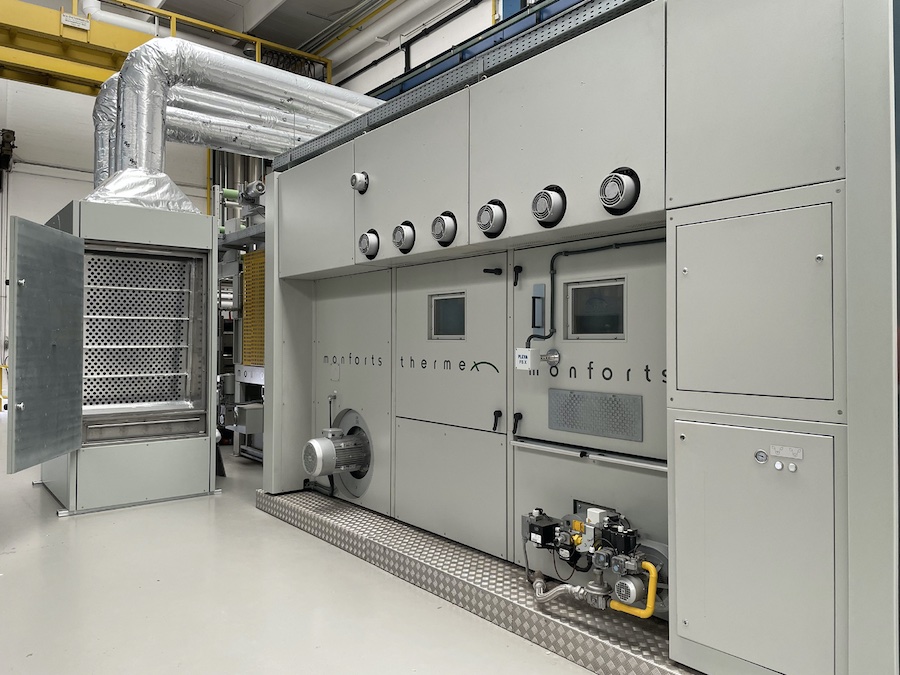
Jeanologia is introducing the first machine that integrates ozone technology to the continuous fabric finishing process. Just like its equivalent for garments, Jeanologia sees G2 Dynamic as a major game-changer for the fabric finishing industry. Using ozone, created from the air in the atmosphere, G2 Dynamic provides an eco-efficient alternative to several of the most resource intensive and pollutant processes in textile production, which can also be counted among the most commonly used, such as desizing, elimination of backstaining and caustification.

The results G2 Dynamic obtains are comparable to those of each of the above-mentioned processes. G2 Dynamic achieves them using up to 95% less water, without thermal energy and with no chemicals at all, as ozone is the only active element this technology needs, and that ozone is turned back to oxygen and released back into the atmosphere as soon as its purpose is accomplished, closing the loop for a Zero discharge process.

This is a qualitative leap forward that allows weavers to exploit a differentiation factor based on the deployment of a new technology and not just the optimization of an existing process. This qualitative leap becomes apparent in terms of sustainability, but it also brings about the simplification of the process, reducing steps and the number of washing boxes the fabric needs to go through to be deemed finished. For example: during desizing, substituting the conventional process with its several consecutive baths for a single prewash with no chemicals and a run through G2 Dynamic, according to Jeanologia they achieve 80% water savings while eliminating backstainging at the same time.


30 textile manufacturers from all over the world have already adopted G2 Dynamic technology and have started reducing their environmental impact and saving a considerable amount of resources. With this new technology tha company says, Jeanologia will save an average of 8.8 million of m3 of water per year, enough to provide clean water for all domestic consumption needs to 3.5 million people during that whole year, the equivalent to the entire population of Uruguay.

Benefits that extend beyond fabric finishing

As all denim and RTD fabric will go through at least one of those processes, G2 Dynamic is the key to create a more sustainable fabric. Not only that, but with G2 Dynamic, a sustainable fabric leads to a sustainable garment.

With this technology buyers will be receiving raw garments that are already primed for the laundry. Fabric treated with G2 Dynamic boosts the effect of laser and shortens the garment finishing processes both in time and steps, saving around 85-95% of water and chemical consumption, as the steps where they are used are either shorter or no longer needed. In consequence, using this fabric reduces the total processing times and increases the productivity, making the whole manufacturing process more efficient and sustainable form fabric to garment finishing.

Jeanologia says, it’s disruptive, it’s simple, it’s eco-efficient and it’s the starting point for even more sustainable garment collections. It' s their visions customers will redefine fabric finishing with them.


More News from JEANOLOGIA S.L.

#Denim

Jeanologia launches Billy

The new AI extracts precise laser designs from a garment image in minutes, transforming how vintage denim is recreated for production. If Jeanologia’s laser changed the way jeans were made at the end of the last century, its AI now takes the next step: moving from reproducing wear to designing it. / archive photo © 2026 Jeanologia

#Textile chemistry

Jeanologia urges industry to accelerate PP Spray phase-out following ZDHC Watchlist update

Potassium permanganate has officially entered the Chemical Watchlist of the ZDHC Foundation, signaling increased scrutiny and potential phase-out of one of the most hazardous chemicals still used in denim finishing. The inclusion confirms an industry shift that Jeanologia anticipated more than a decade ago.

#Denim

Jeanologia celebrates its 30th anniversary transforming how jeans are produced worldwide

Jeanologia celebrates its 30th anniversary reaffirming the mission it was born with in 1994, to transform the textile industry into a more sustainable, efficient, and human-centered sector. Three decades later, that vision has become a global reality. Today, more than 40 percent of all jeans produced worldwide are made using technologies developed by the Valencia-based company.

#Denim

Jeanologia shapes the denim of the future at Kingpins with ‘Mediterranean Soul’

Jeanologia, the global leader in sustainable technologies for the textile industry, returns to Kingpins Amsterdam with its new collection “Mediterranean Soul”, blending nature, creativity, and technology to prove that authentic denim can be designed and produced with efficiency and minimal environmental impact.

More News on Dyeing, Drying, Finishing

#Techtextil 2026

BW Converting to present its Baldwin TexCoat® G4 at Techtextil 2026

BW Converting will present its Baldwin TexCoat® G4 precision spray finishing system at Techtextil Frankfurt 2026, taking place April 21-24 at Messe Frankfurt. Visitors to Hall 12, Booth C56B, will have the opportunity to explore how this advanced spray technology helps textile manufacturers improve finishing quality, increase efficiency and reduce resource consumption across a wide range of applications.

#Techtextil 2026

Smart sensors, smart savings - Reducing energy and cost in textile finishing

As energy prices, sustainability requirements and quality expectations continue to rise, manufacturers of technical textiles face increasing pressure to optimize efficiency while ensuring process reliability. At the same time, skilled labor shortages require production systems that are intuitive, automated and easy to manage. PLEVA addresses these challenges with robust, maintenance-friendly sensor technologies combined with intelligent process control.

#Dyeing, Drying, Finishing

Navis TubeTex and Fibroline announce upcoming Innovation Days

Navis TubeTex and Fibroline LLC announced their upcoming Innovation Days, a collaborative 3-day event designed to showcase advancements in product development technologies, and next-generation sustainable manufacturing solutions.

#Dyeing, Drying, Finishing

BW Converting expands Southeast Asian presence with new agency partnerships in Vietnam and Indonesia

BW Converting is strengthening its presence in Southeast Asia through new agency partnerships in Vietnam and Indonesia, reinforcing the company’s commitment to supporting textile manufacturers across the region. The expansion comes as BW Converting prepares to exhibit at SaigonTex 2026 (April 8–11, Saigon Exhibition and Convention Center, Ho Chi Minh City, Vietnam) and INDO INTERTEX 2026 (April 15–18, Jakarta International Expo, Indonesia).

Latest News

#Techtextil 2026

Performance Apparels: Functional textiles drive innovation at Techtextil 2026

From high-performance fibres and advanced membranes to smart textiles and sustainable material concepts – functional apparel is becoming one of the most dynamic innovation fields in technical textiles. At Techtextil 2026, exhibitors demonstrate how new materials, finishing technologies and digital functions are shaping the next generation of protective, workwear and outdoor systems.

#Textile chemistry

A flagship for chemical production: BASF inaugurates world-scale Verbund site in China

BASF today (March 26, 2026) celebrated the official inauguration of its newly built, world-scale Verbund site in Zhanjiang, Guangdong Province in southern China. Covering an area of around four square kilometers, it is more than a major BASF project in the chemical growth market of China. “Zhanjiang shows what the future of chemistry looks like: efficient, digital and sustainable by design. The site showcases a smart integrated Verbund structure on an industrial scale,” said Dr. Markus Kamieth, CEO of BASF, at the ceremony attended by representatives from government, customers, business partners and employees.

#Nonwovens

VEOCEL™ Lyocell production expands to Asia – Launching a new chapter for nonwovens in the region

VEOCEL™, Lenzing's flagship specialty nonwovens brand, expands production at its Thai plant in Prachinburi. This is the first-ever production of its nonwoven-grade lyocell fibers in Asia. Built in 2022 with a 100,000-ton annual production capacity, the facility - previously focused on fibers for textile applications - now can directly meet the demand for VEOCEL™’s biodegradable¹, wood-based lyocell fibers for nonwovens products. These fibers are an essential ingredient for high-quality nonwovens products, ranging from baby wipes to facial sheet masks and everyday personal hygiene items.

#Research & Development

Hof University develops sustainable textile coating for the fashion of tomorrow from mushrooms

Clothing is often treated as disposable: T-shirts for events, general merchandise, or short-term campaigns frequently end up in the trash after only a few uses. This is particularly problematic given that their production still largely relies on fossil-based materials. This is precisely where a new research project at Hof University of Applied Sciences comes in.

TOP