[pageLogInLogOut]

#Digital Printing

SE-DA invests in Kornit Presto S for on-demand production flexibility, cost-efficiency
© 2021 Kornit Digital
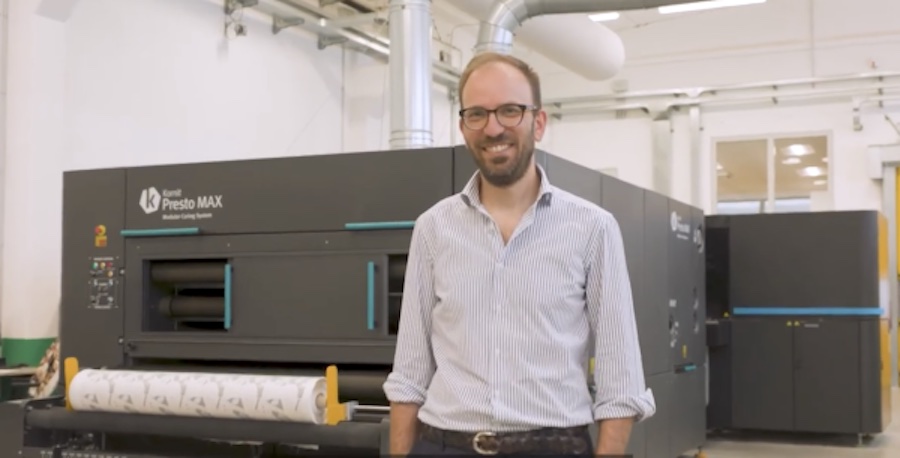
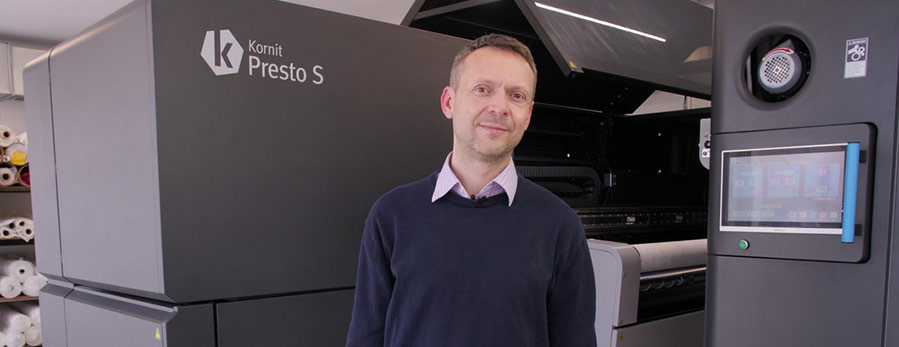
Kornit Digital (Nasdaq: KRNT), a worldwide market leader in digital textile printing technology, announced Poland-based SE-DA has created a “microfactory” production model using the Kornit Presto S system for eco-friendly direct-to-fabric production.

"The production process is environmentally-friendly…customers get a very high-quality graphic…we see a great future in the print-on-demand business.”

Operating as a family business since 1990 and employing a staff of about 200 employees, SE-DA is a professional supplier of high-quality textiles for hotels, restaurants, and healthcare facilities, in addition to home goods. They offer a wide range of decorative fabrics, including curtains, blinds, bedsheets, bathrobes, towels, slippers, and bathroom rugs. SE-DA engages in e-commerce via their HotelTex website, and print and sew various pieces in a variety of materials and quantities on demand.

Having implemented Kornit’s technology, incoming orders are produced with very little setup time, the products are vivid and soft to the touch, and the imprinted materials have a superior light and wash fastness necessary for long-term use. Requiring less inventory has helped improve SE-DA’s bottom line.

“As the demands of our customers grew, we found Kornit Presto S was the best all-around product we could find for high-quality printing to many different fabrics, which gives us great flexibility,” says Damian Marchlewicz, CEO at SE-DA. “The fact that pre- and post-treatment is completely inline makes it possible to print very quickly, keeping costs low while ensuring the production process is environmentally-friendly as no water is used during the entire production process.”

While Kornit’s system represented a significant investment for the business, Damian noted Kornit technicians have been very supportive and helpful in ensuring their comfort with using and maintaining the technology, from the evaluation process to installation.


“Having completed a few training sessions, we’ve found the Presto system very easy to operate, without dedicating a lot of time to learning how to use it,” he says. “Multiple prints go into a single feed, which helps minimize our costs, and the customers get a very high-quality graphic that meets any standard in place. We see a great future in the print-on-demand business.”

Abetted by Kornit’s technology, SE-DA is currently in the process of becoming GOTS and GRS certified.

“Kornit’s single-step, eco-friendly production technology offers considerable value to any textile company that needs to deliver high-quality pieces, in any quantity, in short order,” says Chris Govier, KDEU Managing Director. “SE-DA produces materials that must be safe and durable, standing up to a great deal of wear and tear, and with this system they can guarantee any number of pieces that will exceed the demands of hospitality and healthcare, using responsible, sustainable methods.”

View the video testimonial here:

https://www.kornit.com/case-study/se-da-kornit-digital-case-study/


More News from Kornit Digital

#Digital Printing

Former ASOS CEO Nick Beighton joins Kornit Digital to help shape the future of on-demand fashion

Kornit Digital LTD. (NASDAQ: KRNT) ("Kornit" or the "Company"), a global leader in sustainable, on-demand digital fashion and textile production technologies, today announced it has appointed Nick Beighton, former Chief Executive Officer of ASOS, as a strategic advisor to the Company and its Board of Directors. His appointment reflects Kornit’s continued focus on strengthening its connection to global brands, retailers, and digital commerce platforms as the industry transitions toward on-demand production. The Company plans to nominate Mr. Beighton for election to the Board at Kornit’s 2026 Annual Shareholder Meeting.

#Digital Printing

UK Manufacturer Basic Prints commits to digital-first production model with dual investment in Kornit Digital’s Apollo

Kornit Digital, a global leader in sustainable, on-demand digital fashion and textile production technologies, today announced that UK clothing manufacturer Basic Prints has expanded its digital production capacity with a second Kornit Apollo Direct-to-Garment (DTG) system. This marks a strategic shift supporting Basic Prints’ digital-first manufacturing model.

#Digital Printing

Hybris Productions scales licensed apparel production moving from screen to digital with Kornit Digital

Kornit Digital, a global pioneer in sustainable, on-demand digital fashion and textile production technologies, today announced that Hybris Productions has adopted Kornit’s direct-to-garment (DTG) digital production technology to scale licensed apparel manufacturing with greater speed, design flexibility, and on-demand production capabilities supporting retail and e-commerce growth.

#Digital Printing

Call for speakers and partners: Kornit Konnections 2026

Kornit Konnections today announced it is officially accepting speaker proposals and partner interest for what is set to be the most influential digital apparel industry gathering of the decade. Interested parties should visit www.kornitkonnections.com.

More News on Digital Printing

#Digital Printing

FESPA confirms participation from leading exhibiting suppliers and brands for inaugural textile event

FESPA has confirmed a strong exhibitor line-up for its inaugural Textile show, a dedicated new event that will run as part of FESPA 2026, alongside co-located events: Global Print Expo, Personalisation Experience, European Sign Expo, WrapFest and the brand-new Corrugated.

#Digital Printing

Keeping print inclusive: Empowering women in the print industry

Across all industries, cultivating a diverse and inclusive workplace is increasingly recognised as valuable and essential to long-term success. However, despite the print industry’s significant advancements in technology and innovation, visible representation of women remains limited. As the sector grapples with low recruitment, it’s important to challenge outdated perceptions. Creating real change, however, requires collective effort - no single company can do it alone.

#Digital Printing

Express Print boosts production using an expanded fleet of Mimaki technologies

Express Print, a fast-growing Bulgarian provider of visual communication and soft signage solutions, has significantly enhanced its production workflow with a comprehensive portfolio of Mimaki digital printing systems. Based in Varna and active for more than 10 years, the company maintains a strong focus on the advertising sector. Over the years, it has steadily expanded its operations, driven by a clear vision to bring the full spectrum of large-format printing services in-house, avoiding outsourcing and ensuring complete control over production quality.

#Digital Printing

Erreà upgrades sportswear printing operations with seven high-performance Mimaki digital textile printers

Mimaki Europe, a leading manufacturer of industrial inkjet printers and cutting systems, has supported renowned Italian sportswear brand, Erreà in upgrading its digital textile printing operations with the installation of seven high-performance Mimaki systems. The new installation includes three Tiger600-1800TS industrial dye-sublimation printers and four TS330-1600 solutions, replacing a previous fleet of 28 digital printers. This major upgrade marks a significant step forward in Erreà’s production strategy, enabling the company to streamline its printing infrastructure while improving efficiency, colour consistency and overall production control.

Latest News

#Techtextil 2026

Shima Seiki showcases WHOLEGARMENT® and 3D knitting solutions for technical textiles at Techtextil 2026

Leading textile technology solutions provider SHIMA SEIKI MFG., LTD. of Wakayama, Japan, along with its Italian subsidiary SHIMA SEIKI ITALIA S.p.A., will be participating in the Techtextil 2026 exhibition in Frankfurt, Germany next month. On display will be WHOLEGARMENT® and other advanced three-dimensional knitting applications across a wide range of industries besides fashion apparel that are not typically associated with knitting, such as technical textiles using industrial materials and advanced three-dimensional knitting.

#Research & Development

Textilfabrik 7.0 launched: Mönchengladbach becomes a real-world lab for sustainable textile production

With the official kick-off event of the Textilfabrik 7.0 (T7), a major transformation project for the German textile and apparel industry has been launched in the Monforts Quarter in Mönchengladbach. At the “Textile Roundtable,” an event format organized by the Zukunftsagentur Rheinisches Revier, representatives from industry, research, politics, and the regional economy came together to jointly lay the foundation for CO₂-neutral, circular, and economically viable textile production in Germany.

#Techtextil 2026

Future ready nonwovens and fiber processing solutions – Meet Trützschler at Techtextil 2026

From April 21 to 24, 2026, the Trützschler Group will present its future‑ready solutions at Techtextil in Frankfurt, Germany. At Booth C61 in Hall 12.0, Trützschler Nonwovens will showcase its latest developments for efficient nonwovens production, including comprehensive service and consulting solutions. Highlights include the fully upgraded X‑Series nonwoven cards suitable for spunlace, needle‑punching and air‑through bonding (ATB) processes, as well as the T‑ONE digital working environment enhanced with new features. Trützschler Card Clothing will complement the presentation with a new card wire designed with a specially engineered surface for high‑performance nonwoven applications. Visitors can also take a closer look at Trützschler’s complete solution for the recycling of textile waste, TRUECYCLED.

#Recycling / Circular Economy

Europe needs tipping point to scale textile-to-textile recycling, BCG and ReHubs say

A new report from Boston Consulting Group (BCG) and ReHubs, titled “Advancing Textile Circularity – Europe’s textile waste challenge: Scaling Textile-to-Textile requires enabling mechanisms”, highlights the urgent need for systemic action to tackle Europe’s growing textile waste and scale a circular textile economy.

TOP