[pageLogInLogOut]

#Composites

SGL Carbon puts additional state-of-the-art soft felt line into operation
© 2021 SGL Carbon
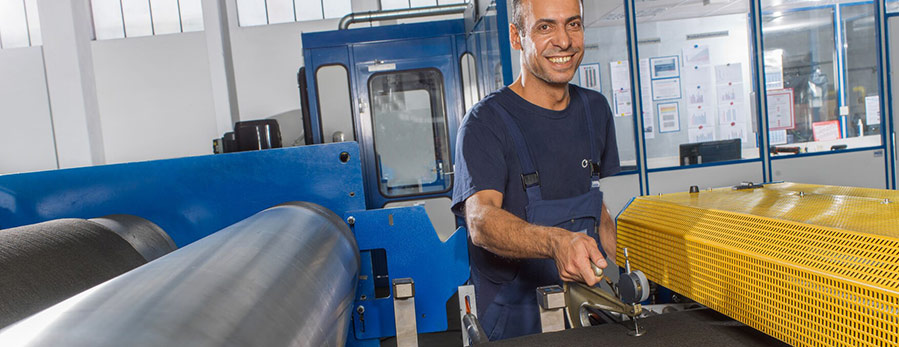
SGL Carbon is expanding and modernizing its soft felt production. The company invested a single digit million euros in the last two years into an additional carbonization facility at its Meitingen site near Augsburg, Germany, which has now been put into regular operations.
  • Expansion and modernization of soft felt production capacities
  • High-quality materials and components for all areas of high-temperature technology, for stationary energy storage systems as well as friction materials in automotivE

Branded as SIGRATHERM® materials the carbon and graphite soft felts are used as particularly high-quality insulation material in resistance-heated and induction-heated vacuum furnaces as well as furnaces with an inert gas atmosphere. Applications include the semiconductor and solar industries ceramic sintering processes for the hard metal industry. In addition, soft felts are used as battery felts (SIGRACELL®) in stationary energy storage and fuel cell systems and as a precursor for the production of carbon-based friction linings for dual clutch transmissions and similar applications in the automotive and aerospace industries.


"With this expansion, we are further extending our lead as a quality and technology leader and can thus expand our product portfolio in line with market developments. The capacity expansion not only enables us to produce significantly higher quantities of soft felts, but also to drive the development of new products even more strongly than before," says Karl Hingst, Director Product Group Fiber Materials at SGL Carbon.

As a leading graphite manufacturer, SGL Carbon not only has the facilities and know-how, but was also the first company in the world to produce soft felts in continuous high-temperature processes.

More News from SGL CARBON SE

More News on Composites

#Composites

Kordsa showcases its global expertise in material technologies at JEC World 2026

Kordsa, a subsidiary of Sabancı Holding, shared its global expertise in material technologies with participants at JEC World 2026, held in Paris. The company’s solutions developed for a wide range of industries—particularly aviation, energy, and automotive—stood out among its key innovations at the exhibition. Throughout the event, Kordsa also presented its vision for sustainable growth and its strategic transformation in composite technologies to international stakeholders.

#Composites

JEC Composites Startup Booster: 2026 winners announced

The leading global startup competition for composites and advanced materials has crowned its 2026 champions, ahead of a landmark 10th anniversary edition next year. The winners of the JEC Composites Startup Booster 2026 were announced on Wednesday, 11 March, at JEC World, recognizing the most promising emerging companies reshaping the future of composites and advanced materials.

#Yarn & Fiber

Teijin Carbon strengthens high‑end sports offering with advanced prepreg and resin technologies for next‑generation bicycle performance

High‑end bicycle manufacturers are entering a new era in which modern frames and components must be lighter, stiffer, tougher and more sustainable – all while enabling fast, repeatable and cost‑efficient production. To support this shift, Teijin Carbon is expanding its portfolio of advanced prepreg systems developed specifically for premium road, gravel and mountain bike applications.

#Composites

JEC WORLD 2026 opens: Paris becomes the World Capital of composites

JEC World 2026 opens tomorrow, March 10, at Paris Nord Villepinte, bringing together the entire composites ecosystem for three days of exhibitions, conferences, technical sessions, strategic industry gatherings, and business meetings. As the “festival of composites”, JEC World is also a destination for a broad spectrum of other professional visitors, eager to discover how these advanced materials can offer sustainable solutions to their industries.

Latest News

#Techtextil 2026

STFI presents concepts for the textile circular economy and solutions for a healthy and safe life at Techtextil

Sächsisches Textilforschungsinstitut e.V. (STFI) has been supporting companies in developing marketable innovations for over 30 years. With a clear focus on sustainability, the environment, health and protection, the STFI offers future-oriented research, textile testing for tailor-made solutions and certification of per- sonal protective equipment. At Techtextil 2026, the institute will present ideas for the textile circular econ- omy and showcase solutions for healthy and safe living.

#Techtextil 2026

Cetex: Textile innovations “Made in Saxony” at Techtextil

This year, the Cetex Institut gGmbH is once again not only exhibiting but also organising a joint booth at Techtextil. Together with co-operation partners, textile innovations “Made in Saxony” will be presented on almost 85 m². The spectrum covers everything from textile machine construction and the manufacture of technical textiles to measuring and testing technology, with research and development also having its place.

#HIGHTEX 2026

The global meeting point of the technical Textiles and nonwoven industry: HIGHTEX 2026

One of the world’s most prestigious technical textiles and nonwoven exhibitions, the HIGHTEX 2026 International Technical Textiles and Nonwoven Exhibition, is preparing to open its doors to industry professionals at the Tüyap Fair and Congress Center in Istanbul between June 9–13, 2026. Bringing together manufacturers, technology developers, and global buyers from all around the world in the field of technical textiles, HIGHTEX 2026 will be an important platform showcasing the sector’s innovative solutions and paving the way for new collaborations.

#Texprocess 2026

Texprocess 2026: Automation, digitalisation and AI reshape textile processing

Investment decisions in textile processing have become increasingly complex. Rising energy prices, labour shortages and geopolitical uncertainties are forcing companies to prioritise technologies that deliver measurable improvements in efficiency and process stability. This applies not only to apparel production, but also to the processing of technical textiles and high-performance materials. Modernisation projects are therefore being evaluated more selectively – but the pressure to upgrade production systems continues to grow. Texprocess 2026 reflects this tension between cautious investment behaviour and increasing technological demand.

TOP