[pageLogInLogOut]

#Associations

Textile machinery: Italian technology charts the course for revival

ACIMIT: "Focus on innovation and sustainability to win global challenges"

Operating in a scenario characterized by geopolitical instability, slowing industrial investments, and new protectionist pressures. This is the main challenge for the Italian textile machinery industry that emerged during the General Assembly of ACIMIT (Association of Italian Textile Machinery Manufacturers), held today in Milan at the Shareholders’ Hall of Palazzo Edison.


The president, Marco Salvadè, presenting the sector’s final figures for 2025 based on ISTAT data, highlighted how the weakness of the European and global manufacturing framework conditioned the sector’s results. However, despite widespread instability and contraction in traditional markets, Italian technology confirms its position as a world leader.

President Marco Salvadè commented: “The path to revival goes through innovation, sustainable transition, and preparation for the great milestone of ITMA 2027.”

In 2025, domestic production in the textile machinery sector stood at approximately €1.94 billion, recording a 9% decrease compared to the previous year. Exports also suffered a contraction, falling by 8% to a total value of €1.675 billion. On the domestic front, home sales amounted to €266 million (-14%), highlighting a demand that, although showing moderate growth in overall domestic consumption thanks to rising imports (+14%), remains insufficient to trigger a genuine acceleration in national investments.

The decline in Italian exports affected numerous traditional target markets, including North America and Turkey, the latter experiencing a particularly difficult trend. However, Asia confirms its position as the primary destination, absorbing 40% of total exports (€667 million), followed by the European Union (24%) and non-EU Europe (11%). In terms of product categories, finishing and dyeing machinery led overseas sales (33% of the total), followed by accessories (20%) and spinning machinery (15%).

Amid this complex scenario, India’s outstanding performance stands out. In 2025, it became the leading market overall for Italian textile machinery exports, with sales leaping to €176 million (+28% compared to 2024). This signal rewards the dynamism of the local supply chain and the recognized value of Italian technological quality.

Salvadè added: “The 2025 data require attention but must be read within an unprecedented and fragmented global economic situation. Our sector competes globally through technological quality and customized, high-value-added solutions. To support this drive, we reiterate to the institutions the need for coherent industrial policies, with incentive tools for innovation and digitalization that are stable over time and easily accessible.”

Sustainability is confirmed as the true competitive pillar of Italian technology. ACIMIT manufacturers continue to invest heavily in R&D to develop highly energy-efficient machinery and advanced automation, while also focusing on solutions capable of drastically cutting the consumption of customer textile companies, simultaneously contributing to a reduction in production costs.

Marco Salvadè concluded: “Today, the ecological transition is no longer an optional accessory, but our main distinguishing feature on international markets. The priority is to strengthen the dialogue with the school and research systems to attract young talent, because without skills there is no innovation.”

If 2025 was a year of transition and resilience, the 2026-2027 biennium will be entirely focused on preparation and global relaunch, with all eyes set on ITMA 2027—the world’s premier showcase for the sector, taking place from September 16 to 22, 2027, in Hanover, Germany. ACIMIT has already launched intensive internationalization programs, translating into numerous dedicated promotional activities carried out in synergy with the Italian Trade Agency (ICE) and the Ministry of Foreign Affairs.

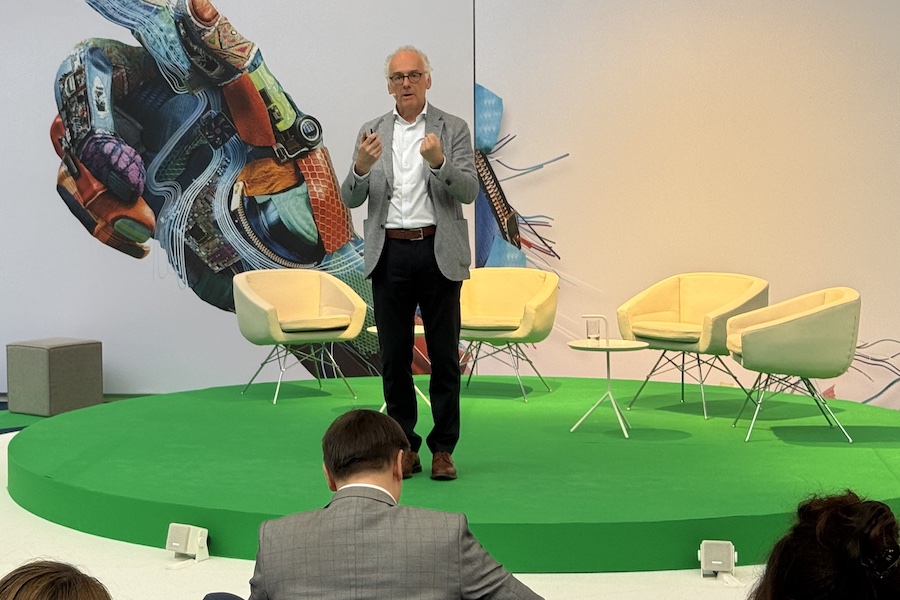
The major ongoing changes were at the heart of the subsequent Public Assembly, titled “Competing in a Changing World.” The debate, moderated by Luca Orlando, journalist and correspondent for Il Sole 24 Ore, brought together institutions and influential figures from the economic and manufacturing spheres.

In addition to Marco Salvadè’s report, the event featured valuable macroeconomic and geopolitical insights from Marco Fortis (Vice President of the Edison Foundation) and Paolo Magri (Chairman of the ISPI Scientific Committee). The perspective was then broadened to encompass the challenges of the supply chain and the European market through contributions from Luca Sburlati (President of Confindustria Moda) and Dirk Vantyghem (Director General of Euratex).

The speakers’ presentations clearly highlighted how the ability to act as a cohesive system, combined with a steadfast commitment to the core pillars of Italian industrial identity—flexibility, innovation, and quality—are decisive factors in cementing the global leadership of Made in Italy.
More News from Associazione Costruttori Italiani di Macchinario per l Industria Tessile (ACIMIT)

#Associations

Bangladesh: Italian textile machinery mission stops in Dhaka and Chittagong

Technological upgrading and the transition toward higher value-added production are driving the new Italian industrial mission to Bangladesh. This year, the mission will split between the country’s two main manufacturing hubs, where Italian manufacturers will meet the leaders of the local textile supply chain in two strategic stages: July 7th in Dhaka and July 9th in Chittagong.

#Associations

Mongolia: Workshop on Italian textile technologies kicks off in Ulaanbaatar

The workshop dedicated to Italian textile technologies will kick off in Ulaanbaatar from 21 to 23 June 2026. Focused on the most advanced innovative solutions for the textile industry, the initiative will bring together 13 Italian textile machinery manufacturers, confirming the growing interest in strengthening industrial cooperation between the two countries and highlighting Mongolia’s strategic importance for Italian textile machinery producers.

#Associations

Turkmenistan: Italian textile machinery focuses on high technology and specialization

The Italian textile machinery industry flies to Ashgabat to participate with a large “Made in Italy” delegation at TURKMEN TEXTILE EXPO 2026, the major international showcase taking place from June 4 to 6, 2026. The Italian presence, coordinated by the Italian Trade Agency (ICE) and ACIMIT (the Association of Italian Textile Machinery Manufacturers), aims to consolidate Italy’s primary technological role in a highly strategic market with interesting prospects.

#Associations

Egypt: Workshop on Italian textile technologies concludes

The workshop dedicated to Italian technologies for the textile industry, held in Cairo on May 5–6, 2026 and focusing on the most advanced innovative solutions for the sector, has come to a close.

More News on Associations

#Associations

Sustainability: European industry calls on EU to keep Single-Use Plastics Directive unchanged

A broad coalition of European industry associations, including EDANA, Euratex and Plastics Europe, has urged EU institutions to maintain the current legal framework of the Single-Use Plastics Directive (SUPD). In a joint statement, the organisations argue that reopening the Directive at this stage would create legal uncertainty, increase regulatory complexity and undermine investment, while its implementation across the European Union is still incomplete.

#Recycling / Circular Economy

New skills for a circular textile economy

Based on the results of a comprehensive analysis, the Erasmus+ project Skills4Circularity is developing three practical training modules covering recycling technologies, eco-design for the circular economy and sustainable manufacturing. The content of the first module, Recycling Technologies, has now been developed and validated together with industry representatives. The module provides participants with knowledge of regulatory requirements, material sorting and the preparation of textile waste for recycling.

#Associations

Towards pragmatic and harmonised labelling in the EU

EDANA, alongside 14 European associations, urges the European Commission and Member States to adopt a pragmatic approach for the future harmonised packaging labels, in line with the EU’s agenda for the EU Single Market, simplification and competitiveness. The system should rely on text-free pictograms, available in achromatic or monochromatic versions matching the packaging palette, with the possibility of using digital labelling as a core element. Our associations represent manufacturers of consumer goods across Europe.

#Associations

Textile PRO Forum calls for greater harmonisation of textile EPR systems across Europe

The Textile PRO Forum has published a new analysis highlighting the need for greater harmonisation of textile Extended Producer Responsibility systems across Europe. The document, Toward harmonised Textile EPR Systems in Europe: analysis and recommendations, presents the results of work carried out by Workstream 1 of the Textile PRO Forum, led by Dr. Eng. Viola Corbellini, Strategic Development and Innovation Expert at Erion Textiles, and Eng. Luca Campadello, General Director at Erion Textiles. The workstream focused on reducing administrative burden for textile producers by identifying areas where procedures could be better aligned across countries.

Latest News

#Recycled Fibers

Recover™ and Ünteks Group partner to scale recycled cotton in knitwear

Recover(TM), a global producer of low‐impact, high‐quality recycled cotton fiber, announces a new partnership with Ünteks Group, a vertically integrated textile manufacturer based in Turkey. The collaboration focuses on the development of circular knit fabrics and garments, combining Recover’s recycled cotton fiber with Ünteks Group’s integrated capabilities across knitting, dyeing, printing, and garment production.

#Spinning

STEELTOP®: A new benchmark in flat tops for spinning preparation

Modern carding generations achieve higher production performance, placing significantly greater stress on flat tops. Higher cylinder speeds and increased fiber density, combined with tighter carding gaps, create more demanding operating conditions. At the same time, poorer raw material quality and the increased use of recycled materials further intensify these challenges. With STEELTOP®, Trützschler introduces a new full steel flat top series developed for these demanding modern carding processes.

#Textile processing

YKK develops concept EXCELLA® zipper tape using nonwoven fabric partially derived from used clothing

YKK Corporation has developed a concept version of its premium EXCELLA® zipper series made from nonwoven fabric sheets created by fiberizing used clothing and other textile materials. Based on a proposal by fashion designer Yuima Nakazato, this item was created as a result of collaboration between Nakazato, Seiko Epson Corporation and YKK. The concept zipper was incorporated as a material component for pieces in the newest YUIMA NAKAZATO Couture Collection, “INFERNO,” which was unveiled in Paris, France on July 8, 2026.

#Textiles & Apparel / Garment

Texworld Apparel Sourcing Paris highlights evolving global sourcing landscape

From 31 August to 2 September 2026, Texworld Apparel Sourcing Paris will bring together more than 1,000 international exhibitors at Paris-Le Bourget Exhibition Centre. This edition reflects the new global balance of textile and apparel sourcing, highlighting a strong diversity of sourcing countries — some unexpected.

TOP