[pageLogInLogOut]

#Associations

Italian Textile Machinery: Orders still declining in 2024 second quarter
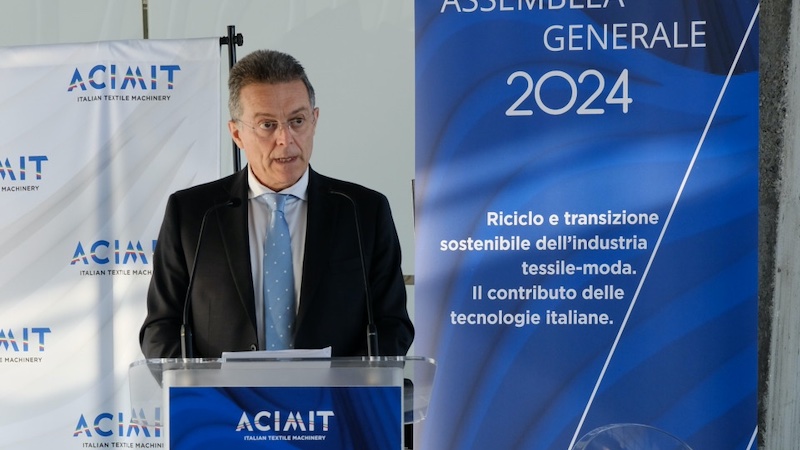
In the second quarter of 2024, the order index for Italian textile machinery, as reported by the Economics Department of ACIMIT – the Association of Italian Textile Machinery Manufacturers, showed a decline compared to the period 2023 April-June (-17%). In value terms, the index stood at 49.8 points (base 2021=100).
Marco Salvadè, president of ACIMIT © 2024 ACIMIT


This result is completely due to the decrease recorded in foreign markets (-22%), where orders represent 86% of the total. Conversely, in Italy, there was a 25% recovery compared to the second quarter of 2023. The absolute value of the index in foreign markets was 48.8 points, while in Italy it was 57.3 points. In the second quarter, the order backlog reached 4.3 months of assured production. Additionally, ACIMIT’s survey shows that in the first six months of 2024 the utilization rate of production capacity by Italian manufacturers was 61%. This percentage is expected to rise to 64% in the second half of the year.

Marco Salvadè, president of ACIMIT, stated: “The order index for the second quarter shows a clear slowdown abroad compared to last year. This decline highlights the high uncertainty due to the difficult geopolitical situation“. The confirmation of what is indicated by the ACIMIT index also comes from Italian export figures, updated to the first quarter of 2024. Excluding China and Egypt, the main foreign markets show a general decline in demand for textile machinery, not just Italian one.

More News from Associazione Costruttori Italiani di Macchinario per l Industria Tessile (ACIMIT)

#Associations

Textile machinery: Italian technology charts the course for revival

Operating in a scenario characterized by geopolitical instability, slowing industrial investments, and new protectionist pressures. This is the main challenge for the Italian textile machinery industry that emerged during the General Assembly of ACIMIT (Association of Italian Textile Machinery Manufacturers), held today in Milan at the Shareholders’ Hall of Palazzo Edison.

#Associations

Bangladesh: Italian textile machinery mission stops in Dhaka and Chittagong

Technological upgrading and the transition toward higher value-added production are driving the new Italian industrial mission to Bangladesh. This year, the mission will split between the country’s two main manufacturing hubs, where Italian manufacturers will meet the leaders of the local textile supply chain in two strategic stages: July 7th in Dhaka and July 9th in Chittagong.

#Associations

Mongolia: Workshop on Italian textile technologies kicks off in Ulaanbaatar

The workshop dedicated to Italian textile technologies will kick off in Ulaanbaatar from 21 to 23 June 2026. Focused on the most advanced innovative solutions for the textile industry, the initiative will bring together 13 Italian textile machinery manufacturers, confirming the growing interest in strengthening industrial cooperation between the two countries and highlighting Mongolia’s strategic importance for Italian textile machinery producers.

#Associations

Turkmenistan: Italian textile machinery focuses on high technology and specialization

The Italian textile machinery industry flies to Ashgabat to participate with a large “Made in Italy” delegation at TURKMEN TEXTILE EXPO 2026, the major international showcase taking place from June 4 to 6, 2026. The Italian presence, coordinated by the Italian Trade Agency (ICE) and ACIMIT (the Association of Italian Textile Machinery Manufacturers), aims to consolidate Italy’s primary technological role in a highly strategic market with interesting prospects.

More News on Associations

#Associations

Sustainability: European industry calls on EU to keep Single-Use Plastics Directive unchanged

A broad coalition of European industry associations, including EDANA, Euratex and Plastics Europe, has urged EU institutions to maintain the current legal framework of the Single-Use Plastics Directive (SUPD). In a joint statement, the organisations argue that reopening the Directive at this stage would create legal uncertainty, increase regulatory complexity and undermine investment, while its implementation across the European Union is still incomplete.

#Recycling / Circular Economy

New skills for a circular textile economy

Based on the results of a comprehensive analysis, the Erasmus+ project Skills4Circularity is developing three practical training modules covering recycling technologies, eco-design for the circular economy and sustainable manufacturing. The content of the first module, Recycling Technologies, has now been developed and validated together with industry representatives. The module provides participants with knowledge of regulatory requirements, material sorting and the preparation of textile waste for recycling.

#Associations

Towards pragmatic and harmonised labelling in the EU

EDANA, alongside 14 European associations, urges the European Commission and Member States to adopt a pragmatic approach for the future harmonised packaging labels, in line with the EU’s agenda for the EU Single Market, simplification and competitiveness. The system should rely on text-free pictograms, available in achromatic or monochromatic versions matching the packaging palette, with the possibility of using digital labelling as a core element. Our associations represent manufacturers of consumer goods across Europe.

#Associations

Textile PRO Forum calls for greater harmonisation of textile EPR systems across Europe

The Textile PRO Forum has published a new analysis highlighting the need for greater harmonisation of textile Extended Producer Responsibility systems across Europe. The document, Toward harmonised Textile EPR Systems in Europe: analysis and recommendations, presents the results of work carried out by Workstream 1 of the Textile PRO Forum, led by Dr. Eng. Viola Corbellini, Strategic Development and Innovation Expert at Erion Textiles, and Eng. Luca Campadello, General Director at Erion Textiles. The workstream focused on reducing administrative burden for textile producers by identifying areas where procedures could be better aligned across countries.

Latest News

#Textile processing

YKK develops concept EXCELLA® zipper tape using nonwoven fabric partially derived from used clothing

YKK Corporation has developed a concept version of its premium EXCELLA® zipper series made from nonwoven fabric sheets created by fiberizing used clothing and other textile materials. Based on a proposal by fashion designer Yuima Nakazato, this item was created as a result of collaboration between Nakazato, Seiko Epson Corporation and YKK. The concept zipper was incorporated as a material component for pieces in the newest YUIMA NAKAZATO Couture Collection, “INFERNO,” which was unveiled in Paris, France on July 8, 2026.

#Textiles & Apparel / Garment

Texworld Apparel Sourcing Paris highlights evolving global sourcing landscape

From 31 August to 2 September 2026, Texworld Apparel Sourcing Paris will bring together more than 1,000 international exhibitors at Paris-Le Bourget Exhibition Centre. This edition reflects the new global balance of textile and apparel sourcing, highlighting a strong diversity of sourcing countries — some unexpected.

#Textile processing

Dedicated car seat model of SHIMA SEIKI’s P-CAM® R Cutting Machine unveiled

Leading Japanese textile solutions provider SHIMA SEIKI MFG., LTD. of Wakayama, Japan, showed a special version of its P-CAM® R multi-ply computerized cutting machine dedicated to the production of car seats for the first time, at a private exhibition held over two days on Thursday, July 2nd and Friday, July 3rd at the Kariya City Industrial Promotion Center in Aichi Prefecture.

#Research & Development

ALADIN paves the way for circular and demand-driven textile production in Europe

Textile production can be organized sustainably by utilizing short supply chains and preventing overproduction. This can already be achieved today by intelligently connecting and efficiently utilizing existing infrastructure. At the same time, production becomes circular when innovative technologies and materials are used that enable high-quality recycling. The ALADIN research project, launched in May 2026 and co-funded with five million euros under the EU Horizon Europe program, is creating the conditions for this.

TOP



