[pageLogInLogOut]

#Associations

AATCC announces 2023 Manual

AATCC is pleased to announce the release of the 2023 edition of the Manual of International Test Methods and Procedures. This will be the 98th volume of the AATCC Manual. It is available as a hardbound book, USB, and individual standard PDFs. USB and individual standards will be available starting January 2, 2023. The book will be ready for purchase on or before January 15, 2023.

New & Revised Standards

There are 15 new or technically revised standards in the 2023 AATCC Manual. Several methods have been reorganized for easier use. Most notably, AATCC TM197 was separated into two methods for vertical wicking. TM197 is now specifically for evaluating wicking rate to specified distances. AATCC TM213 is a new method for evaluating wicking rate to specified times. Both methods provide guidance and troubleshooting for everything from timing multiple specimens to optimal viewing for dark specimens.

Make plans to purchase your copy in January!

Visit https://members.aatcc.org/store/ or search for individual standards at https://www.aatcc.org/testing/#tm.
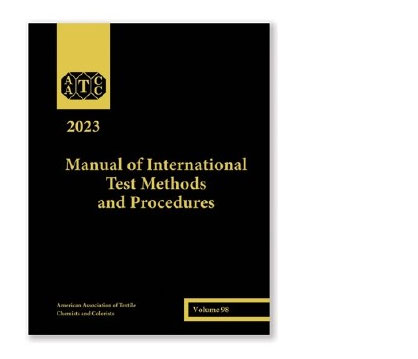
© 2022 AATCC
© 2022 AATCC


AATCC TM16.1-2022, Test Method for Colorfastness to Light: Outdoor. Revised in 2022 for clarity and to add the History section.

AATCC TM16.2-2022, Test Method for Colorfastness to Light: Carbon-Arc. Revised and added History section in 2022.

AATCC TM81-2022, Test Method for pH of the Water-Extract from Wet Processed Textiles. Revised in 2022 to align to the AATCC Style Guide.

AATCC TM82-2022, Test Method for Fluidity of Dispersions of Cellulose from Bleached Cotton Cloth. Revised in 2022 to align with the AATCC Style Guide.

AATCC TM90-2022, Test Method for Antibacterial Activity of Textile Materials: Agar Plate. Revised in 2022 to clarify and align with prescribed AATCC style guidelines.

AATCC TM98-2022, Test Method for Alkali in Bleach Baths Containing Hydrogen Peroxide. Revised in 2022 to align to the AATCC Style Guide.

AATCC TM102-2022, Test Method for Determination of Hydrogen Peroxide by Potassium Permanganate Titration. Revised in 2022 to align to AATCC Style Guide.

AATCC TM107-2022, Test Method for Colorfastness to Water. Revised in 2022 for clarity and align with prescribed AATCC style guide.

AATCC TM111-2022, Test Method for Weather Resistance of Textiles: Exposure to Daylight and Weather. Revised in 2022 for clarity and to add the History section.

AATCC TM144-2022, Test Method for Alkali in Wet Processed Textiles: Total. Revised in 2022 to align to the AATCC style guide.

AATCC TM157-2022, Test Method for Colorfastness to Solvent Spotting. Revised in 2022 to provide replacement chemistries for perchloroethylene, and title change.

AATCC TM174-2022, Test Method for Antimicrobial Activity of New Carpets. Revised in 2022 to clarify and align with prescribed AATCC style guidelines.

AATCC TM186-2022, Test Method for Weather Resistance: UV Light and Moisture Exposure. Revised in 2022 to align with the style guidelines.

AATCC TM192-2022, Test Method for Weather Resistance of Textiles: Sunshine-Arc Lamp Exposure With and Without Wetting. Revised in 2022 for clarity and to add the History section.

AATCC TM197-2022, Test Method for Vertical Wicking Rate of Textiles: to Specified Distances. Revised in 2022 (with title change) to remove wicking rate to specified times (now TM213) and define other parameters. Jurisdiction transferred to RA114.

AATCC TM209-2022, Test Method for pH and Total Alkali in Wet Processed Textiles: Combined. Revised in 2022 to align to the AATCC Style Guide, and to correctly reference in Section 7.5.

AATCC TM213-2022, Test Method for Vertical Wicking Rate of Textiles: to Specified Times. Developed in 2022 (previously part of AATCC TM197), by AATCC Committee RA114.


Editorial Revisions & Reaffirmations

Additional standards were published with editorial revisions or reaffirmation.

AATCC TM8-2016e(2022)e, Test Method for Colorfastness to Crocking: Crockmeter. Reaffirmed and editorially revised to add History section in 2022.

AATCC TM15-2021e, Test Method for Colorfastness to Perspiration. Editorially revised in 2022 to correct a typo and update conditioning tolerances.

AATCC TM17-1999e2(2018)e2, Test Method for Wetting Agents, Evaluation of. Editorially revised in 2022 to note jurisdiction transfer to AATCC Committee RA114.

AATCC TM27-1952e8(2018)e2, Test Method for Wetting Agents: Evaluation of Rewetting Agents. Editorially revised in 2022 to note jurisdiction transfer to AATCC Committee RA114.

AATCC TM43-1952e6(2018)e2, Test Method for Wetting Agents for Mercerization. Editorially revised in 2022 to note jurisdiction transfer to AATCC Committee RA114.

AATCC TM66-2017e2, Test Method for Wrinkle Recovery of Woven Fabrics: Recovery Angle. Editorially revised in 2022 to add History section.

AATCC TM79-2010e2(2018)e2, Test Method for Absorbency of Textiles. Editorially revised in 2022 to note jurisdiction transfer to AATCC Committee RA114.

AATCC TM116-2018e(2022)e, Test Method for Colorfastness to Crocking: Rotary Vertical Crockmeter. Reaffirmed and editorially revised in 2022 to add the History section.

AATCC TM128-2017e2, Test Method for Wrinkle Recovery of Fabrics: Appearance. Editorially revised 2022 to add History section.

AATCC TM146-2011(2022)e, Test Method for Dispersibility of Disperse Dyes: Filter. Reaffirmed and editorially revised to add the History section.

AATCC TM183(2020)e, Test Method for Transmittance or Blocking of Erythemally Weighted Ultraviolet Radiation through Fabrics. Editorially revised in 2022 to remove the UPF compilation as it has been discontinued.

AATCC TM195-2011e2(2017)e4, Test Method for Liquid Moisture Management Properties of Textile Fabrics. Editorially revised in 2022 to note jurisdiction transfer to AATCC Committee RA114.

AATCC TM198-2011e3(2020)e, Test Method for Horizontal Wicking of Textiles. Editorially revised in 2022 to note jurisdiction transfer to AATCC Committee RA114.

AATCC TM199-2013e(2018)e2, Test Method for Drying Time of Textiles: Moisture Analyzer. Editorially revised in 2022 to note jurisdiction transfer to AATCC Committee RA114.

AATCC TM200-2017e2, Test Method for Drying Rate of Textiles at their Absorbent Capacity: Air Flow. Editorially revised in 2022 to note jurisdiction transfer to AATCC Committee RA114.

AATCC TM201-2012(2014)e3, Test Method for Drying Rate of Fabrics: Heated Plate. Editorially revised in 2022 to note jurisdiction transfer to AATCC Committee RA114.

AATCC TM204-2019e, Test Method for Water Vapor Transmission of Textiles. Editorially revised in 2022 to note jurisdiction transfer to AATCC Committee RA114.
More News from American Association of Textile Chemists and Colorists

#Associations

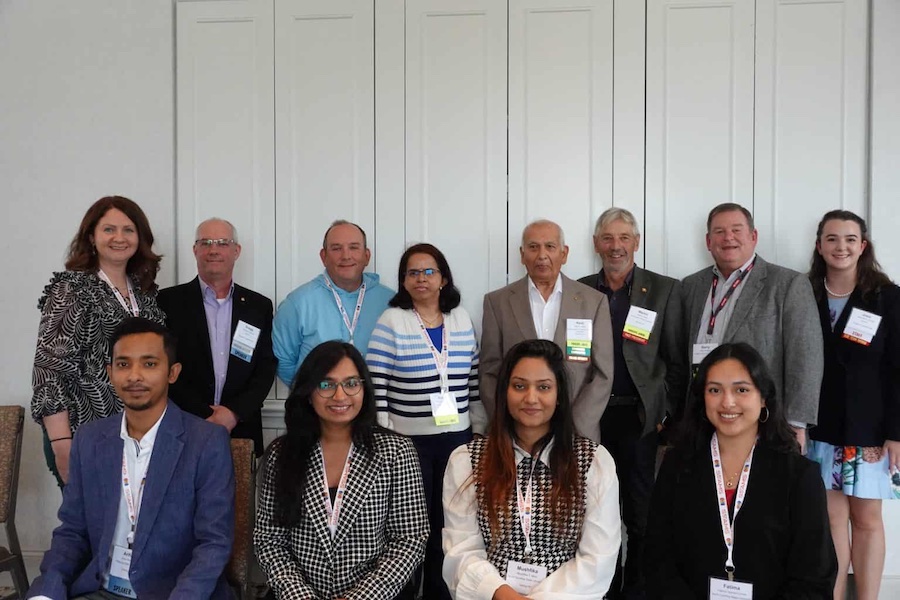
AATCC announces 2025 Herman & Myrtle Goldstein Graduate Student Paper Competition winners

The American Association of Textile Chemists and Colorists (AATCC) recognized the winners of the 2025 Herman & Myrtle Goldstein Graduate Student Paper Competition. Founded in 1982 to give student members the chance to conduct and present original research, the competition was renamed in 1994 in honor of Herman and Myrtle Goldstein, following their US$60,000 endowment. Their gift is a lasting remembrance of their dedication to young people in the textile industry.

#Research & Development

New funding available for textile research

The AATCC Foundation Student Research Support Grant Program provides financial assistance for undergraduate and graduate students pursuing textile-related projects. Students may submit proposals now for funding to be awarded January 2026. Applications must be submitted by October 1, 2025, to be considered.

#Recycling / Circular Economy

AATCC’s Circularity Conference approaches as organization continues 2025 Sustainable Textile Event series

The American Association of Textile Chemists and Colorists (AATCC) announces that registration is closing soon for its highly anticipated Circularity Conference, continuing this year’s sustainability event series that has delivered significant value to industry professionals.

#Associations

AATCC Textile Standards adopted by Colombian and Sri Lankan Governments

AATCC test methods and procedures are international standards, meeting the criteria set forth by the World Trade Organization and used around the globe. The standards gain additional recognition through Memoranda of Understanding with Colombia and Sri Lanka.

More News on Associations

#Associations

European Business Coalition welcomes provisional application of EU–Mercosur Agreement and calls for Swift and full implementation

With the European Commission’s decision to provisionally apply the EU–Mercosur Interim Trade Agreement, a process spanning more than 25 years now moves decisively into its implementation phase.

#Associations

EDANA joins industry coalition urging a strong internal market legal basis for the New Circular Economy Act

EDANA has joined 67 European industry associations in a joint industry statement calling on the European Commission and co-legislators to anchor the forthcoming New Circular Economy Act (CEA) in the Internal Market legal basis (Article 114 TFEU).

#Associations

EDANA warns of consequences of misclassification of PET spunbond imports

EDANA would like to remind its members and industry stakeholders of the legal requirement to comply with the EU rules on customs classification when importing nonwovens from third countries outside the EU. In this regard, it was recently discovered that there appears to be a high level of customs misclassification occurring in our industry. This could have dangerous and costly consequences for importers.

#Associations

Engineering depth and diversity for composites

Airbond is the latest member of the British Textile Machinery Association (BTMA) to receive recognition for contributions to the composites industry. The engineering firm based in Pontypool, South Wales, has just received the Make UK Energy and Sustainability Award for its Lattice 3D Printing project.

Latest News

#INDEX 2026

EDANA unveils nominees for INDEX™26 Awards: Highlighting the next generation of nonwoven excellence

EDANA is proud to unveil the highly anticipated nominees for the INDEX™26 Awards, the nonwoven industry’s highest accolade for technical and sustainable excellence. Out of a record-breaking field of entries, these finalists represent the cutting edge of material science—from bio-based hygiene fibers and PFAS-free protective textiles to revolutionary water-filtration machinery. Each nominee has been selected by a jury of industry experts for their ability to solve critical global challenges, including the transition to a circular economy and the pursuit of enhanced consumer performance.

#Raw Materials

Lenzing Group positions bio‑based materials as a strategic asset for Europe’s economic security

The Lenzing Group, a leading supplier of regenerated cellulose fibers for the textile and nonwovens industries, hosted a high‑level roundtable in Brussels to discuss how bio‑based materials can strengthen Europe’s economic security and support the shift toward a fossil‑free future. Organized in cooperation with Euractiv, the event brought together representatives of the European Commission, the UK Mission to the EU, academia, civil society, and industry.

#Natural Fibers

Beyond Cotton: Natural Fibres in the Spotlight at the Bremen Cotton Conference - Branded by DNFI

Climate targets, fragile supply chains, and rising regulatory requirements are fundamentally changing the perspective of the textile industry - the focus is increasingly shifting toward the base material. Not only cotton, but natural fibres are gaining significant importance: they stand out not only because of their outstanding functional properties, but also because they make a valuable contribution to the bioeconomy and responsible product development.

#Textiles & Apparel / Garment

Coats to showcase innovative reinforcement and filler materials for leather goods and accessories at APLF 2026

Coats, a world-class Tier 2 manufacturer and trusted partner for the apparel and footwear industries, will be promoting four advanced materials from its ‘Lifestyle Solutions’ portfolio at APLF 2026 in Hong Kong in March. Each innovation has been specifically engineered to help luxury and premium brands elevate the craft, durability, sustainability and creative expression required in the manufacturing of handbags, purses, and other high-end designer accessories.

TOP