[pageLogInLogOut]

#Associations

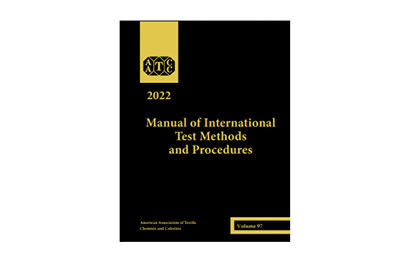
2022 International Manual of Test Methods and Procedures

AATCC standards are developed, specified, and performed around the world. Volume 97 of The AATCC International Manual of Test Methods and Procedures will be available beginning January 2022. USB editions and PDF versions of individual standards will be available on January 4, 2022.

The hardbound version will be available for purchase after January 15, 2022. To purchase a 2022 Technical Manual, click here: https://members.aatcc.org/store/2022b/3601/ for the USB version or here:https://members.aatcc.org/store/2022a/3600/ for the hardbound book. You can also email ordering@aatcc.org to purchase a Technical Manual.

The following AATCC standards have been developed, revised, or reaffirmed since the publication of the 2021 volume of the Manual of International Test Methods and Proce­dures. In accordance with AATCC M13, Rules of Procedure for AATCC Test Method and Technology Committees, all technical changes are unanimously approved by the responsible research committee and the Technical Committee on Research (TCR) before publication.

AATCC TM6-2021 Test Method for Colorfastness to Acids and Alkalis. Revised to clarify and align with pre­scribed AATCC style guidelines.

AATCC TM15-2021, Test Method for Colorfastness to Perspiration. Revised for clarity and to add a history section.

AATCC TM20-2021 Test Method for Fiber Analysis: Qualitative. Revised to update Table V.

AATCC TM20A-2021 Test Method for Fiber Analysis: Quantitative. Revised to correct Table I.

AATCC TM35-2018e2 Test Method for Water Resis­tance: Rain. Editorially revised to remove excess wording from Figure 2 and to add history.

AATCC TM 110-2021 Test Method for Whiteness of Tex­tiles. Revised for clarity and to add history section to align with AATCC Style Guide.

AATCC TM114-2021 Test Method for Retained Chlo­rine: Tensile Loss. Revised to clarify and align with pre­scribed AATCC style guidelines.

AATCC TM118-2020e Test Method for Oil Repellency: Hydrocarbon Resistance. Editorially revised to update from CAS# 8012-95-1 (which is paraffin oil) to CAS #8042-47-5 (which is white mineral oil) to correct the reference.

AATCC TM133-2020e Test Method for Colorfastness to Heat: Hot Pressing. Editorially revised to update test method reference to match current title.

AATCC TM148-2014e4(2021) Test Method for Light Blocking Effect of Textiles and Related Materials: Photo-detector. Reaffirmed and editorially revised to add history per AATCC Style Guide.

AATCC TM163-2013(2020)e2 Test Method for Color­fastness to Storage: Dye Transfer. Editorially revised to update history order.

AATCC TM165-1999e10(2021)e Test Method for Color­fastness to Crocking: Textile Floor Coverings—Crock-meter. Reaffirmed and editorially revised to include history section per the AATCC Style Guide.

AATCC TM173, Test Method for Calculation of Small Color Differences for Acceptability. Withdrawn and replaced with AATCC EP14, Evaluation Procedure for Small Color Differences.

AATCC TM182-2021 Test Method for Relative Color Strength of Dyes in Solution. Revised to clarify the wave­length requirements, update terms, and add history section to align with AATCC Style Guide.

AATCC TM185-2021 Test Method for Chelating Agent Content in Hydrogen Peroxide Bleach Baths: Copper PAN Indicator. Revised to clarify and align with prescribed AATCC style guidelines.

AATCC TM191-2021 Test Method for Acid Cellulase Enzyme Treatment of Cellulosic Fabrics. Revised to clar­ify and align with prescribed AATCC style guidelines.

AATCC TM196-2011e3(2021) Test Method for Colorfast­ness to Sodium Hypochlorite of a Textile Floor Covering. Reaffirmed in 2021.

AATCC TM203-2021 Test Method for Light Blocking Effect of Textiles: Spectrophotometric. Revised for clarity and to add history section per AATCC Style Guide.

AATCC TM211-2021 Test Method for the Reduction of Bacterial Odor on Antibacterial-Treated Textiles. NEW method used to supplement current industry test methods and directly address odor caused by bacteria not simply organism numbers. It allows for measurement of odor and the capacity for odor reduction by treated articles.

AATCC TM212-2021 Test Method for the Fiber Frag­ment Release During Home Laundering: Accelerated. NEW method used to measure the fiber fragment shedding from fabrics in an accelerated laundering setting.

AATCC EP6-2021 Evaluation Procedure for Instrumen­tal Color Measurement. Revised for clarity and to add history section to align with AATCC Style Guide.

AATCC EP7-2021 Evaluation Procedure for Instrumen­tal Assessment of the Change in Color of a Test Specimen. Revised to remove table option and restructure calculations for clarity.


AATCC EP9-2021 Evaluation Procedure for Visual Assessment of Color Difference of Textiles. Revised to update steps in Table III and to align with AATCC Style Guide.

AATCC EP11-2021e Evaluation Procedure for UV Energy of Optically Brightened Textiles: Spectrophotometer Cal­ibration. Revised to update reference to ASTM E308 table references and to add history section per the AATCC Style Guide. Editorially revised the AATCC ordering process and clarified stability and storage.

AATCC EP13-2021 Evaluation Procedure for Electrical Resistance of Electronically Integrated Textiles. Revised to update steps in Table III and to align with the AATCC Style Guide.

AATCC EP14-2021 Evaluation Procedure for Small Color Differences. NEW Evaluation Procedure to replace AATCC TM173, Test Method for Calculation of Small Color Differences for Acceptability.

AATCC LP1-2021 Laboratory Procedure for Home Laundering: Machine Washing. Revised to update the tables and add Type 4 ballast.

AATCC M3-2008(2021)e2 High Efficiency Washers in North America. Reaffirmed in 2021.

AATCC M11-2021 Glossary of AATCC Standard Termi­nology. Revised to add terminology.
© 2021 AATCC
© 2021 AATCC


More News from American Association of Textile Chemists and Colorists

#Associations

AATCC announces 2025 Herman & Myrtle Goldstein Graduate Student Paper Competition winners

The American Association of Textile Chemists and Colorists (AATCC) recognized the winners of the 2025 Herman & Myrtle Goldstein Graduate Student Paper Competition. Founded in 1982 to give student members the chance to conduct and present original research, the competition was renamed in 1994 in honor of Herman and Myrtle Goldstein, following their US$60,000 endowment. Their gift is a lasting remembrance of their dedication to young people in the textile industry.

#Research & Development

New funding available for textile research

The AATCC Foundation Student Research Support Grant Program provides financial assistance for undergraduate and graduate students pursuing textile-related projects. Students may submit proposals now for funding to be awarded January 2026. Applications must be submitted by October 1, 2025, to be considered.

#Recycling / Circular Economy

AATCC’s Circularity Conference approaches as organization continues 2025 Sustainable Textile Event series

The American Association of Textile Chemists and Colorists (AATCC) announces that registration is closing soon for its highly anticipated Circularity Conference, continuing this year’s sustainability event series that has delivered significant value to industry professionals.

#Associations

AATCC Textile Standards adopted by Colombian and Sri Lankan Governments

AATCC test methods and procedures are international standards, meeting the criteria set forth by the World Trade Organization and used around the globe. The standards gain additional recognition through Memoranda of Understanding with Colombia and Sri Lanka.

More News on Associations

#Techtextil 2026

Italian textile machinery innovation takes center stage in Frankfurt for Techtextil 2026

The Italian textile machinery industry is gearing up for a key event on the international trade fair calendar: Techtextil 2026, taking place from April 21–24 in Frankfurt, Germany. A prestigious representation of Italian companies will participate in the German exhibition—a global benchmark for technical and innovative textiles—to present cutting-edge technologies dedicated to an ever-expanding market.

#Textile processing

Major expansion for ACG Kinna follows record year

In response to growing demand for its full textile and finished product line automation services, ACG Kinna – a member of TMAS, the Swedish textile machinery association – has inaugurated a 1,000-square-metre expansion at its headquarters in Skene, Sweden.

#Techtextil 2026

Precision, performance and progress: British textile machinery at Techtextil and Texprocess 2026

As global demand accelerates for lighter, stronger and more sustainable technical textiles, the machinery and testing technologies behind their manufacture are evolving at pace. At the Techtextil and Texprocess exhibitions in Frankfurt this April, eight members of the British Textile Machinery Association (BTMA) will demonstrate how advanced engineering continues to shape the performance, precision and resource efficiency of advanced fibre and fabric production.

#Nonwovens

INDA honors four industry leaders with 2026 Lifetime Service and Technical Achievement Awards

INDA, the Association of the Nonwoven Fabrics Industry, has announced the four distinguished recipients of the 2026 INDA Lifetime Service Award and Lifetime Technical Achievement Award. Tom Daugherty, Pricie Hanna, Carey Hobbs, and CK Wong are being recognized for their exceptional leadership, innovation, and enduring contributions to advancing the nonwovens industry and strengthening the global community it serves.

Latest News

#Raw Materials

New study shows low environmental impact by Cotton made in Africa Organic Cotton from Tanzania

Today, the Aid by Trade Foundation (AbTF) is announcing the results of a comprehensive life-cycle analysis (LCA) for cotton produced in Tanzania under the Cotton made in Africa Organic (CmiA Organic) standard. The study emphasises the small ecological footprint of CmiA Organic verified cotton. This can largely be traced back to the absence of synthetic pesticides, artificial fertilisers, and artificial irrigation. Consequently, CmiA Organic cotton can help the textile industry meet regulatory requirements as well as science-based targets. The results also show that the consequences of climate change threaten the livelihoods of these cotton farmers, even though the type of agriculture they practise barely contributes to climate change.

#Raw Materials

Better Cotton Initiative strengthens regenerative focus in standard update

The Better Cotton Initiative (BCI) has strengthened the regenerative focus of its field-level standard with the launch of a new version of its Principles & Criteria (P&C), which marks the next step in the organisation’s journey to becoming a regenerative standards system.

#Man-Made Fibers

Selenis and Kintra Fibers partner to scale 100% bio-based synthetic fiber technology

Selenis, a leading global specialty polyester manufacturer, today announced a strategic manufacturing partnership with materials science company Kintra Fibers to scale Kintra’s patented fiber-grade PBS resin - a 100% bio-based and biodegradable material designed for textile applications.

#Functional Fabrics

PERFORMANCE DAYS proves its relevance as the industry’s key meeting point

Held on March 18–19, 2026, PERFORMANCE DAYS once again confirmed its position as a leading international platform for functional textiles. A total of 3.366 trade visitors and around 560 exhibitors gathered in Munich, with the event already kicking off successfully on DAY 0, which received highly positive feedback for its interactive format. Despite challenging conditions caused by the public transport strike in Munich, the event saw strong attendance and a consistently high level of activity across both exhibition days.

TOP