[pageLogInLogOut]

#Associations

Textile machinery: Orders once more on the rise for first quarter 2021
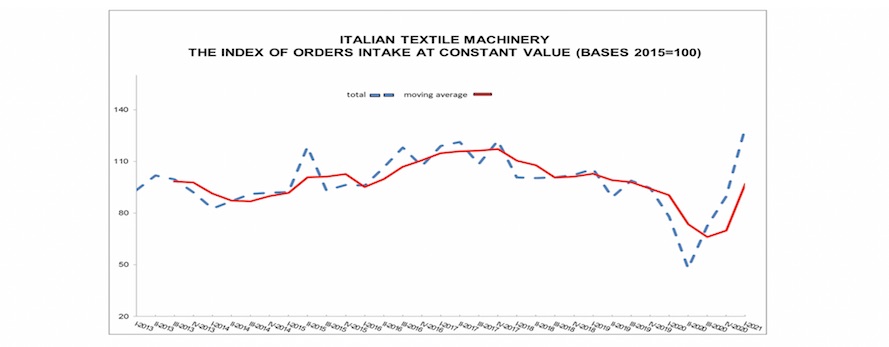
(c) ACIMIT 2021
The index of orders intake for textile machinery compiled by ACIMIT, the Association of Italian Textile Machinery Manufacturers during the period January-March 2021 was up by 66% compared to the same period for 2020. The value of the index was confirmed at 129.3 points (basis: 2015 = 100).

This result depended on a positive performance for orders coming in from abroad as well as from Italian market. A 68% increase was recorded on foreign markets, with the absolute value of the index reaching 125.5 points. On the domestic side, the upward trend in orders was more contained, but still significant (+54% compared to the first quarter of 2020), with an absolute value of the index at 164.1 points.

ACIMIT President Alessandro Zucchi commented on these results, "This significant increase in orders should be compared with the first quarter 2020 results, the period in which the pandemic began and production almost completely stopped."


"Still, these numbers are certainly encouraging,” adds Zucchi, “even though the pandemic is still not under control, especially in Countries that are essential markets for our industry, such as India. Investments in the textile sector have thus seen a rather patchy recovery. Without a widespread vaccination plan on a global scale, our people remain limited in their movements, jeopardizing the possibility of seizing business opportunities in different markets.”

“A future recovery is also threatened by rising prices for raw materials,” states ACIMIT’s president. “A significant growth trend is currently under way, beginning from last summer and continuing to swell between late 2020 and early 2021. These price hikes are pushing up input costs and, in the absence of a price adjustment, the negative impacts for machinery manufacturers could be quite significant.”

More News from Associazione Costruttori Italiani di Macchinario per l Industria Tessile (ACIMIT)

#Associations

Italian textile machinery orders show quarterly recovery in Q2 2026

In the period between April and June 2026, order intake for Italian textile machinery manufacturers showed mixed but encouraging signals for the second half of the year. The order index at constant prices stood at 46.6 points (taking 2021=100 as the base year), showing a slight decrease of 3% compared to the same quarter of 2025. This trend was largely due to the contraction recorded in the domestic market, which fell by 25% compared to the corresponding period of the previous year.

#Associations

Textile machinery: Italian technology charts the course for revival

Operating in a scenario characterized by geopolitical instability, slowing industrial investments, and new protectionist pressures. This is the main challenge for the Italian textile machinery industry that emerged during the General Assembly of ACIMIT (Association of Italian Textile Machinery Manufacturers), held today in Milan at the Shareholders’ Hall of Palazzo Edison.

#Associations

Bangladesh: Italian textile machinery mission stops in Dhaka and Chittagong

Technological upgrading and the transition toward higher value-added production are driving the new Italian industrial mission to Bangladesh. This year, the mission will split between the country’s two main manufacturing hubs, where Italian manufacturers will meet the leaders of the local textile supply chain in two strategic stages: July 7th in Dhaka and July 9th in Chittagong.

#Associations

Mongolia: Workshop on Italian textile technologies kicks off in Ulaanbaatar

The workshop dedicated to Italian textile technologies will kick off in Ulaanbaatar from 21 to 23 June 2026. Focused on the most advanced innovative solutions for the textile industry, the initiative will bring together 13 Italian textile machinery manufacturers, confirming the growing interest in strengthening industrial cooperation between the two countries and highlighting Mongolia’s strategic importance for Italian textile machinery producers.

More News on Associations

#Raw Materials

Cotton Brazil Dialogues 2026 concludes with 50 international participants immersed in Brazilian cotton production

The Cotton Brazil Dialogues concludes its 2026 edition after a series of technical visits to farms, cotton gins and reference centers, as well as workshops focused on Brazilian cotton production. A total of 50 participants from 14 countries took part in the field trips. The initiative is led by the Brazilian Association of Cotton Growers (Abrapa) and the National Association of Cotton Exporters (Anea), with support from the Brazilian Trade and Investment Promotion Agency (ApexBrasil).

#Europe

European textile industry calls for €10 handling fee on ultra-fast-fashion imports

The introduction of the €3 customs duty on low-value imports marks an important milestone in Europe’s efforts to address the challenges created by the rapid growth of ultra-fast-fashion imports. Together with the abolition of the €150 customs duty exemption, it demonstrates that policymakers are willing to act when market distortions become impossible to ignore. However, the European textile and clothing industry considers this a first step rather than the final destination.

#Associations

Business situation weakens slightly, but the industry stays cautiously optimistic

The International Textile Manufacturers Federation (ITMF) has published the results of its 39th Global Textile Industry Survey (GTIS), conducted from 14 to 22 July 2026 among companies along the entire global textile value chain. Worldwide, 10% of participants rated their business situation as good, 53% as satisfactory and 37% as bad — a balance of -26pp, down from -17pp in May but still well above the 2023 lows. All regions are now in negative territory, from South Asia at -3pp to North & Central America at -58pp.

#Associations

IVGT membership: expertise that pays off

For energy-intensive textile companies, government compensation mechanisms are an important economic factor. The IVGT successfully supports its member companies in applying for state aid and thereby regularly contributes to significant financial relief.

Latest News

#Spinning

Heberlein reinforces its commitment to the Chinese market

Heberlein, globally recognised as a leading provider of air interlacing and air texturing jets for synthetic filament yarns, is consolidating its success in the Chinese market with its APh- and APe-series for DTY applications. Particularly in the field of Air Covering, Heberlein technologies combine excellent quality with significant savings in compressed-air consumption. A new service hub in Shengze City underlines the company’s long-term commitment in the Chinese market.

#Raw Materials

Redesigned World Cotton Day website offers tools, ideas and inspiration

With World Cotton Day just one month away, the International Cotton Advisory Committee (ICAC) has launched a completely redesigned www.WorldCottonDay.com, creating a new global home for everyone who wants to learn about, celebrate, and support cotton.

#Recycled Fibers

RE&UP’s Next-Gen Cotton fibers power Zalando private label t-shirt collection crafted from innovative recycled textiles

RE&UP Recycling Technologies’ Next-Gen Cotton powers a new collection from Zalando’s private labels, marking a step forward in bringing textile-to-textile recycled fibers into commercial fashion production. Launching on Zalando in August, the collection comprises five t-shirts across YOURTURN by Zalando and Even&Odd by Zalando, made from a circular-knit fabric blending 80% organic cotton with 20% RE&UP Next-Gen Cotton — textile-to-textile recycled fiber produced from textile waste. This is the first time RE&UP's recycled fibers feature in Zalando's private label assortment.

#Heimtextil 2027

Heimtextil Trends 27/28: ‘Home-Maxxing’ between performance and respite

Sleep better, recover faster, live more efficiently: the desire for optimisation has long since reached our homes. Under the title ‘Home-Maxxing – The Performance of Everyday Living’, Heimtextil Trends 27/28 show how our relationship with efficiency-driven thinking and technology is influencing the design of spaces and textiles. The more sleep, wellness, routines, materials and spaces are optimised, the stronger the desire for a home that does not demand even more of us.

TOP