[pageLogInLogOut]

#Yarn & Fiber

Global Sae-A Group completes construction of the second spinning mill in Costa Rica
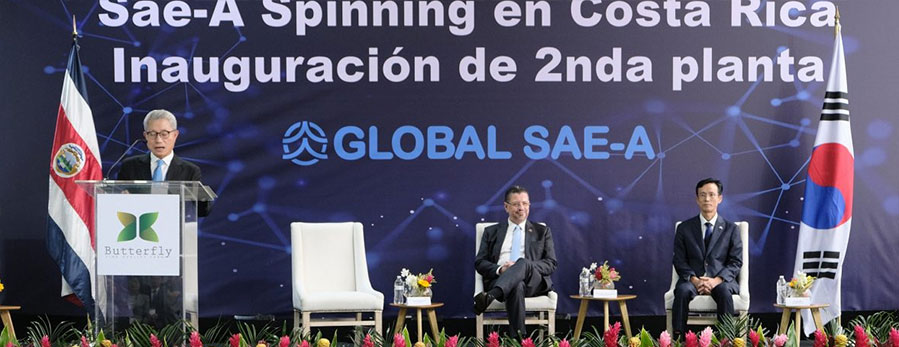
Woong-ki Kim, the Chairman of Global Sae-A Group is giving a speech at the completion ceremony for its second spinning mill in Coris, Cartago © 2022 Global Sae-A
(2022-08-19) Global Sae-A Group, a leading yarn manufacturer and one of the world’s largest apparel manufacturers based in Korea, held the building completion ceremony for its second spinning mill in Coris, Cartago, in the presence of President Rodrigo Chaves, Vice-Minister of Foreign Trade Jimena Chinchilla, CINDE’s CEO Eric Scharf, and Korean Ambassador Jin Hae Kim.

This is the Korean company’s second factory in Costa Rica, where construction of its third factory has already begun and is expected to go into operation in 2024.

The company will create 200 more jobs across multiple areas for people with different educational levels, from primary to higher education

The President of Costa Rica, Rodrigo Chaves Robes, who attended the completion ceremony, said in his congratulatory message, “The Global Sae-A Group, which operates factories in over 40 countries around the world, invested in Costa Rica in 2015 and in the seven years since, they have created hundreds of jobs. They have contributed greatly, not only to our Cartago family, but also towards Costa Rica’s development.
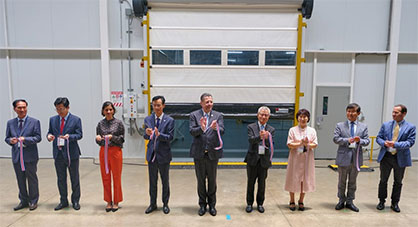
Ribbon-cutting ceremony held for its completion of second spinning mill in Coris, Cartago.<br />
Sang Soon Han, James Ha, Jimena Chinchilla, Jin Hae Kim, President Rodrigo Chaves, Chairman of Global Sae-A Group Woong-ki Kim, Soo-nam Kim, KM Kim, and Eric Scharf (from left to right) © 2022 Global Sae-A
Ribbon-cutting ceremony held for its completion of second spinning mill in Coris, Cartago. Sang Soon Han, James Ha, Jimena Chinchilla, Jin Hae Kim, President Rodrigo Chaves, Chairman of Global Sae-A Group Woong-ki Kim, Soo-nam Kim, KM Kim, and Eric Scharf (from left to right) © 2022 Global Sae-A


Sae-A started business in Costa Rica in 2015 in order to produce quality yarn. Currently, the company has 400 employees and plans to hire at least 200 more over the next few months.             

This expansion is due to the completion of the new spinning mill, the second of Sae-A’s three factories in Costa Rica. Its third factory is already under construction, and the company plans to build more factories in the country in the future.

“We decided to invest in Costa Rica seven years ago because of its political and social stability, along with its excellent talent availability. We believe that it was a successful investment,” says Sang Soon Han, Sr., President of Sae-A Spinning. “This second factory is part of our USD 150 million investment plan for Costa Rica, which includes the third factory. The construction for the third factory has already begun and it will be completed by the end of 2023. The second factory introduced a storm water reuse system, and was built as an eco-friendly building and certified as LEED Silver by USGBC. Furthermore, we hope to continue to grow in Costa Rica by constructing a recycled yarn manufacturing factory as well as our fourth factory, in line with the global sustainability trends.”

Founded in 1986, Sae-A Trading, a subsidiary of Global Sae-A Group, has become one of the world’s largest apparel manufacturers and exporters. Currently, 60,000 associates at 40 factories in the CAFTA countries and ten countries in Asia manufacture more than 2.6 million articles of clothing every day with yarn supplied by Sae-A Spinning.


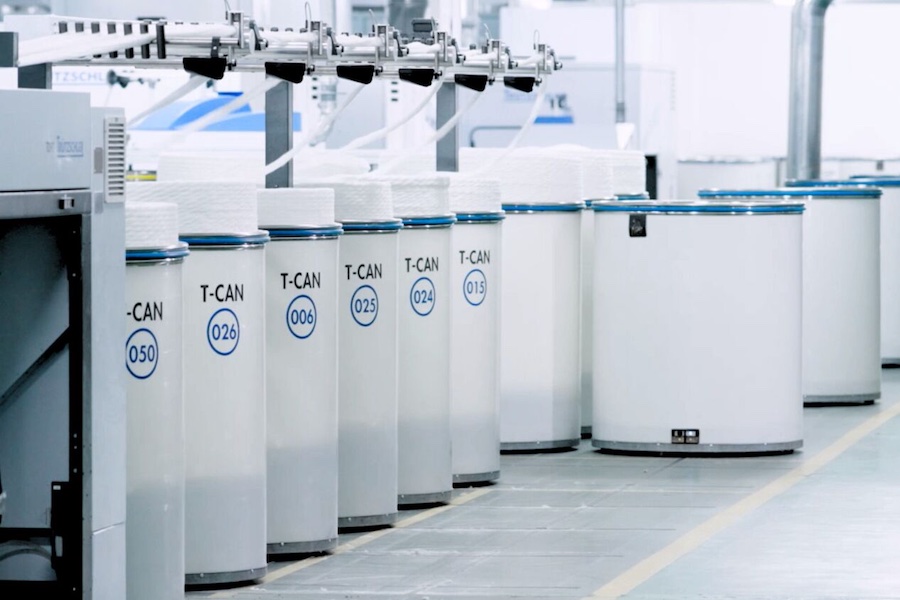
Sae-A Spinning manufactures yarn every day with its cutting-edge technology and the productive labor and talent of Costa Ricans. The yarn is sent to sewing factories to produce finished products for famous fashion brands in the US and Europe.

CINDE’s Managing Director Jorge Sequeira congratulated Sae-A on its impressive growth in Costa Rica. “The company is one of the success stories of our strategy to invest in new regions, as well as a great opportunity to attract investment in other parts of Costa Rica in line with the trends of nearshoring and friendshoring that seek a market close to primarily North America, or its allies with political, social and economic stability.”

The establishment and operation of Sae-A Spinning in Costa Rica is an important milestone for the company as it has become the first company to perform vertical integration in the apparel manufacturing industry for all production processes, from spinning to weaving, dyeing, and sewing. Currently, the company produces 18 million kilograms of yarn per year.

Global Sae-A Group, headquartered in Seoul, South Korea, is the world’s largest apparel exporter and manufacturer, with over 60,000 associates across 10 countries, 24 offices and 40 factories worldwide.
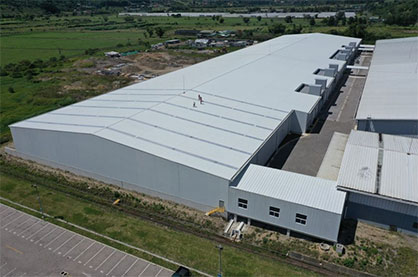

The front of second mill in Coris, Cartago © 2022 Global Sae-A


More News from TEXDATA International

#ITM 2026

ITM 2026: The new geography of textile production

New production hubs are emerging across North Africa and Central Asia, while Türkiye is accelerating its transformation toward higher-value, technology-driven and more sustainable textile manufacturing.

#Research & Development

“Production is a product”

From technical textiles and AI-driven robotics to the limitations of textile circularity: Professor Dr Thomas Gries looks back on more than two decades of development at ITA Aachen. In the interview, he explains why production technology remains a decisive success factor, discusses international collaborations and innovation ecosystems, and shares his views on the transformation of production landscapes and the challenges facing an increasingly regulated industry.

#Knitting & Hosiery

“We need to move away from the price trap and return to a value-driven mindset.”

With its new Textile Innovation Center, KARL MAYER is sending a strong signal for innovation, collaboration, and the future of textile applications. In this interview, Karl Josef Mayer discusses new opportunities in warp knitting, the processing of staple fibres, recycling, the changing role of machinery manufacturers, and why the textile industry must once again focus more strongly on the value of textiles. by Oliver Schmidt

#Associations

“Innovation, resilience and international experience remain the great strengths of the Swiss textile machinery industry”

Geopolitical uncertainty, growing competitive pressure from China, new free trade agreements and the shift towards a circular economy are currently reshaping the global textile industry. In this interview, Cornelia Buchwalder discusses the current mood within the Swiss textile machinery sector, the industry’s distinctive innovative strength, new market opportunities in India and Asia, and the technological trends that could shape the upcoming trade fair cycle leading up to ITMA 2027.

More News on Yarn & Fiber

#Recycling / Circular Economy

The textile industry in transition

Recycling, traceability, eco-design and digitalisation are among the key future challenges facing the European textile industry. The Erasmus+ project Skills4Circularity, involving 21 partners from twelve countries, is investigating the skills required to address these challenges. As the German industry partner, the Industry Association for Finishing – Yarns – Fabrics – Technical Textiles (IVGT) is bringing the industry’s perspective to the project.

#Research & Development

GenuTrace client advisory: Is your cotton supply chain UFLPA ready?

U.S. Customs and Border Protection has released updated operational guidance (CBP Publication No. 5560-0526) expanding its forced labor enforcement framework. The guidance supersedes the original 2022 UFLPA Operational Guidance and now covers all forced labor enforcement authorities — UFLPA, CAATSA, and WROs/Findings — in a single unified document. For cotton importers, the enforcement posture has not softened. It has become more structured, more documented, and more demanding. Learn more about UFLPA.

#Spinning

"We will become a recycling powerhouse"

The textile industry is now in its fourth consecutive year of crisis, while automation, artificial intelligence and recycling are reshaping the rules of the game. In this interview, Rieter CEO Thomas Oetterli discusses the first signs of a market recovery, reflects on his first three years at the helm of the company, explains the integration of Barmag, outlines Rieter’s vision of the fully automated spinning mill and highlights the strategic importance of recycling. In doing so, he explains why the new Rieter Group aims to play a leading role in transforming the textile value chain into a circular economy.

#Man-Made Fibers

ROICA™ launches new global brand identity and digital experience

ROICA™, the premium stretch fiber developed by Asahi Kasei, today announced the launch of its new global brand identity, including a new key visual and a fully redesigned website. This milestone initiative marks the beginning of a new phase in ROICA™’s evolution as a global brand.

Latest News

#Spinning

New spinning package with two-step filtration for recycled yarns and more

At the ITM in Istanbul, BB Engineering unveiled its new, patented ValuePack spinning package for the first time, which features a two-stage filtration system. This is particularly beneficial for re-cycling processes. Until now, spinning packs have used either metal powder (“sand”) or filter candles as filter media. Both options are suitable for differ-ent applications, and each has its own specific advantages and dis-advantages.

#ITMA 2027

ITMA 2027 gains strong momentum

In line with the theme "Co-creating the future of textiles", ITMA continues to strengthen its support for start-ups, recognising their role in driving innovation and shaping the future of textile and garment manufacturing. Through the Start-Up Valley, emerging companies gain access to a global marketplace where they can connect with industry leaders, potential partners, investors and customers.

#ITM 2026

Positive market signals for KARL MAYER at ITM 2026

KARL MAYER is pleased with its participation as an exhibitor at ITM 2026. Faced with the challenges of rising domestic costs and fierce competition from low-priced Asian markets, the industry leader had traveled to Istanbul with mixed feelings – yet still draws a really positive conclusion.

#Associations

Mongolia: Workshop on Italian textile technologies kicks off in Ulaanbaatar

The workshop dedicated to Italian textile technologies will kick off in Ulaanbaatar from 21 to 23 June 2026. Focused on the most advanced innovative solutions for the textile industry, the initiative will bring together 13 Italian textile machinery manufacturers, confirming the growing interest in strengthening industrial cooperation between the two countries and highlighting Mongolia’s strategic importance for Italian textile machinery producers.

TOP