[pageLogInLogOut]

#Yarn & Fiber

Covestro and Genomatica produce important chemical raw material using biotechnology
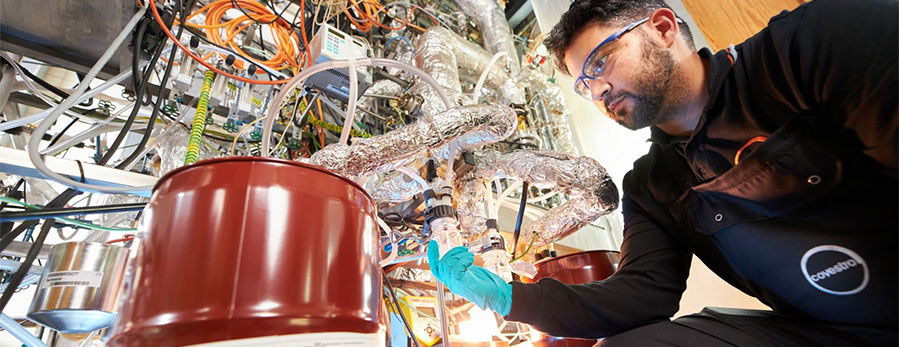
Covestro employee Mario Lopes in the pilot plant where Covestro produced significant quantities of the bio-based raw material HMDA for the first time. © Covestro
Breakthrough for HMDA, widely-used ingredient, paves the way for more sustainable coatings, apparel, adhesives and plastics

Material manufacturer Covestro and biotechnology pioneer Genomatica announced an important industry milestone to advance sustainability resulting from their partnership. The two companies have teamed to be the first to successfully produce significant volumes of a plant-based version of the chemical raw material HMDA (hexamethylene diamine).
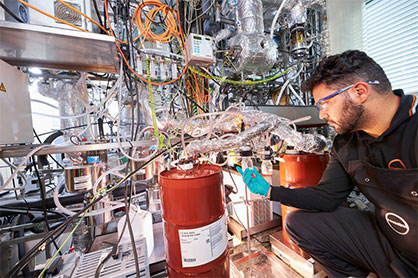
Covestro and Genomatica have teamed to be the first to successfully produce significant volumes of a plant-based version of the chemical raw material HMDA (hexamethylenediamine). © Covestro


HMDA, with a worldwide market of 2 million tons per year, is a key ingredient for a widely-used type of nylon (nylon-6,6), as well as an important component for raw materials for coatings and adhesives from Covestro. Up to now, HMDA has been manufactured from fossil feedstocks. Coatings and adhesives can be produced more sustainably thanks to bio-based HMDA, made from renewable feedstocks. Areas of application include automotive, construction, furniture, textiles and fibers.

Teams from Genomatica and Covestro have been working together to develop a commercial process technology for bio-based HMDA. The companies expect to produce ton quantities of high-quality material over the course of multiple production campaigns. Both partners are already processing and testing material from their initial production campaigns, and the resulting bio-HMDA is of high purity and quality. The companies plan to advance the program to full commercial scale, and Covestro has secured an option from Genomatica to license the resulting integrated GENO™ HMD process technology for commercial production.
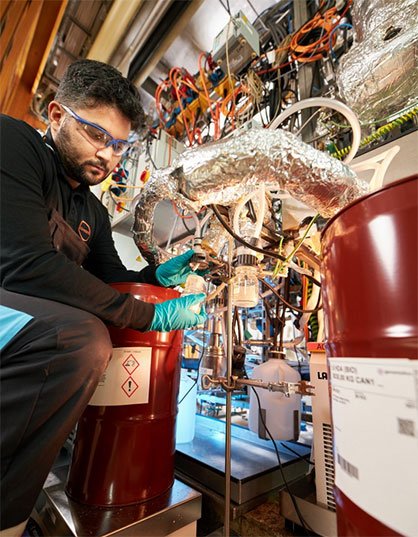
The breakthrough for the production of a biobased HMDA paves the way for more sustainable coatings, apparel, adhesives and plastics. © Covestro


Genomatica develops widely-used ingredients and materials using biotechnology and renewable, plant-based feedstocks rather than fossil feedstocks and their associated extractive processing methods. These materials are used by brands and their suppliers in popular goods ranging from apparel to cosmetics. Covestro brings extensive know-how in the field of research, chemical process technology and application development. The cooperation for the development of alternative raw materials based on biotechnology advances Covestro’s global program to achieve the circular economy.

Covestro established an R&D Competence Center for biotechnology to further strengthen its overall know-how in this field. Bio-based raw materials and biotechnology have also been identified as one of five focus areas at Covestro´s Venture Capital (COVeC) approach.

"The increased use of alternative raw materials, including the utilization of biotechnology, is an important pillar of our approach to fully embrace the circular economy and help make it a global guiding principle," says Covestro CEO Dr. Markus Steilemann. "Our program with Genomatica, which complements our internal R&D, is one of our largest external funding of biotechnology R&D to date, and underscores both the field’s importance to Covestro and the results it can deliver."

Replacing fossil-based raw materials

"This program is of great importance to us, because markets are increasingly asking for more environmentally compliant products based on renewable raw materials, which are just as powerful as their fossil-based alternatives," says Dr. Thorsten Dreier, global head of the Covestro business entity Coatings & Adhesives. "We can reduce this dependence on fossil feedstocks with innovative technology and our partnership. With a purely plant-based HMDA, we can significantly advance our corporate objective of CO2-neutral production."

A sample of the bio-based HMDA. The raw material is of a high quality and purity. © Covestro


"Genomatica is committed to delivering a portfolio of sustainable materials that can help any brand reduce the carbon footprint of its products while maintaining the performance customers count on," said Christophe Schilling, Genomatica CEO. "Covestro is a valued partner that is playing a leading role in improving the environmental impact of many of today’s most prevalent materials. Together, we are taking an important step to reduce greenhouse gas emissions for a broad range of products we use in daily life."



More News from Covestro AG

#Smart Textiles

Covestro, FILK Freiberg, and OUT e.V. develop flexible, conductive polymer smart textile system

As the smart textiles market continues to grow across healthcare, personal protection, sportswear, and automotive applications, developers are seeking new ways to integrate electronic functionality directly into textiles, without the rigidity and complexity of conventional wiring. To address this challenge, FILK Freiberg Institute, an independent research institution with expertise in polymer coatings for textile applications, collaborated with Optotransmitter-Umweltschutz-Technologie (OUT) e.V. The joint project, funded under the German Industrielle Gemeinschaftsforschung (IGF) program of the Bundesministerium für Wirtschaft und Energie (BMWE), focused on developing flexible, conductive polymer surfaces for next-generation smart textiles.

#Techtextil 2026

Covestro to exhibit solutions for a more sustainable and productive textile industry at Techtextil 2026

Covestro will present a broad portfolio of material innovations for textile coatings, adhesive films and thermoplastic polyurethanes (TPUs) at Techtextil 2026 (Hall 11.0, Booth C79). The exhibits will demonstrate how advanced solutions can enhance durability, recyclability and manufacturing efficiency across applications such as automotive, infrastructure, protective apparel and sportswear. A particular focus will be on more sustainable coating technologies, including antimicrobial systems based on INSQIN® in combination with AGXX from Heraeus Precious Metals, as well as the integration of Pontacol® thermoplastic adhesive films into Covestro’s offering.

#Technical Textiles

Covestro showcases monomaterial concept in autonomous SUE People Mover

UE | STUDIOS has unveiled the fully autonomous electric minibus “Self-driving Urban E-Shuttle” (SUE), placing strong emphasis on sustainable material design. Developed within a project funded by the Federal Ministry for Economic Affairs and Energy (BMWE) and the European Union, the vehicle will begin public road testing this year. At the core of the concept is the consistent use of recyclable monomaterials to improve circularity at end of life.

#Textile chemistry

Covestro and Heraeus Precious Metals collaborate to enable safer, more sustainable antimicrobial textile coatings

Laboratory tests reveal that AGXX antimicrobial surface technology from Heraeus Precious Metals is fully compatible with Impranil® PU dispersions which are part of the waterborne INSQIN® textile coating technology from Covestro, paving the way for more sustainable antimicrobial textile coatings. This discovery comes at a key moment for the textile coatings industry. As the sharing economy continues to grow, more people are coming into regular contact with high-use surfaces, creating ideal conditions for bacteria, viruses, and other microorganisms to thrive.

More News on Yarn & Fiber

#Yarns

Yarn Expo Shenzhen 2026 closes doors, advancing sustainable and innovative sourcing in South China

Yarn Expo Shenzhen 2026 served as a strategically positioned mid-year sourcing platform for the Greater Bay Area, highlighting Shenzhen’s role in connecting regional demand, supply and innovation exchange across the textile value chain. During the three-day fair, over 20,000 visits were drawn from 74 countries and regions[1], as exhibitors and buyers engaged with new developments in greener, performance-led, and value-added yarn and fibre solutions. Held in conjunction with Intertextile Shenzhen Apparel Fabrics and PH Value, the fair underscored the benefits of closer synergy and new materials across yarn, fabric and apparel platforms for the South China market.

#Yarns

Yarns and technologies in symbiosis: Biella Yarn presents Fall/Winter 2027/2028 collection “New Romance_”

Biella Yarn, the flat knitting brand of Suedwolle Group, launches new Fall/Winter 2027/2028 collection, inspired by the symbiosis of yarns and technologies – elements that blend, adapt and evolve together, forming something new without losing their origin. The name “Neu Romance_” reflects the emotional and neurological dimension of the yarns: a connection that engages the senses, experienced through material, touch and interaction. The collection is further brought to life through design collaborations, featuring selected yarns used in different design approaches.

#Recycling / Circular Economy

The textile industry in transition

Recycling, traceability, eco-design and digitalisation are among the key future challenges facing the European textile industry. The Erasmus+ project Skills4Circularity, involving 21 partners from twelve countries, is investigating the skills required to address these challenges. As the German industry partner, the Industry Association for Finishing – Yarns – Fabrics – Technical Textiles (IVGT) is bringing the industry’s perspective to the project.

#Research & Development

GenuTrace client advisory: Is your cotton supply chain UFLPA ready?

U.S. Customs and Border Protection has released updated operational guidance (CBP Publication No. 5560-0526) expanding its forced labor enforcement framework. The guidance supersedes the original 2022 UFLPA Operational Guidance and now covers all forced labor enforcement authorities — UFLPA, CAATSA, and WROs/Findings — in a single unified document. For cotton importers, the enforcement posture has not softened. It has become more structured, more documented, and more demanding. Learn more about UFLPA.

Latest News

#Recycling / Circular Economy

Reju opens its first R&D Center in the U.S. in Conshohocken, Pennsylvania

Reju, the company specializing in textile regeneration, today announced the opening of a Research and Development (R&D) Center in Conshohocken, Pennsylvania, the company's first proprietary research center in North America. Located within Technip Energies' existing Advanced Materials and Catalysts research center, the lab will allow Reju to accelerate the rollout of its recycling technologies and develop its next-generation circular solutions.

#Weaving

Itema reaffirms its commitment to the Syrian textile industry at NasTex 2026

From July 18th to 21st, Itema will exhibit at NasTex at the Damascus Fairground (Hall 11 – Stand C02), marking its return to one of the Middle East’s historically significant textile markets. Itema will showcase advanced weaving technology designed to support the competitiveness and technological evolution of Syrian manufacturers and announces a new partnership with Growfast Agency as the sole agent of Itema in Syria.

#Knitting & Hosiery

KARL MAYER's HKS 2-SE Expands Possibilities for Premium Stretch WARP KNITS

Warp knitted fabrics with a woven look are more in demand than ever in the fashion and apparel industries. Stretch WARP KNITS, in particular, impress with their freedom of movement, breathability, and virtually wrinkle-free wear – thereby opening up new style worlds such as smart casual or business casual. When it comes to the highly efficient production of premium-quality stretch WARP KNITS, the HKS 2-SE has long been the machine of choice. KARL MAYER’s best-selling tricot machine produces standard elastic fabrics characterized by high gauges, smooth, delicate surfaces, and a soft hand feel.

#Textiles & Apparel / Garment

Catalyst Club launches in Florence: Where conversations become catalysts for change

The first chapter of Catalyst Club debuted in Florence, bringing together creative directors, entrepreneurs, manufacturers, journalists and innovators from across the fashion and textile industry for an evening of dialogue, exchange and connection.

TOP